Is there a link between Elon Musk and effective altruism?
In our aim to guide individuals towards the most effective associations, Mieux Donner uses many resources from effective altruism, a school of thought and movement that seeks to identify the best ways to help others and put them into practice. However, we regularly read remarks about an alleged link between effective altruism and Elon Musk, which we wanted to take the time to analyse.
We should remember, however, that the aim is not to show that effective altruism is reliable because it is not associated with Musk. That would be a fallacy: ideas do not become true or false according to the reputation of the people who support or oppose them. The idea of this article is to address common misconceptions about the link between effective altruism and Elon Musk, in a factual way.
Let’s start by reminding ourselves that “effective altruism” is not a person. It refers either to the philosophical principles on which it is based – using evidence and reason to improve the world – or to a community of people who aspire to follow these principles [1]. Similarly, there is no such thing as an “effective altruism position”. The movement delegates a great deal of autonomy to its members, who are free to update their beliefs in the light of new evidence. On the other hand, we can refer to opinion polls or studies on the type of actions pursued by members of the movement.
The question “Is there a link between Elon Musk and effective altruism?” is problematic in its formulation. We think that it is actually disguising several separate questions. So let’s untangle them all.
1-Does Elon Musk give money to effective altruism?
There are no known records of donations by Elon Musk to major organisations associated with effective altruism such as Open Philanthropy or the Center for effective altruism. There is no record of donations to associations recommended by GiveWell or Giving Green, leading evaluators using the principles of effective altruism. One case of a donation was recorded in 2014 to the Future of Life Institute [2], which does not claim to be an effective altruist but has already received funding from a funder that is part of the movement [3]. We discuss the case of OpenAI below. These donations by Musk are not exclusive and have already included other organisations such as Oxfam and Wikipedia.
We cannot rule out the possibility that there have been other anonymous donations, although most analysts assume that the bulk of the donations made by the billionaire from the Musk Foundation tend to fund projects of the billionaire or his family, as well as other philanthropic initiatives (the majority of the funds, however, seem to go unused) [4].
2-Are Elon Musk's actions representative of the actions advocated by the members of the effective altruism movement? In other words, do the members of the movement share his values?
The multi-billionaire:
- Through DOGE, supported the gutting of USAID, a decision that many in the movement found distressing. Several initiatives affiliated with effective altruism or supported by a large portion of the movement’s members benefited from USAID funds [5]
- Is not concerned with the animal cause, a subject in which several associations explicitly linked to the effective altruism movement are active [6].
- Has, through DOGE, supported the cutting of funding for the US AI Safety Institute, a key institution for AI safety, another common concern of members of the community. [7]
So the answer seems to lean very strongly in the no direction (or, at least, learning about Musk’s latest actions doesn’t predict the allocation of funds (even less so desired) among the various initiatives that find their way into the community) [8].
His support for the German far-right AfD party and his apparent collusion with the far-right in general [9] significantly increases the probability that Musk defends at least a nationalist view of morality, which is the opposite of the impartiality principle of effective altruism [10]. The principle of impartiality holds that different lives cannot be prioritised on the basis of arbitrary criteria such as group membership, nationality, skin colour or species.
As a counterbalance to these elements, it can be argued that the creation of Neuralink or SpaceX would be representative of certain ambitions of effective altruism by virtue of, on the one hand, suggesting a project for the safety of AI or the continued survival of humanity [11]. Neither of these strategies has, to our knowledge, received financial support from organisations affiliated with effective altruism.
In contrast, Musk funded and was involved in OpenAI (which he has now left), an organisation that was viewed positively within the effective altruism movement in its early days, and which secured funding from other major funders of effective altruism [12]. But OpenAI’s evolution later took a major turn, breaking the company’s commitment to safety. This turn of events is generally attributed to Sam Altman (who was never affiliated to the movement) and is now causing great concern within the community [13].
Finally, some of the research carried out by members of the effective altruism movement warns against narcissistic, sadistic or psychopathic actors taking control of the future [14]. Elon Musk is not immune to such suspicions [15]. Several people committed to effective altruism are also defending the governance of AI and space [16], two areas that would (deliberately) limit the actions taken by a player like Elon Musk.
3-Do members of the movement have, on average, a positive opinion of Elon Musk?
Demographic, psychological and opinion surveys are regularly carried out on the effective altruism community, but none have looked at Elon Musk’s popularity. Given that Musk’s popularity is declining, it is logical to infer that more people supported him in the past than now, but the proportion is difficult to determine.
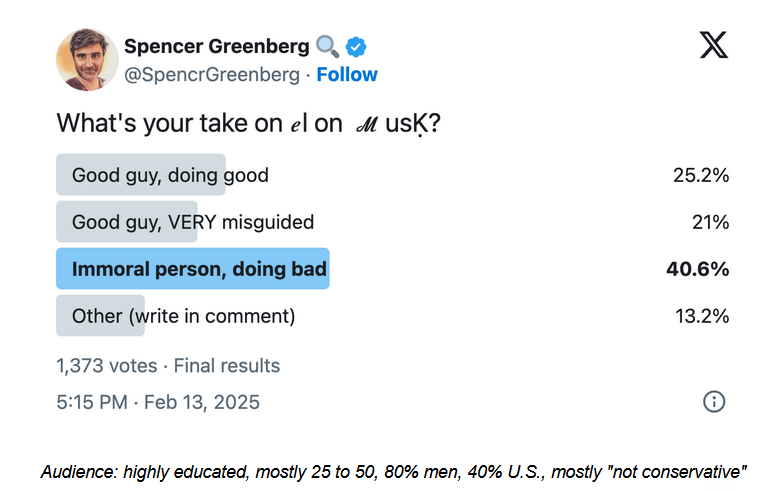
In an informal version, you can find below a tweet from Spencer Greenberg, close to effective altruism but also followed by people unconnected to this community. The poll was posted on X, severely limiting exposure to Musk’s critics, most of whom have migrated to BlueSky.
4-Did Elon Musk interact with members of the effective altruism movement?
Yes, the director of the Center for AI Safety in the United States, some (but not all) of whose members are affiliated to the movement, is advising Elon Musk on the catastrophic risks of AI for his company xAI, despite their alleged differences over the strategies to be put in place to counter these risks. It should be noted that Musk has no power over what the Center for AI Safety says, that CAIS advice is not binding and that it is provided for a token $1 a year. [17]. The director of CAIS also advises ScaleAI, another AI company.
Elon Musk was also invited to a panel on AI Safety in 2015 at a conference related to effective altruism [18]. Presumably, influential people in this field regularly interact with him. AI Safety researcher Eliezer Yudkowsky, who has reportedly spoken with him on several occasions, describes his interactions with him as an attempt to convince Musk of a cautious approach to AI risks that had failed profoundly [19].
5 -Do Musk and the members of effective altruism share the idea that AI poses an existential risk?
Part of the community shares this concern, but they don’t draw the same conclusions. Whether this opinion actually influences the policies advocated by Elon Musk in terms of AI is relatively unclear, given that he himself is invested in his company xAI. Furthermore, the idea that AI poses an existential risk, while common, is not unanimous within effective altruism. Most people who advocate this possibility and who do not work for an AI company tend to push for stricter regulations, international coordination, the mandatory presence of a safety team within AI companies, or even a slowdown, pause or halt in the progress or deployment of AIs [20].
Even within these companies, double talk is fairly common, but in general the actions they defend tend to discourage regulation, international coordination and even the presence of safety teams (as at Meta, for example). This suggests either that talk of safety is a lever for public reputation, or that the players at the head of these companies favour a high-risk strategy motivated by a race dynamic (which seems to be the case with Musk), or that they consider the solutions to be easily achievable.
There is no survey of the attitude of the community as a whole to the strategies to be adopted, but as mentioned above, the one promoted by Elon Musk does not seem to be particularly supported (in contrast to work on the interpretability of neural networks, control, model organisms, etc.).
5.1 -L'idée au sein de la communauté que l'IA présente un danger vient-elle d’Elon Musk ?
Non. Les analyses menant aux préoccupations en sécurité de l’IA sont aujourd’hui mises en avant par des groupes d’experts internationaux [21] et des travaux empiriques [22]. Historiquement, les premières personnes à avoir discuté formellement la question provenaient du Machine Intelligence Research Institute, une organisation fondée dans les années 2000 et dédiée à la sécurité de l’IA [23].
The idea was then presented in a more accessible way by the philosopher Nick Bostrom in his book Superintelligence, and more recently popularised by people like journalists Brian Christian and Daren McKee and the youtuber Rob Miles. Engineers such as Chris Olah and Richard Ngo have also been influential in highlighting the problem from a technical point of view [24]. In France, YouTube channels such as Mr.Phi and Science4All have also contributed to this popularisation [25].
Today, the subject is regularly raised by eminent figures in AI research such as Geoffrey Hinton, Nobel Prize winner and Turing Award winner, Demis Hassabis, also a Nobel Prize winner, Yoshua Bengio, Turing Award winner, and Stuart Russel and Ilya Sutskever, who are among the most frequently cited researchers [26].
5.2 -Does defending the safety of AI serve Elon Musk's presumed political interests, such as conservatism or economic ultraliberalism?
Answering this question would require us to identify and measure the social impact that AI safety initiatives have had on the clearly identified interests of these political currents. Most of the arguments on both sides of the debate are speculative, not based on empirical data.
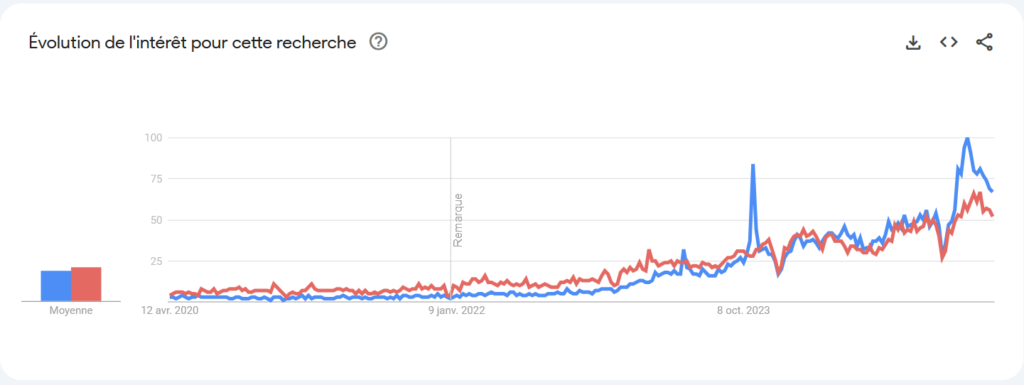
Failing that, it is possible to use approximations. Typically, the AI ethics movement is quite marked by its critical discourse on conservatism and ultraliberalism. It is worth noting that the popularity of the term “AI Safety” has not been at the expense of that of “AI Ethics” on Google, for example:
Moreover, at the 2025 AI Action Summit, an adjacent conference brought together members of the AI ethics and AI safety community to encourage dialogue [27]. Finally, it can be noted that the effective altruism community is rather left-biased [28]. However, these observations do not constitute strong evidence.
Broadly speaking, the interest of members of effective altruism in AI safety revolves around a desire to prevent AI from losing control so that sentient beings can be guaranteed a prosperous existence in an unbiased manner (there are, of course, variations in views). While this is distinct from a focus on model bias or environmental impact, both communities share a desire to prevent suffering without relying on arbitrary distinctions.
6- Does Elon Musk have a positive view of effective altruism?
Rather not. Elon Musk has two tweets accessible today about effective altruism on his profile, which are mild mockery (mining a database from 2010 to 2020 returned nothing else) [29].
In 2023, Elon Musk tweeted about a book by William McAskill, co-founder of the movement, on longtermism, describing it as “very close to his philosophy”. We believe that McAskill’s comments nevertheless defend positions that are at odds with the direction taken by the billionaire (for example, Chapter 9, “Will the Future be Good or Bad?”, where the author expresses his concern about poverty and animal suffering, or Chapter 10, “What to do?” section “Doing Good collectively”, about not losing sight of more common moral issues).
As a reminder, Elon Musk has an estimated total of over 10,000 tweets. This small number of tweets relating to the issue and his actions seems to indicate a lack of interest in the movement.
It is also important to note that endorsement of an idea by a criticizeable person is not necessarily a valid criticism of that idea – it is a well-known case of dishonour by association [30]. For example, Elon Musk has tweeted, among other things, that he is a stoic, which does not seem to be a good reason to reject Seneca’s principles of stoicism (which Musk probably understood very little). There may of course be good reasons, independent of this reasoning.
Our commitment to rigour and transparency
Mieux Donner’s recommendations aim to improve the world as much as possible for each euro donated. Our evaluations are based first and foremost on reliable evaluators whose methodology is accessible. We do not change our opinion based on the identity of the people who talk to us, but on our own judgement of the rigour and reliability of their reasoning.
Talk of improving the world can of course be used to put forward points of view that are distant from or even opposed to our own: we advise our audience to rely on reliable data and rigorous reasoning in order to judge for themselves the admissibility of these arguments. We in no way condone diverting these aspirations to neglect human and animal suffering.