In the second half of 2025, donors using the Mieux Donner platform contributed €8,920 to the Safeguarding the Future Fund. These donations come on top of contributions from 1,774 donors who supported the same fund through our German partner Effektiv Spenden, and from 179 donors who gave to a separate fund dedicated specifically to AI safety. In total, €746,000 was directed to projects reducing catastrophic risks.
Romain Barbe
Founder · Mieux Donner · Reading time: 5 min
€8,920Collected via Mieux Donner
1,774Effektiv Spenden donors to the Safeguarding the Future Fund
€746,000Total allocated in H2 2025
Mieux Donner does not currently offer the option to donate to the dedicated AI safety fund. French donors can contribute, without tax deduction, to the Safeguarding the Future Fund, whose allocation also finances part of the AI safety projects, as detailed below.
Both funds are managed by Effektiv Spenden and allocate their resources every six months, drawing on the expertise of Longview Philanthropy, whose teams working on nuclear policy and AI safety are among the most experienced in their respective fields. Here is how the money was allocated in the second half of 2025.
The expiration of the New START disarmament treaty between the United States and Russia has raised the risk of a new nuclear arms race between major powers, with direct consequences for European and international security.
A €170,000 grant from the Safeguarding the Future Fund supports a project at the Center on Conflict, Development and Peacebuilding of the Geneva Graduate Institute. The project studies measures that could prevent a new arms race and reduce the risk of escalation.
In practice, the project brings together international security specialists in working sessions, and then shares the resulting analyses with policymakers, including the US Congress, and with a broader specialist audience.
Bulletin of the Atomic Scientists: informing the public about nuclear risks (€220,000)
The Bulletin of the Atomic Scientists is a US non-profit organisation founded in 1945, best known for the Doomsday Clock, the symbolic indicator of the level of catastrophic risk facing humanity.
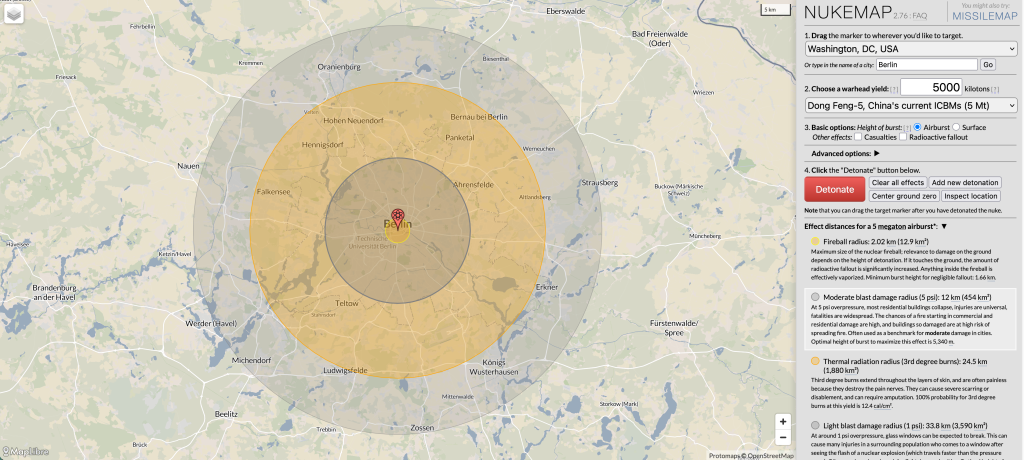
A €220,000 grant funds the project "New Histories, Media, and Tools for Nuclear Engagement", led by Professor Alex Wellerstein. Wellerstein, a professor at the Stevens Institute of Technology, is also the creator of NUKEMAP, an online simulation of nuclear weapon effects used by more than 60 million people since 2012.
The nuclear map developed by Professor Wellerstein.
The project aims to produce content and tools that help a broad audience better understand nuclear risks. It includes:
around fifty historical articles on the Bulletin's website, using nuclear history to challenge common assumptions and update public understanding of these risks,
24 long-form videos for YouTube and Nebula on nuclear history, technology, and policy, filling a gap on these platforms which are currently dominated by non-expert content,
a podcast mini-series timed with Doomsday Clock announcements,
around six interactive online tools: a modernised interface and mobile app for NUKEMAP, an updated MISSILEMAP, simulations of reactor accidents and realistic scenarios of a nuclear exchange, and interactive databases,
a free open-source toolkit that will allow other NGOs to develop their own map-based web tools at roughly 90% lower cost.
Safe AI Forum: international scientific cooperation on AI safety (€356,000)
Advanced AI systems pose complex global risks that can only be addressed through cross-border research and shared technical understanding. A €356,000 grant, drawn from both the Safeguarding the Future Fund and the dedicated AI safety fund, supports a project by the Safe AI Forum (SAIF) that is specifically designed to enable this international scientific cooperation.
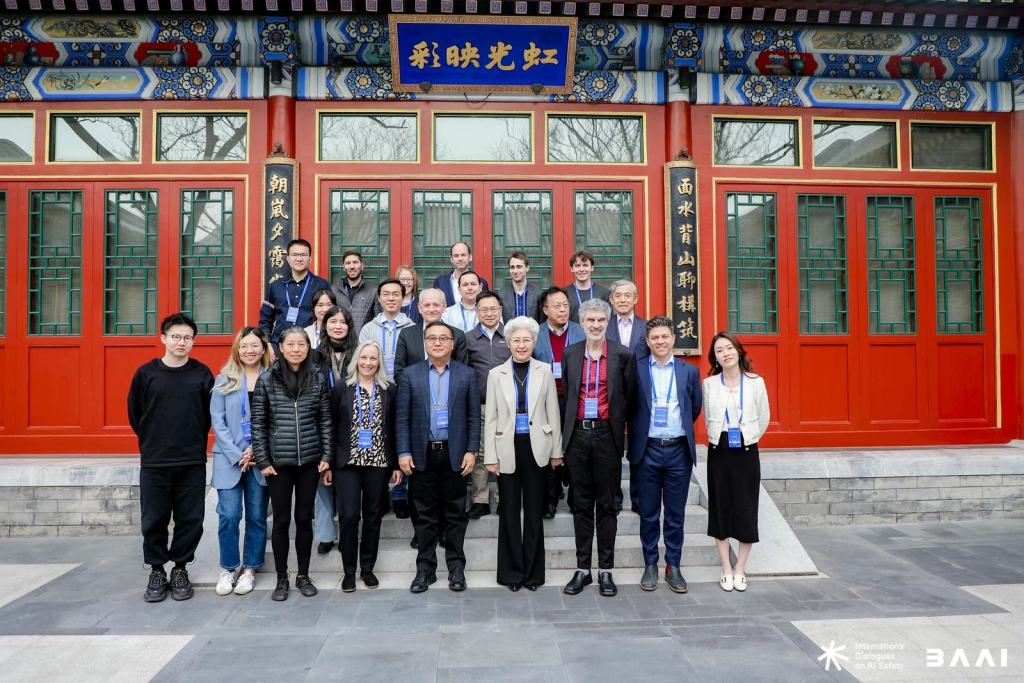
SAIF's flagship project is the International Dialogues on AI Safety (IDAIS) conference series. These dialogues bring together leading researchers from the United States, China, the United Kingdom, and the European Union, including several Turing Award laureates (often called the "Nobel Prize of computing") such as Yoshua Bengio, Andrew Yao, and Geoffrey Hinton, alongside scientists from institutions including Berkeley, MIT, Oxford, and Tsinghua University.
Scientists including Yoshua Bengio and Stuart Russell at the International Dialogues on AI Safety in Beijing, 2024.
The aim of these meetings is to build a shared technical understanding of the challenges posed by current AI models, across national borders and political contexts. By connecting the expertise of influential researchers at the international level, SAIF helps lay the scientific foundations for safer global AI development.
How to contribute
The Safeguarding the Future Fund continues to receive donations toward the next allocation. French donors can give through Mieux Donner with no operating fees taken by the platform. To learn more about the fund, how it works, and our previous announcements, see our original announcement of the Effektiv Spenden partnership published in September 2024.
Support the Safeguarding the Future Fund
Contribute to the next allocation. No operating fees are taken by Mieux Donner.