Why donating to multiple nonprofits can reduce your impact
When we decide to make a donation, it’s natural to want to spread our generosity over several causes that are close to our hearts. However, this approach can have unexpected consequences and reduce the impact of our action, even if the intention is to multiply the positive effect. Dividing your donation budget between several charities, instead of concentrating it on those that are most effective, can lead to a less favourable result.
We have a limited budget
First of all, it’s essential to understand that each of us has a limited budget for our donations. Whether it’s a sum allocated each month or each year, it’s important to manage this generosity strategically in order to amplify its impact. If you have a certain amount to donate, for example 100 euros, you can choose to divide it between several charities. But dividing this amount between several causes can dilute your impact.
The amount of aid produced varies enormously
The impact of a donation can vary considerably from one organisation to another. In some cases, it is possible to have an impact 100 times greater by supporting the most effective associations. These differences in impact stem from the way they work, the transparency of their actions and their ability to achieve concrete results. When the aim is to do as much good as possible, it is essential to choose organisations that have proven their effectiveness by using funds rigorously and aiming for the best results.
Not all donations are made with the aim of helping as many people as possible. Sometimes we choose to donate because a cause touches us personally or because we enjoy supporting a certain association. Although these donations are generous, they are not part of a drive to help as many people as possible. When the aim is to help as many people as possible, it is crucial to give to associations recommended by international evaluators. This ensures that each donation has a real and lasting impact.
The problem of dividing donations
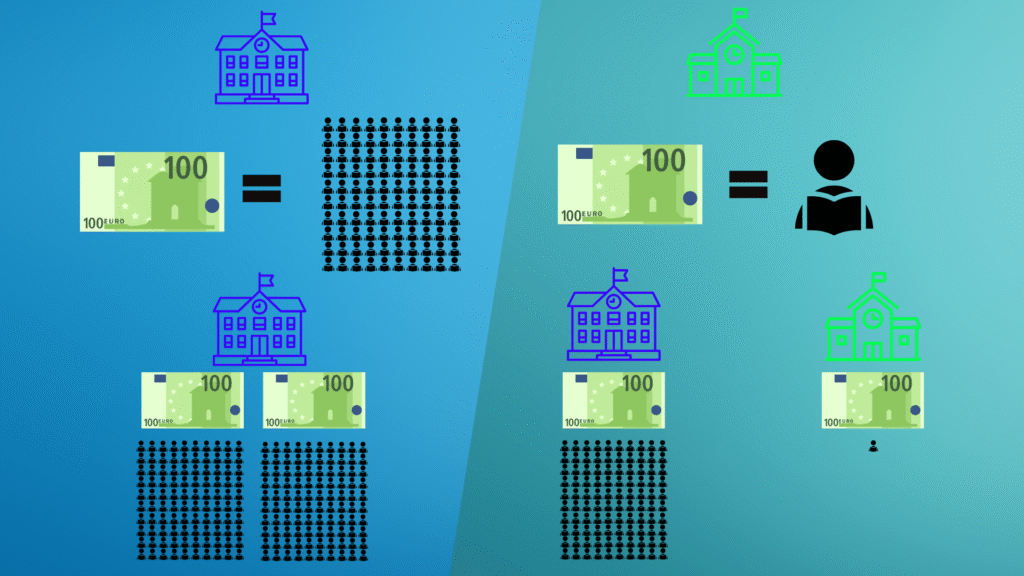
The principle is simple: there are often significant differences in effectiveness between charities. For example, if one charity provides schooling for 200 children for 100 euros, and another provides schooling for only 2 children for the same amount, it’s clear that the first charity offers much better results. If you choose to divide your 100 euros between these two charities, you will only be giving 101 children access to school, whereas by concentrating your donations on the first charity, you would have enabled 200 children to benefit from an education.
This strategy of dividing your money between multiple charities may seem generous, but it often results in a much lower overall impact. Instead of concentrating your generosity on actions that produce real results, you risk spreading your resources over causes whose effectiveness is uneven. The result: you help fewer people, or less effectively.
This phenomenon is not just a personal observation; it has been studied by researchers such as Paul Smeets, who has conducted experiments showing that some people, despite being aware of the differences in effectiveness, sometimes tend to divide their donations, in particular out of a desire to consider the second association.
Is this unfair to other charities?
It’s understandable to wonder whether this seems unfair to charities that don’t receive funds. However, when we think about the impact of a donation, the real injustice probably lies with the people we could be helping, but who are left in situations of distress. These people, generally among the most destitute in the world, have no means of improving their situation without effective support.
By concentrating our donations on the most effective charities, we can make a real difference to the lives of hundreds or even thousands of people who need it most. In comparison, the injustice to the charity that receives no funds is secondary. What’s more, if the charity’s aim is really to help others, it should prefer funds to go where they can help the most. The real question is: who do we want to do justice to, an organisation or those who are suffering?
The exception to the rule
That said, there is one important exception to this principle. Mieux Donner sets itself apart by selecting associations with a proven and measurable impact. The organisations on our site have been rigorously evaluated according to criteria of effectiveness and transparency. This means that there is no great difference expected between them in terms of results, or that differences in impact may depend on moral considerations or risk aversion.
If you choose to divide your donations between these associations, you are not reducing your overall impact, as each of these organisations is equally effective in using the funds.
Why not multiply charities?
The real danger of splitting your donations comes when you want to add more charities to your portfolio. While this may seem like a way of covering several causes, it risks diluting the overall impact.
Unless you make particularly informed and strategic choices, it is often best to focus your generosity on charities recommended by independent evaluators that meet the criteria for effectiveness. You can vary the causes within these associations, but adding organisations that are not recognised for their effectiveness reduces your impact. This means fewer people being helped, even if your intentions are good.
Criteria | Concentrated donation: 1 most effective association | Limited portfolio: several associations, all very effective | Mixed portfolio: effective + less effective associations |
Average efficiency (impact per €) | ★★★★★ | ★★★★★ | ★★☆☆☆ |
Risk of impact dilution | Minimal | Low | High |
Search time / due-diligence | Low | Moderate (select from recommended associations) | High |
Emotional value (diversity of causes) | Limited to one cause | Good: several causes, all high-impact | High, but can mask loss of effectiveness |
Risk of supporting ineffective projects | Low | Low | High |
Simple administration (tax receipts, transfers, etc.) | Very simple | A little more complex | Complex |
Compatible with a “help as much as possible” strategy | Perfect | Very good | Poor to average |
The case of donation platforms with a large number of associations
It is important to stress that a large number of donation platforms do not seek to highlight associations according to criteria of effectiveness, but rather to group together as many associations as possible. The main aim of these platforms is often to raise as much money as possible, without necessarily worrying about the real impact of the donations. Adding a multitude of organisations can, as we have seen, dilute the impact and reduce overall effectiveness. The result is that fewer people are helped in concrete, measurable ways.
The consequences of this reduction in efficiency are particularly serious for the most disadvantaged people, those who do not have the resources to improve their situation. These people, who need urgent help, would prefer us to concentrate our efforts and resources on the most effective solutions to really improve their situation. Giving to effective, carefully selected associations is the fairest and most impactful way to act.
Prioritise to amplify the impact of your donations
In short, generosity is not just a question of quantity, but of quality. Rather than dividing your budget between a large number of charities, it’s better to concentrate your efforts on those that demonstrate a concrete and measurable impact. Mieux Donner allows you to make this choice with confidence, by offering you a selection of the most effective and transparent associations.
Don’t let the temptation to multiply your beneficiaries lead you to reduce the impact of your donations. By concentrating your generosity on the most effective initiatives, you have the opportunity to help many more people in a much more significant way.