If you want to make a significant positive impact in the world—be it by improving well-being, reducing suffering, or tackling pressing global challenges—you may find yourself asking a fundamental question: Should I donate effectively or invest for impact?
This article explores the definitions, compares the evidence, and examines the arguments for both approaches to determine which strategy may deliver the greatest results. We also delve into recent research, practical principles, and case studies such as the Global Innovation Fund’s impact claims.
Definitions: Donating Effectively vs. Impact Investing
Donating Effectively
Donating effectively refers to giving money to charities or organisations that have been rigorously assessed for their impact. The goal is to direct funds to interventions that yield the greatest benefit per dollar spent, based on robust evidence such as randomised controlled trials (RCTs) and cost-effectiveness analyses.
Impact Investing
Impact investing, by contrast, involves investing in for-profit or nonprofit ventures that aim to achieve measurable social or environmental benefits alongside financial returns. Examples include funding renewable energy projects or supporting companies that promote affordable healthcare access in low-income regions. The potential appeal lies in generating both financial and social returns, which could theoretically multiply your resources for future philanthropic efforts.
Impact investing appears superior to investing in neutral sectors (e.g., general stocks) or harmful industries (e.g., fossil fuel exploration). When choosing between impact investing and conventional investment strategies, the former can deliver meaningful positive outcomes while avoiding harmful externalities.
However, the question remains: Is impact investing effective compared to donating now to evidence-backed charities?
Donating Effectively > Impact Investing: What the Research Shows
Research by Hauke Hillebrandt, PhD, and John Halstead, DPhil, in their paper “Donating effectively is usually better than Impact Investing” suggests, as its name suggests, that donating to high-impact charities is often more effective than impact investing even considering that your money can be used for a longer period of time. Their findings, originally published in 2020, highlight several key challenges that limit the potential of impact investing to deliver outcomes comparable to high-impact donations.
Core Challenges of Impact Investing
1. Finding Truly Impactful Companies
Identifying companies with genuine enterprise impact—those that make a meaningful positive difference—is difficult. Unlike charities vetted through rigorous evaluations such as randomised controlled trials (RCTs), the impact of many businesses remains uncertain.
2. Achieving Additionality
Additionality refers to the unique contribution an investor makes to a company’s success, we can also use the word “counterfactual” that can be used in broader areas. This can include providing additional capital (“investment impact”) or non-financial support (e.g., advice, networks). For large public stock markets, it is particularly challenging to achieve additionality, as investments often merely replace those of other investors.
3. Trade-offs Between Financial Returns and Social Impact
Socially impactful investments often require financial sacrifices. Investors must navigate a trade-off between maximising their financial returns and their social impact, which complicates the ability to consistently outperform donations to evidence-backed charities.
4. Displacement Effects
Investments can displace other impact investors, meaning your capital might simply substitute funds that another investor would have provided, thereby reducing your unique contribution to the project’s success.
Principles for Effective Impact Investing
Hillebrandt and Halstead identified six guiding principles to maximise the effectiveness of impact investing:
- Support Companies Benefiting (Poor) Consumers or Producing Positive Externalities.
Focus on ventures that directly benefit underserved populations or contribute to public goods, such as renewable energy or affordable healthcare.
- Choose a High-Impact Cause Area.
Just as with donations, selecting neglected but high-impact areas—like global health or climate change—is crucial.
- Support Companies in Uncrowded Markets.
Investing in underfunded sectors increases the likelihood of making a difference by filling funding gaps.
- Work in Inefficient Markets and Expect Financial Sacrifice.
High-impact investments often require operating in markets where conventional investors are absent, accepting lower financial returns in exchange for greater social impact.
- Work on Neglected Problems.
Addressing issues overlooked by other impact investors offers higher potential for making a unique contribution.
- Exploit an Information or Network Advantage.
Leveraging specialised knowledge or connections can help identify impactful opportunities that others might miss.
Why Principles Alone Are Necessary but not Enough
The study critiques common principles of impact investing—such as supporting companies in inefficient markets or neglected sectors—as insufficient. While these principles provide a baseline for evaluating investments, they are more of a starting point than a reliable framework for ensuring high-impact outcomes. The challenge lies in the implementation: finding opportunities where financial resources truly create additional value is rare, especially when competing with other well-capitalized investors.
The Comparative Advantage of Donating
Unlike impact investing, donating effectively avoids many of the uncertainties tied to market dynamics. High-impact charities focus on direct interventions with measurable results. For example, charities addressing neglected diseases or providing cost-effective health solutions achieve impact at a scale that is difficult to replicate in the private sector. It’s also worth mentioning that, for some actors, lending money may seem easier than donating it.
While impact investing has its merits, such as influencing market behaviour and fostering innovation, it often struggles to match the immediate and measurable outcomes of donating effectively. Moreover, the landscape of impact investing is highly competitive. According to the Global Impact Investing Network (GIIN), the global impact investment market is estimated at $1.57 trillion in assets under management, spread across 3,907 organizations. With so many actors competing for the best opportunities, additional investors may not make a meaningful difference.
Conversely, in the nonprofit sector, the bottleneck is often not the lack of opportunities but the lack of funding. There are still hundreds of millions of children who are not vaccinated, not protected from malaria, and suffering from vitamin A deficiency—problems with well-documented, cost-effective solutions that remain underfunded. The limiting factor here is not innovation or scalable opportunities, but simply a shortage of money. In this context, donations to rigorously evaluated charities provide a direct, proven way to save lives and improve global well-being.
Evaluating the Best Evidence for Impact Investing
This is an apples to oranges comparison and while this claim seems compelling, it does not hold up to rigorous scrutiny when compared to the evidence standards used by organisations like GiveWell. Even for leading impact investing organisations, the evidence suggests that donating effectively—where every dollar goes directly to proven, high-impact interventions—tends to deliver better outcomes. There are three key issues:
1. Lack of Conservative Impact Estimates
GiveWell use highly conservative assumptions when evaluating the impact of their recommended charities. For example, the Vitamin A supplementation program run by Helen Keller International is supported by multiple RCTs (Randomised Controlled Trials). Despite this, GiveWell significantly reduces its impact estimates (by as much as a factor of four) to account for uncertainties like replication failures.
By contrast, GIF bases its claims on optimistic projections rather than robust, conservative evaluations. This leads to inflated impact estimates. For instance, GIF attributes a large portion of the final impact of a project to its initial funding round without rigorous evidence. Using this kind of optimistic estimation, some new projects could claim to be 240 times more cost-effective than GiveWell’s cash transfer benchmark—for example, HealthLearn’s impact model claims such figures (see HealthLearn Impact Model). However, when assessed with more conservative methods, the real cost-effectiveness of such projects would likely be significantly lower. That’s why HelthLearn used a division > 10 of their assessed impact and speak of x24 not x240 or above.
2. Overestimating Contributions Across Funding Rounds
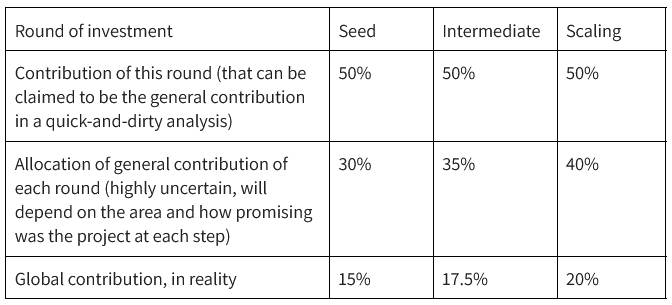
Impact investing often involves multiple funding rounds (e.g., seed, intermediate, scaling).
There is no need to consider several rounds of funding when you are donating, but you should probably do with impact investing. Which GIF is not doing and extrapolate one round with the overall impact:
Such attribution inflates GIF’s perceived impact. In reality, later rounds often play a smaller role in a project’s overall success, and the cumulative contributions of earlier rounds should be carefully reassessed. Factoring this in, GIF’s impact estimates could be reduced by a factor of three.
3. Ignoring counterfactuals
One of GiveWell’s strengths is its careful consideration of counterfactual impact—what would happen if they did not fund a project. For instance:
To address this, GiveWell adjusts its impact calculations to reflect these counterfactual scenarios. They also perform backward-looking analyses to estimate how often projects they chose not to fund were supported by other actors.
Chief Economist of the Global Innovation Fund said :
I think it can be actually difficult to defend the assumption because it’s exactly what all the other serious actors of this sectors tried to do, taking a 50% counterfactual would be a more credible assumption waiting extra evidence.
Other Propositions
It’s worth mentioning that these approaches are not mutually exclusive, and it’s possible to allocate resources in varying proportions. Additionally, investing for 40 years doesn’t exclude eventually donating the accumulated funds. Gradients and variations are always possible.
Donating the Returns of Your Impact Investments
If giving away your principal feels daunting, another strategy worth considering is donating the returns from your impact investments. This approach allows you to retain your initial capital while still contributing meaningfully to causes you care about.
While impact investing typically offers slightly lower financial returns compared to traditional investments, the difference may not be as significant as you think. For example, the University of California Study found a median internal rate of return (IRR) of 6.4% for impact funds, compared to 7.4% for conventional funds—a difference of just 1%. This small trade-off could align with your financial goals while still generating positive social or environmental outcomes, albeit at a smaller scale compared to direct donations.
Here’s how donating your returns could work in practice:
1. Retain Your Principal
Keep your invested capital intact and only donate a portion of your annual returns. For instance:
- If your impact investment yields 6% annually, you could donate the full 6%, treating it as a recurring gift without depleting your initial investment.
- Alternatively, you could choose to donate 4% while reinvesting the remaining 2% to keep up with inflation. This way, your portfolio remains sustainable over the long term.
2. Maximise Certainty Through Donations
While the impact of impact investing is inherently uncertain and often orders of magnitude less effective than direct donations, directing the returns to evidence-backed charities ensures your money achieves the greatest possible benefit. This combination could allow you to balance financial security with high-impact giving.
Invest to give
“Invest to give” is a strategy where individuals or organisations, firmly committed to donating in the future, choose to invest their resources first in order to grow the total amount available for philanthropy. The rationale is that, over time, financial returns from investments can significantly increase the resources available, potentially doubling or even tripling the total donation amount after adjusting for inflation. For example, with an average annual return of 6%, a donor’s funds could grow by over 50% in less than a decade. This strategy may also allow donors to prepare for large-scale opportunities, such as funding future initiatives that require substantial resources or supporting innovations that are not yet available.
However, investing to give comes with important trade-offs. Many of the highest-impact interventions available today address urgent, time-sensitive needs, such as preventing deaths from malaria, famine, or vaccine-preventable diseases. These causes often represent “low-hanging fruit,” where the cost-effectiveness is extraordinarily high. Waiting to donate risks losing the opportunity to address these problems while they are still tractable. Furthermore, over time, as these immediate issues are addressed, the cost of achieving comparable impact may increase due to marginally diminishing returns—e.g., the cost per life saved might rise as the easiest and most cost-effective interventions are exhausted.
Another risk lies in the unpredictability of future impact opportunities. While it is possible that innovations or new areas of intervention could significantly increase the effectiveness of future giving, this is uncertain. Similarly, economic downturns or personal value drift may affect the donor’s capacity or willingness to follow through on their philanthropic intentions. There’s also the consideration of immediate funding gaps faced by high-impact organizations today, which may limit their ability to scale or operate at full capacity if donations are delayed.
While “invest to give” can be a compelling approach for those focused on long-term impact, the comparison between donating now versus donating later is complex and depends on factors like the urgency of current needs, expected returns on investments, and the evolving landscape of high-impact interventions. We plan to explore this topic more deeply in future articles, analyzing the evidence and trade-offs to help donors make informed decisions.
A Real-Life Experiment in Maximising Impact
Imagine you have several hundred million dollars at your disposal, with a mission to help others as much as possible using the resources available to you. You have access to a world-class team of researchers, incluidng experts in global health, biosecurity, and animal welfare, dedicated to figuring out how to create the most positive impact. What you would finally do would be an interesting result.
This is not a hypothetical scenario—it’s the story of Open Philanthropy. Founded in 2014, Open Philanthropy has become a major player in the philanthropy sector. Its mission is simple but ambitious: “Our mission is to help others as much as we can with the resources available to us.” They are dedicated to finding impactful causes in the world using rigorous research, evidence, and reasoning. Currently, they have a team of 140 people, including 90 working on research or specific programs.
While we don’t have access to their full reasoning, all the analyses, and while the main funders may have some biases and limit the scope of their foundation, it is still noteworthy to see that Open Philanthropy focuses primarily on donations rather than impact investing. Their mission is to help others as much as possible with available resources, and their team of top-class researchers has rigorously explored the best ways to achieve this. The fact that Open Philanthropy channels its resources primarily into donations rather than impact investing strongly suggests that, for those aiming to maximise impact, donating effectively to evidence-backed charities often outperforms impact investing.
Of course, Open Philanthropy’s approach doesn’t rule out the potential value of impact investing in certain contexts. It provides a compelling real-world data point for the effectiveness of donations in comparison to impact investing.
General Conclusion: Donating Effectively Outperforms Impact Investing
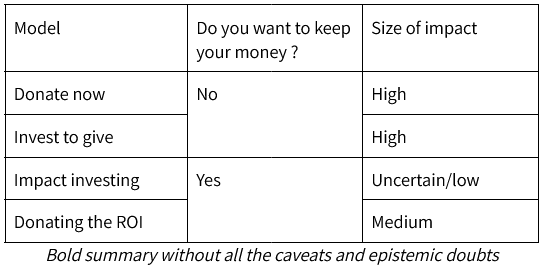
Impact investing is challenging, often with multiple limitations, and donating is generally more effective. While “invest to donate later” can compete with donating now, it only works if the intent to donate remains central.
If your plan is to retain your money, impact investing is unlikely to be the best way to make a difference. Donating the returns (ROI) from your investments may create more impact than simply investing.
For those pursuing impact investing, the evidence suggests it is difficult to argue that this approach achieves the greatest possible impact. If you’re serious about making a meaningful difference, it’s worth considering donating your resources—either now or later—to maximise their potential.
You can reach out to me at romain@mieuxdonner.org if you have other arguments or a new study/report to share.