Malaria, its harms, and why it should have already disappeared
Today, a child dies every 60 seconds from malaria, a preventable disease [1]. Every year, 600,000 people fall victim to this disease, mainly in sub-Saharan Africa. Yet combating it has never been easier.
The populations most affected by malaria are also the most vulnerable: children under 5, pregnant women and families living in precarious areas. In many regions, communities do not have access to essential information on preventing the disease, or the means to protect themselves effectively. Access to care and reliable resources remains limited, making the fight against malaria even more difficult.
Malaria is still particularly deadly in sub-Saharan Africa, but it is a global risk, particularly in other tropical regions of Asia and Latin America. With climate change, transmission zones are changing, and the threat could extend to regions not previously affected. Tourism is also a risk, all the more so at a time when travelling has never been so easy.
Malaria: a deadly but preventable disease
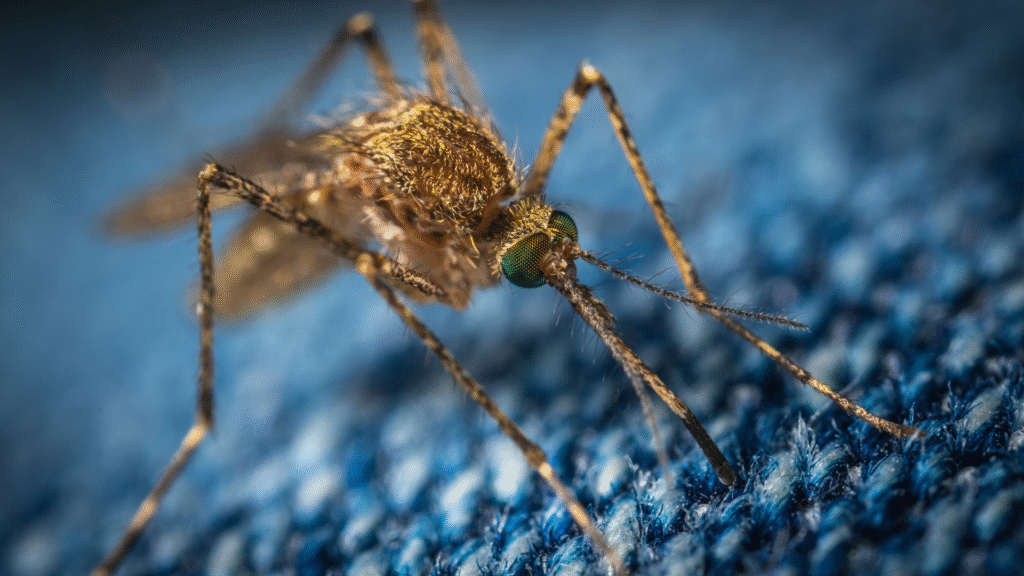
Malaria is a parasitic disease transmitted by the bite of mosquitoes infected with the Plasmodium parasite. After being bitten, the infection develops in the liver before spreading to the red blood cells.
Let’s take the example of a 4-year-old child in sub-Saharan Africa. At first, he presents symptoms of fever. His family took him to a local health centre, but it no longer had any treatment available and the next centre was too far away for him to travel. After a few days, the fever became more intense, accompanied by vomiting and breathing difficulties. In the absence of anti-malarial treatment, the child’s breathing becomes increasingly difficult, and his heart struggles to beat normally. The parents watch helplessly as their child’s health slowly deteriorates until death.
This tragic situation could be avoided by simple prevention methods such as the use of insecticide-treated mosquito nets. [2]
Mosquitoes bite at night, so putting a mosquito net over your bed can prevent most infections. Thanks in no small part to this simple and inexpensive prevention method, the number of deaths has been halved in 20 years. But some 500,000 children still die of malaria every year.
We have eradicated this disease in many parts of the world. We can look forward to a world where no more children die from it.
Exceptional efficiency
A mosquito net costs around 5 euros. These nets are extremely effective: they act as a physical barrier against mosquitoes, while killing them on contact. This means that you can maintain a minimum level of protection even if there are holes in the net.
Against Malaria Foundation (AMF), one of the most rigorously evaluated organisations in the world, distributes these nets in the areas most at risk. According to GiveWell‘s independent analysis, giving to AMF is one of the best ways to save lives with a donation [3].
A true story: "Malaria no longer exists in our village".
When Rob Mather, founder of AMF, was distributing 50,000 mosquito nets in Uganda, one day he called a local Red Cross contact. They put him through to a village elder called Mohammed. Rob knows that before the distribution, there were 357 cases of malaria in this village of 700 inhabitants. Two young boys had died.
Mohammed thanks him. “Thank you for the mosquito nets.”
Six months later, there are only 7 cases. The following month: zero. Mohammed walked six kilometres to a Red Cross office to send a message:
Even a small donation changes lives
Many people think you have to give hundreds of euros to make a difference. But with effective generosity, every euro really does count.
Why prioritise the fight against malaria?
Effective generosity is not about giving more, but about giving better: choosing the causes and organisations where our gift has the greatest possible impact.
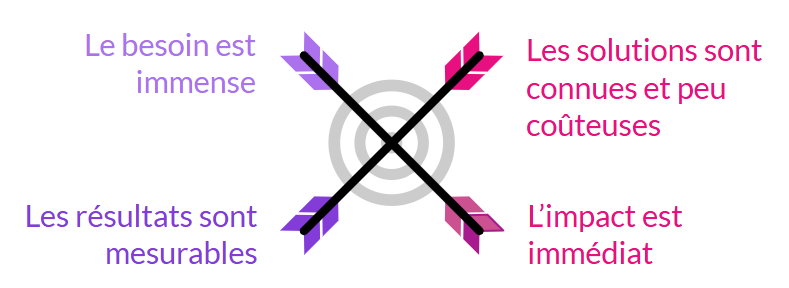
Malaria meets all the criteria for a priority cause:
The most influential associations
Some associations stand out for their exceptional effectiveness in combating malaria. These organisations work hand in hand with local governments to target at-risk areas, plan large-scale distributions and evaluate the results.
Against Malaria Foundation (AMF) distributes mosquito nets in a targeted, transparent and data-driven way. It is regularly ranked as one of the best charities in the world by GiveWell and The Life You Can Save.
Thanks to its rigorous approach, AMF guarantees that every euro is used where it can save the most lives.
Malaria Consortium offers a chemoprevention programme for malaria, based on oral medication, and is regularly rated as one of the best associations in the world by GiveWell.
Act with discernment, save lives
Every mosquito net funded is a life protected. Every well-directed donation is another chance to beat a disease that should no longer kill.
By choosing to give effectively, you can save real lives for just a few euros.