
Impact





You can have 100x more impact by donating to the best charities
When we decide to give, our intention is to improve the world. Did you know that your choice of charity can multiply the impact of your generosity by 100x? The real impact of your donation can vary enormously depending on the charity you choose to support. Some charities are up to 100 times more effective than others. Understanding where to give therefore becomes essential to maximise the positive impact of your contributions.
Differences in cost-effectiveness: a striking observation
Many of us assume that all charities are more or less equally effective. In reality, the differences are considerable. A study by Lucius Caviola, re-shared by Our World in Data, found that the most effective charities can have 100 times more impact than the average.
Where the average charity delivers a modest impact, the most effective ones dramatically amplify what each euro achieves. In practice, your donations can save far more lives, or improve quality of life far more, when you direct them to highly effective organisations.
Why such a difference in impact?
The gap in cost-effectiveness comes mainly from the interventions that charities choose to fund. Global health is a clear example. According to data from the Disease Control Priorities project (DCP2), some health interventions, such as distributing medicines or insecticide-treated nets to fight malaria, are extremely cost-effective.
Some charities, staffed by committed volunteers and even funded by serious institutions such as the World Bank or the WHO, may focus on programmes that are far less effective by comparison, or that can even do harm. The most effective charities focus on low-cost, evidence-based interventions that save lives and improve quality of life at scale.
For example, the Against Malaria Foundation distributes insecticide-treated nets to at-risk populations, preventing thousands of malaria cases at very low cost.
It's not just about the numbers; it's about compassion. Every donation has the power to touch lives and families. I choose to support the most effective charities because I recognise the potential to help hundreds more people. Every person I can help matters, and I am committed to making a lasting difference in the world. Romain, co-founder of Mieux Donner
Variations in impact are not limited to one sector
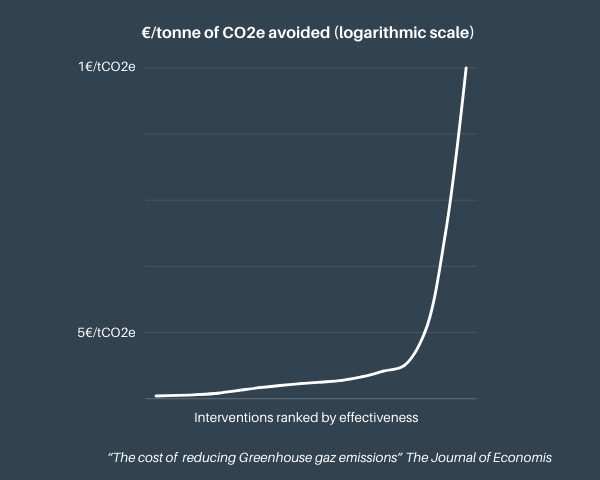
Beyond global health, effectiveness also varies enormously in the fight against climate change. Measures aimed at reducing greenhouse gas emissions can be remarkably effective, or deliver very little per euro invested. The data shows that some actions, such as shaping public policy on environmental regulation or supporting technological innovation, allow considerable progress.
Here too, some approaches cut emissions at a lower cost, maximising the impact of each euro spent.
The Clean Air Task Force, for example, works to promote clean, innovative energy policy, helping to cut emissions significantly at a lower cost.
The first-ever study of how much happiness charities create with donations
The World Happiness Report 2025, the world's leading publication on global wellbeing and how to improve it, is published by the Oxford University Wellbeing Research Centre, in partnership with Gallup and the United Nations Sustainable Development Solutions Network. The Happier Lives Institute, a wellbeing research organisation, wrote a chapter of the report to find and review every existing estimate of how much happiness charities create. The review identified 24 estimates of charity effectiveness from four different evaluators.
When the top five charities in the sample are compared with the average UK charity (excluding guide-dog charities), the top five are around 150 times more effective. A donation of 1,000 euros to a leading charity can therefore have the same impact as roughly 150,000 euros given to a more mainstream one.
But every charity in this sample had chosen to be assessed by the research teams, so the report notes they are probably much better than average. Compared with the quick analyses of guide-dog charities and homelessness support, the best charity is around 3,500 times more effective than these popular destinations for our charitable euros. See the full analysis.
A recurring phenomenon
While this article focuses on global health, climate change and wellbeing, similar gaps appear in other areas, from social policy and education to criminal justice1. In each of these fields, some interventions greatly outperform the rest. Directing your donations towards these high-impact interventions maximises your contribution to a better world.
A morally crucial choice
Faced with these gaps in effectiveness, the question of where to give becomes a major ethical decision. By choosing to support an extraordinarily effective charity, you can multiply the impact of your donation. The difference can, quite literally, be saving hundreds of lives rather than a handful for the same sum.
Giving then becomes not only altruistic but strategic. As an individual, you have the power to maximise your contribution to global wellbeing by choosing carefully which charities you support.
An opportunity to seize
The good news is that information on charity effectiveness is more accessible than ever. Organisations such as Mieux Donner are committed to giving you recommendations grounded in solid evidence, so you can make informed choices and be confident that your donation has a real, measurable impact.
Conclusion
In the end, it is not only about giving: it is about giving effectively. By directing your donations towards the charities with the greatest impact, you can help change the world in a meaningful way. The potential is immense, and it is within everyone's reach to make a difference.
Support the most effective charities
Discover the charities recommended by Mieux Donner and maximise the impact of your donations.
Donate now[1] Benjamin Todd has written an excellent synthesis article, combining data sets from many fields. Todd (2023): How much do solutions to social problems differ in their effectiveness? A collection of all the studies we could find
Published 22 October 2024, last updated 21 March 2025