Introduction
The philanthropic sector is moving towards a scientific and rigorous approach, understanding the importance of allocating resources where they will have the greatest impact. International organisations are increasingly aligning their actions with rigorous criteria of effectiveness and transparency. In France, however, this crucial shift is struggling to take hold. The current practices of foundations and redistributing bodies often show a lack of methodological clarity in the selection and evaluation of projects, limiting their effectiveness in the face of growing needs.
At the Forum National des Associations et Fondations, we spoke to a variety of players to understand their practices. Around ten semi-structured interviews were conducted, combining closed answers (yes/no) and explanatory developments, and enabled us to gather enlightening data on their decision-making processes. Although illustrative, the feedback highlights a clear trend: a lack of methodological rigour often limits the impact of donations, and more needs to be done to bring French philanthropy into line with international best practice.
Note: This article is based on our observations and discussions at the Forum National des Associations et Fondations, which illustrated the current challenges facing philanthropy in France. Our intention is to promote collective reflection on ways of improving the effectiveness of donations to maximise their social impact.
Project selection and assessment methodology
1. Unstructured internal selection process and lack of impartiality
Many foundations use selection criteria developed internally, without a standardised framework or rigorous method. These criteria are mainly based on subjective preferences, which limits their impartiality and their ability to maximise the impact of the resources allocated.
For example, during our discussions at the Forum, some participants mentioned decisions such as “we have decided to concentrate on planting trees in France”, without any in-depth reflection on the relevance of this action. These choices did not take into account crucial issues such as :
- Quel est votre objectif en plantant des arbres ? Est-ce une méthode efficace pour y répondre ?
- Est-ce en France que la plantation d’arbres est la plus nécessaire pour lutter contre le changement climatique ?
- Quelles essences d’arbres sont adaptées au contexte local ?
- Quel est le taux de survie des arbres plantés ?
- Une monoculture a-t-elle réellement un impact positif sur la biodiversité ?
These exchanges reflect a lack of shared reflection on the whys and wherefores of these projects. This ignores the importance of these issues, as highlighted by researchers Stefan Schubert and Lucius Caviola, who have studied the variations in impact between associations:
Consequences
Without asking these fundamental questions about choice of cause and method, decisions remain subjective, even arbitrary. This is literally "playing darts in the dark", with the risk of wasting resources on initiatives with limited or no impact, while other, far more effective interventions remain underfunded.
2. Lack of use of the theory of change
The theory of change is a strategic planning method that defines a clear path towards measurable objectives, detailing the necessary steps and underlying assumptions. This approach makes it possible to structure interventions to maximise their effectiveness. However, few foundations use it, which often makes it difficult to evaluate and justify funding choices.
Consequences
Without a theory of change, projects can lack strategic direction, making it difficult to assess their progress and adjust approaches where necessary. This limits their potential for long-term success and compromises the overall impact of funding.
3. Evaluation methods without comparison with and without the intervention
Most of the entities surveyed do not assess the net impact of their projects, i.e. the real impact taking into account what would have happened in the absence of the intervention. Robust methodologies such as randomised controlled trials, which allow the effects of the intervention to be distinguished from those of other external influences, or even compared with a baseline scenario, are only used in rare cases. Without a comparison group, it is difficult to demonstrate a real impact, making the results less reliable.
Consequences
Without comparison, it is impossible to say that the effects observed are really attributable to the intervention, or even that they are beneficial. Foundations therefore run the risk of funding projects that do not have the desired effect, depriving other, more effective initiatives of essential funding. Without reliable measurements, precious resources can be allocated to initiatives with limited or negative real impact. For example, the American “Scared Straight” programme aimed to deter young offenders from re-offending by showing them the reality of life in prison.
The approach seemed intuitive and initially the re-offending rate appeared low, encouraging funding and media coverage of the programme. However, when a research team compared the results with those of similar young people who had not taken part, they found that the young people who had taken part in the programme had a higher re-offending rate. Far from being a deterrent, the programme had the opposite effect, increasing the likelihood of re-offending. This example shows the importance of comparing results to ensure that an intervention has the desired impact.
Alignement avec les normes internationales
1. Lack of international impact indicators
Most foundations do not use international indicators, although the World Bank and the World Health Organisation (WHO) have adopted them to measure the impact of their projects. These include DALYs (disability-adjusted life years), equivalent years of schooling, WELBYs (adjusted years of well-being) and tonnes of CO2e emissions avoided.
These indicators, which are widely used, make it possible to assess the concrete positive effects of various interventions and facilitate comparison between projects. They also provide greater transparency for donors, who can better understand the impact of their support.
Consequences
Not adopting comparable indicators makes it impossible to determine whether certain projects are generating a significant impact or, on the contrary, producing minimal or even uncertain effects. This deprives decision-makers and donors of a clear understanding, making it difficult to distinguish between initiatives that are genuinely beneficial and those whose impact is negligible. In the absence of comparisons, there is a risk of failing to perceive the extent of the effects in relation to other, more effective interventions, or even of confusing uncertain results with positive effects.
2. Failure to take into account the cost-effectiveness of interventions
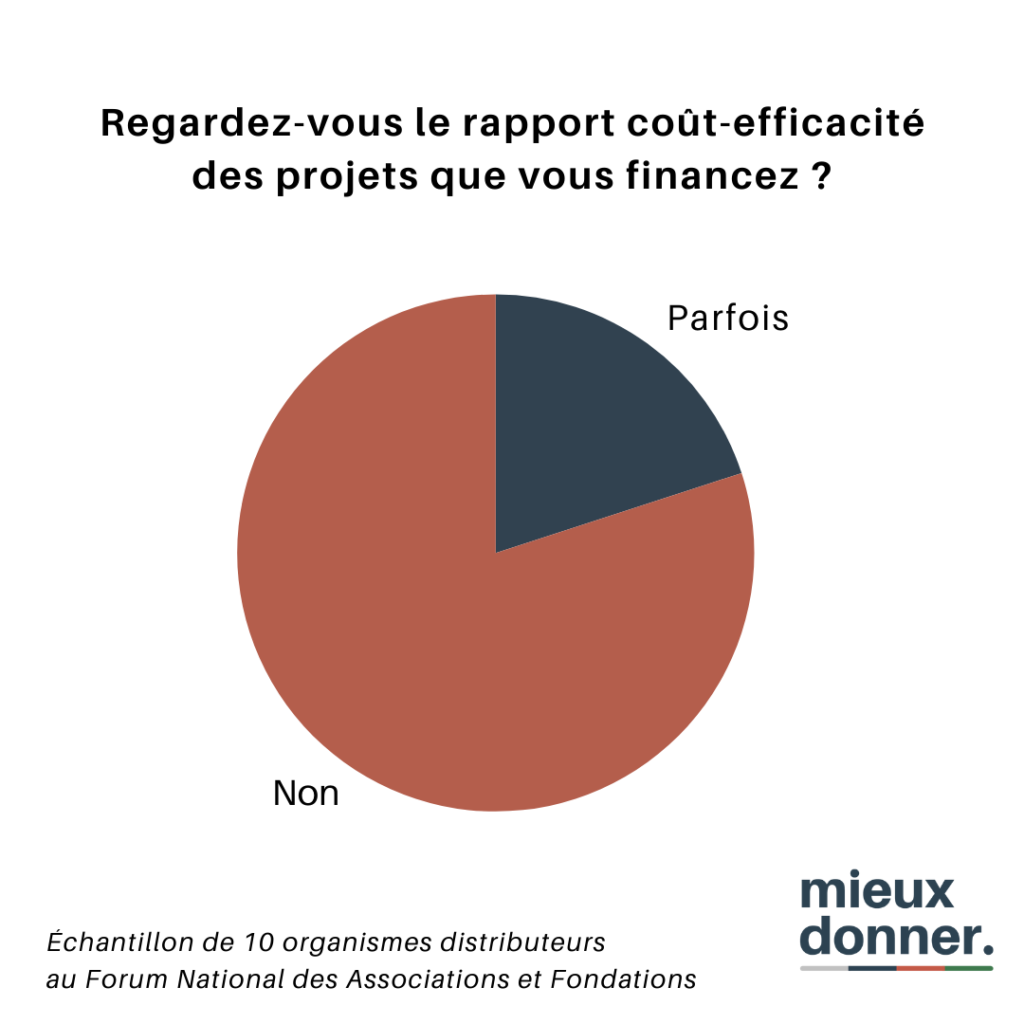
None of the organisations studied took into account the cost of their interventions in relation to the results obtained. Yet cost-effectiveness is an essential criterion for ensuring that every euro spent maximises the impact produced.
Consequences
Ignoring cost-effectiveness can lead to the funding of projects that, although potentially beneficial, are much more expensive than other solutions that are just as effective, or even more so. Without this analysis, we can end up building a wall with precious stones when bricks would be more than adequate.
3. Lack of knowledge of international organisations specialising in impact assessment
None of the people involved were familiar with international evaluation organisations such as GiveWell, which has been evaluating the impact and effectiveness of charities for over 15 years. Other players, such as the World Bank, use impact measurement tools such as DALYs and have been comparing the effectiveness of interventions on health and poverty in developing countries for over three decades, but the results of their report were completely unknown.
Consequences
The lack of knowledge about international best practice is robbing foundations of years of progress and expertise. The integration of proven tools derived from in-depth research could enable the sector to make significant advances in efficiency.
Recommandations
1. Structuring projects with a theory of change
Establish measurable objectives and precise strategies to ensure that funded projects have a solid and realistic action plan, maximising their potential for success.
2. Use scientific evaluation methodologies
Comparing the results with a baseline scenario or control group (ideally as part of randomised controlled trials) makes it possible to measure the real impact of an intervention.
3. Adopt standardised impact indicators
Incorporating indicators such as DALYs or equivalent years of schooling would enhance the comparability of funded projects and make it easier to assess their real impact.
4. Taking cost-effectiveness into account in funding decisions
Evaluate the cost of the results obtained to maximise the impact of each euro spent, giving priority to interventions offering the best cost-impact ratio.
5. Careful scrutiny of projects without concrete impact measurements
Be sceptical about projects that claim to have an “impact” without providing tangible evidence, to ensure that they have a real and quantifiable effect.
Answers to frequent criticisms
"We can't use the same unit to measure everything".
In cases where greater precision is required, it is entirely possible to introduce specific units, such as those used by GiveWell. These units take into account the preferences of beneficiaries in terms of concrete results, for example on issues of health, opportunities or increased income.
However, for the majority of shares, the existing units are sufficient to provide relevant information.
On issues of health, poverty, support for minorities, reduction of suffering or support for self-fulfilment, there are standardised units of measurement, in particular “WELBYs” (adjusted years of well-being), which effectively reflect the impact of these interventions on human well-being. Without aiming for perfection, the use of these units remains accessible and provides useful clarity for comparing and prioritising actions.
If you think you need to create a new measure, first check that it doesn’t already exist in a similar form. And if you do create one, be transparent and ready to accept constructive criticism to improve your model.
"Assessment takes time and resources".
Using existing methods, a pre-assessment is not time-consuming and already gives an idea of the feasibility and potential impact of a project. For example, Charity Entrepreneurship offers an initial assessment in ten minutes, with a few columns and scores based on relevant criteria, to get an order of magnitude. With a slightly more detailed spreadsheet, a pre-assessment can be refined in an hour or two, enabling decision-makers to better direct funding. Investing this time upstream is a simple way of avoiding high costs in the long term by ensuring that resources are used effectively.
"Some actions are not measurable".
While not everything can be precisely quantified, the effort of trying already provides additional rigour. Even if they are imperfect, standardised units of measurement enable us to make much more accurate and effective decisions, an observation widely supported by behavioural psychology and the work of Kahneman, winner of the Nobel Prize for economics. In complex areas, observation and analysis methods can provide valuable insights. For example, a French association promoting plant-based food has succeeded in evaluating and quantifying its impact, demonstrating that even seemingly intangible results can be assessed using a methodical approach.
Conclusion
The French philanthropic sector is at a crossroads. While international players are adopting practices based on effectiveness and rigorous evaluation, France is slow to adopt these approaches. Yet this transition is essential if we are to meet today’s challenges and maximise the impact of our funding.
At Mieux Donner, we believe that the future of philanthropy lies in tried and tested, transparent methods. We hope that these findings and recommendations will encourage French foundations to draw inspiration from best practice to amplify their contribution to sustainable social change.
About Mieux Donner
Mieux Donner is an association dedicated to identifying and promoting high-impact charities. It supports donors and organisations in their philanthropic efforts to maximise the effectiveness of their contributions.