The French Innovation Fund for Development: 4 years of concrete results for the effectiveness of development aid
At Mieux Donner, we share a strong conviction: the effectiveness of interventions is essential to creating a real and lasting impact in the fight against poverty and inequality. With this in mind, we took a moment to look at the recent activity report from the French Innovation Fund (Fonds d’Innovation pour le Développement FID) [1], which, like us, places rigorous evaluation and the use of evidence at the heart of its work.
The activity report from the Fonds d’Innovation pour le Développement (FID) highlights an innovative, evidence-based approach to amplifying the impact of international aid. Since its creation, the FID has worked to support projects that have demonstrated their effectiveness, particularly in areas such as health, education and the fight against poverty.
1. The FID: A structure serving social innovation and efficiency
1.1 History and mission of the FID
The Fonds d’Innovation pour le Développement (FID) was created in 2020 with the aim of supporting experimental approaches and evaluating their impact using rigorous scientific methods. Under the chairmanship of Esther Duflo, the IDF’s mission is to support projects that have demonstrated their concrete impact, particularly in crucial areas such as health, education and the fight against poverty. By focusing on innovative solutions and an approach based on scientific evidence, the IDF aims to amplify the impact of every euro invested and to help the most vulnerable populations in a sustainable and measurable way.
1.2 A structure designed for impact
The IDF is hosted by Agence Française de Développement (AFD) under a management agreement with the French ministries concerned, in particular the Ministry of Europe and Foreign Affairs (MEAE) and the Ministry of the Economy, Finance and Industrial and Digital Sovereignty. This hybrid structure enables it to benefit from AFD’s institutional framework while retaining independent governance.
This organisation stands out for its ability to combine funding, social innovation and rigorous evaluations in order to guarantee the impact of the funds allocated. By working closely with French ministries and benefiting from the support of AFD, the IDF embodies a modern and effective approach to development aid.
2. The vision and fundamental principles of the IDF
The IDF places rigorous project evaluation at the heart of its strategy, and this approach is aligned with the principles of Better Giving. We share the belief that interventions should be prioritised based on available data to help more. Just as the IDF is committed to funding initiatives with high impact potential, Mieux Donner strives to recommend the most effective organisations, in order to amplify the impact of donations and ensure lasting change for the most vulnerable populations.
2.1 A vision focused on rigorous assessments
One of the strengths of the IDF is its commitment to rigorous evaluation of the projects it supports. The report emphasises that each project is evaluated against precise, evidence-based criteria, ensuring that the investments made generate real change. This includes large-scale impact assessments and measures of return on investment, an aspect that is often lacking in traditional international aid interventions.
The IDF also emphasises the need to adopt an approach based on results, and not just on the resources committed. This method is essential to ensure that the funds allocated are not just used, but that they have a real impact on the beneficiaries, whether in terms of lives saved, schooling provided or improved health.
2.2 L’Innovation sociale et technologique au cœur des projets
The IDF report also mentions a number of innovative projects that have proved their worth, such as those financed in West Africa for the management of natural resources and public health. These initiatives use innovative technological solutions to maximise impact while reducing costs. For example, the IDF supports projects that combine the use of new technologies with interventions on the ground to ensure sustainable solutions.
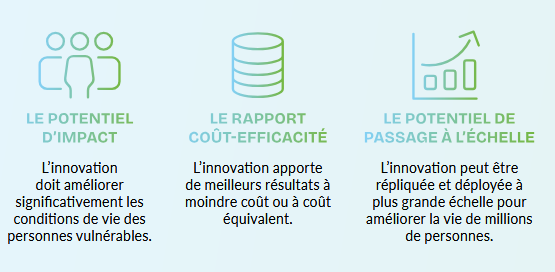
Projects are selected on the basis of their potential for innovation, their ability to be replicated in other contexts, and the effectiveness demonstrated in their implementation.
2.3 Measuring the impact
The report also highlights one of the major challenges facing international aid: the difficulty of measuring the real impact of projects on the ground. The IDF is striving to fill this gap by investing in high-performance evaluation tools. Thanks to partnerships with academic institutions and rating agencies, the FID is able to measure the impact of its investments not only in the short term, but also over the long term.
Selection criteria for FID Projects. From the 2021-2024 activity report
This approach allows us to better understand which projects are truly effective and to ensure that resources are allocated optimally. For example, in the health sector, projects such as the introduction of the R21 malaria vaccine are an example of success, with a cost per healthy life year much lower than other interventions in low-income countries. These low-cost, high-impact projects are a priority for the FID.
2.4 Clear stages of development
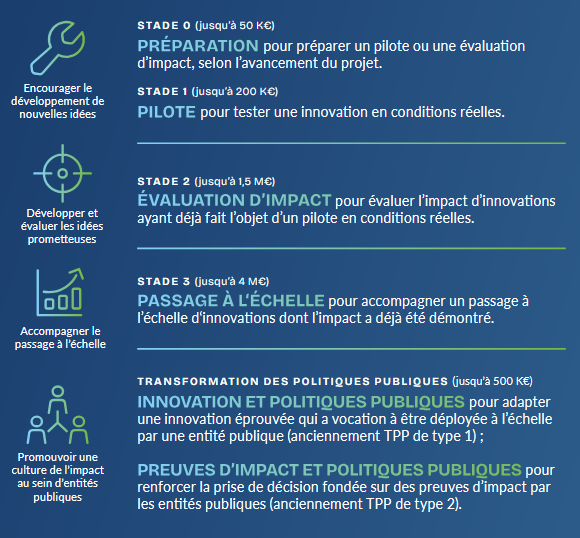
The report highlights one of the IDF’s strengths: its methodology, which is structured around a number of clear development stages to maximise the impact of the projects it funds. From the design phase onwards, the FID ensures that each initiative goes through a rigorous validation process, supported by evidence-based impact assessments. This multi-stage approach, from needs analysis to scaling up, ensures that projects are not only adapted to local realities, but also capable of producing sustainable results. Projects are selected on the basis of strict criteria, assessing their potential for innovation, their effectiveness and their ability to be integrated into long-term public policies.
Development stages of FID projects. From the 2021-2024 activity report
The IDF also adopts a dynamic and progressive approach to monitoring its projects. Each stage of development is accompanied by an evaluation phase, enabling actions to be adjusted in real time. This iterative approach ensures that projects are constantly fine-tuned to improve their performance and impact. For example, if a project does not achieve the expected results during the pilot phase, it is reassessed, adjusted or abandoned if necessary, allowing resources to be directed where they are most needed. This transparent and adaptable process is essential to guarantee the effectiveness of the funds invested and to optimise the results for the most vulnerable populations.
3. Review of the first 4 years of FID
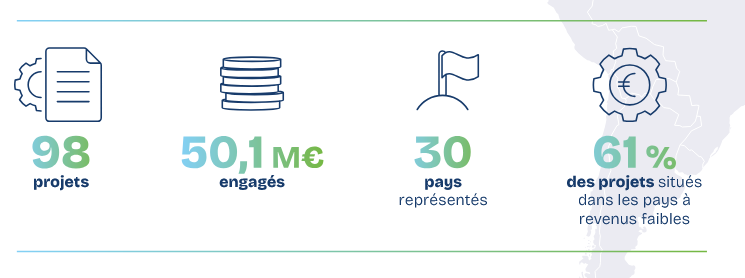
In the space of four years, the FID has supported nearly a hundred projects aimed at improving the living conditions of the most vulnerable populations in low-income countries. One of its main successes lies in its ability to demonstrate the real impact of initiatives through rigorous evaluation. The IDF has funded projects in a variety of sectors, including health, education and governance, and has enabled high-potential innovations to be deployed on a larger scale.
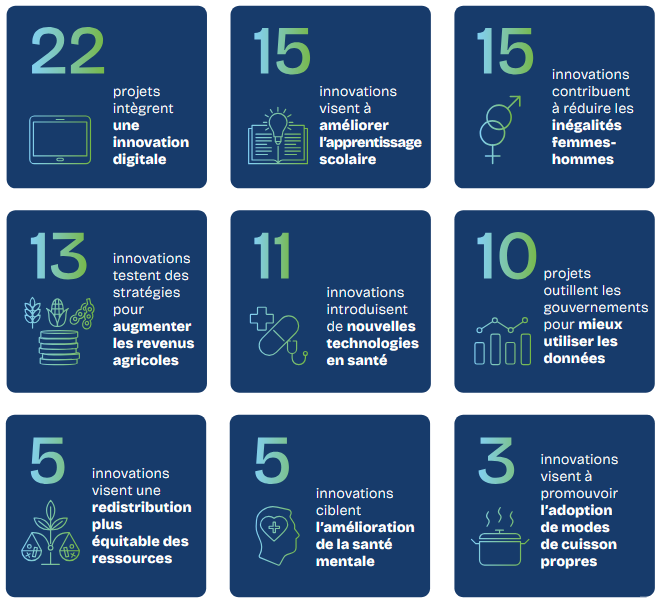
Image taken from the 2021-2024 Activity Report
More than 3,500 applications have been received since the fund was launched, and after applying their selection criteria only 98 projects have been selected, demonstrating a high level of prioritisation and a focus on the most promising interventions. The IDF has invested a total of €50.1 million, enabling projects such as the introduction of digital solutions for tax collection in Senegal or the improvement of school education in Côte d’Ivoire to achieve concrete results. These projects have not only shown significant short-term gains, but have also paved the way for a move to scale involving other donors and government partners.
An inspiring model for helping others effectively
The IDF report shows an organisation that stands out for its rigour and its commitment to financing projects whose impact can be measured and demonstrated. The implementation of innovative solutions, the search for efficiency in the use of resources and the commitment to rigorous evaluation are aspects that should become standards for development aid worldwide.
At a time when many challenges persist, such as health and climate crises, the IDF represents an approach that could serve as a model for other international aid funding organisations. By relying on evidence and results-based interventions, it is possible to make aid more effective, more targeted and more sustainable.
In our report on the effectiveness of French international aid, we already emphasised that increasing funding for the IDF was an excellent way of increasing the impact of official development assistance. This publication only confirms our enthusiasm for supporting the work of the IDF. At Mieux Donner, we help to direct funds towards highly effective associations, for both individual and collective generosity. We keep a close eye on initiatives such as the IDF, which enable us to find out which interventions work best. It is highly likely that we will be directing donations towards projects that have benefited from FID support to ensure a lasting impact.