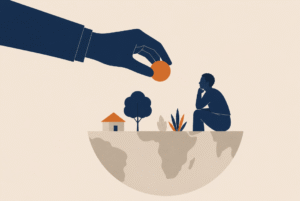
What if helping animals was among the most urgent causes?
Doing Good, Better: 5 Keys for More Effective Generosity
We often think that generosity is about intentions. What if it was also about results? This is the question William MacAskill poses in his book Doing Good, Better, dedicated to a movement still relatively unknown in France: effective altruism.
Its principle is simple: if we want to help, let’s do it where our impact is greatest. This involves going beyond the obvious, questioning our intuitions, and sometimes exploring neglected or counter-intuitive causes with high transformative potential.
This book challenges without guilt. It invites a step back, to measure the real effect of our donations, and to give not only with the heart but also discerningly.
We offer a series of 5 thematic summaries to discover the book’s ideas, illustrated with concrete examples, and better understand how they can change our way of acting.
What if the most lives we could alleviate today… weren’t human ?
The issue of animal welfare is often relegated to the background, perceived as a comfort topic for privileged societies. Yet in Doing Good, Better, William MacAskill shows that it is a massive and often invisible issue.
He reminds us that it’s also one of the areas where each euro given can have an immense impact, as suffering is widespread, underestimated, and relatively inexpensive to reduce. A cause both neglected, manageable, and with lasting effects—three key criteria of effective altruism.
Why focus on animal suffering?
Each week, more than a billion land animals are slaughtered for human consumption. Before this, most of them live in extremely difficult conditions: battery cages, mutilations, lack of care. These are billions of sentient individuals, trapped in a system of production that generates suffering on a very large scale.
Simple interventions can have immense effects, whether by reducing the consumption of animal products, improving farming standards, or supporting alternatives, it is possible to prevent much suffering at a low cost.
Yet, this cause remains extremely neglected. Less than 1% of global philanthropy is dedicated to it. Even more so in developing countries, where the issues are still massive.
What "Doing Good, Better" says on the subject
MacAskill proposes a profound change in moral perspective. He shows that our ethical intuitions are often biased by proximity, appearance, and habit. Yet, nothing justifies rationally that the suffering of an animal is considered less serious than that of a human, if it is comparable in intensity.
He also notes that certain interventions can be incredibly effective: campaigns for dolphin protection have already improved animal conditions in Europe and the U.S. Organizations evaluated by Animal Charity Evaluators (ACE) can sometimes improve the lives of hundreds of animals for every euro given.
The effective altruism movement proposes not to rank causes but to expand our moral circle. Including animals in our ethical choices, as we did in history with other previously excluded groups from moral consideration.
What actions have the most impact?
1. Advocacy for Animal Welfare
Advocacy for animal welfare is a powerful efficiency lever. Corporate reforms, pressure on supply practices, and campaigns for stricter legal standards are yielding tangible results, especially in Europe and North America.
3. Informing and Educating
Finally, information and education remain essential. Well-designed campaigns can change behaviors, reduce animal product consumption, and generate lasting demand effects.
How to Make a High-Impact Donation in This Area?
On animal welfare, William MacAskill recommends relying on independent evaluations to assess the true capacity of actions to reduce large-scale suffering.
Internationally, organizations like Animal Charity Evaluators identify the most effective associations each year, based on rigorous criteria of impact, transparency, and cost-effectiveness. This includes, for example, The Good Food Institute, The Humane League, and Faunalytics.
In France, Mieux Donner shares these evaluations, enabling everyone to support these high-impact initiatives confidently.
MacAskill suggests integrating animal welfare into your “impact portfolio.” It’s not about opposing species but considering avoidable suffering wherever it can be effectively reduced.
And as always, he advocates for clarity: not all actions for animals are equal. Some are poorly documented or ineffective. The key is to rely on available data and make informed contributions.
What This Says About Us
Choosing to help animals is not about being overly sensitive. It’s recognizing an ethical blind spot, a massive and often invisible injustice. Accepting that our generosity can go to those who cannot ask, but suffer greatly.
Animal suffering is a vast avoidable injustice. Well-targeted donations can save or improve millions of lives. It’s not enough to have a good heart; we must use it wisely.
What if your next donation changed the lives of 1,000 animals?