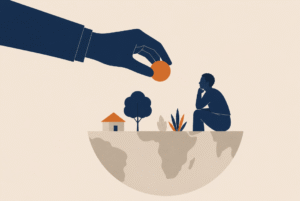
What if the most useful donation also concerned individuals who are not yet born?
Doing Good, Better: 5 Keys for More Effective Generosity
We often think generosity plays out at the level of intentions. What if it also played out at the level of results? This is the question William MacAskill poses in his book Doing Good, Better, dedicated to a still relatively unknown movement in France: effective altruism.
Its principle is simple: if we want to help, let’s help where our impact is the greatest. This means going beyond the obvious, questioning our intuitions, and sometimes exploring neglected or counter-intuitive causes with high transformative potential.
This book challenges without guilt. It invites us to take a step back, measure the real effect of our donations, and give not just with the heart, but discerningly.
We offer you a series of 5 thematic summaries to discover the ideas in the book, illustrated with concrete examples, and better understand how they can change our way of acting.
What if the most useful donation today was not just about the people we see, but those who might be here tomorrow?
We have all faced unforeseen risks: global pandemic, climate disasters, political instability.
What if part of our generosity was precisely to prevent tomorrow’s catastrophes? In Doing Good, Better, William MacAskill advocates for a broader philanthropy, concerned not only with immediate needs but also with the future, sometimes distant.
Future Generations: The Blind Spot of Our Generosity
MacAskill invites us to consider future generations in our moral compass. Not just in place of current lives, but in addition. This is what he calls long-term ethics: thinking not by the millions, but by billions of individuals who might exist tomorrow, and for whom we have an indirect responsibility today.
Certain global threats are well-known: pandemics, technological advances, systemic collapses, large-scale famines, or even loss of control over AI advancements. They all have one thing in common: they are often visible but underfunded, yet their destructive potential is immense.
This creates a paradoxical opportunity: because these causes are neglected, actions in their favor can have a disproportionate effect. One can help finance preventive research, support an organization alerting decision-makers, or reinforce the resilience of critical systems.
What "Doing Good, Better" says about these issues
MacAskill not only advocates for short-term aid; he integrates concepts of long-term impact, sustainability, and prevention into his approach. According to him, we must learn to think of time as an ethical dimension in its own right. It’s no less urgent, just less visible.
He addresses so-called “existential” risks, those that might threaten human survival or drastically reduce future potential. This is not science fiction but a serious analysis category supported by academic work.
This doesn’t mean abandoning today’s urgencies. Rather, it means complementing our actions with those oriented towards the future. For example, funding an organization working on AI security or pandemic prevention can be just as pertinent as helping a humanitarian NGO.
Concrete actions: giving for the future
Among high-impact potential actions, MacAskill cites:
- Supporting organizations focused on reducing existential risks (e.g., among the associations recommended by Mieux Donner as relevant for contributing to the future’s preservation).
- Research on biosecurity, artificial intelligence governance, or setting up global coordination mechanisms.
- Advocacy for public policies oriented towards resilience, notably in climate, agriculture, or cybersecurity.
He also emphasizes the importance of interconnected thinking: strengthening global health today also enhances our ability to withstand tomorrow’s pandemics. Acting for the climate means preserving the conditions for a sustainable human future.
How-to guide for "future"-oriented giving
MacAskill suggests a useful discernment grid: does my donation help significantly, is the cause neglected, and is it viable? In long-term risk cases, the answer is often three times “yes.”
He recommends allocating part of your philanthropic budget to these themes. It’s also essential to ensure that chosen organizations publish data, follow rigorous methods, and accept uncertainty without renouncing.
Yes, patience is needed. Some effects won’t be measurable until 20, 50 years later or beyond our lifetime. But that doesn’t make them any less essential.
Why it's difficult, but why it’s worth it
Long-term thinking demands an unusual cognitive effort. The level of uncertainty is much higher. You must project, abstract from the present, imagine the invisible. Yet, it’s also a rare and powerful form of solidarity: donating for lives not yet born.
MacAskill calls this the ethics of temporal generosity. Not as an abstract duty, but as a lucid and courageous way to expand our impact.
Preserving the future is expanding your moral horizon. It’s acting where few do, with immense potential impact.
“Thinking of those not yet present might be the greatest gift we can offer.”
What if your next donation wasn’t just for today… but for a future you can influence now?