
Earthquakes, wars, famines, humanitarian disasters: rethinking our donations to save more lives
Emilie Combres
Communications Officer
Reading time: 10 minutes
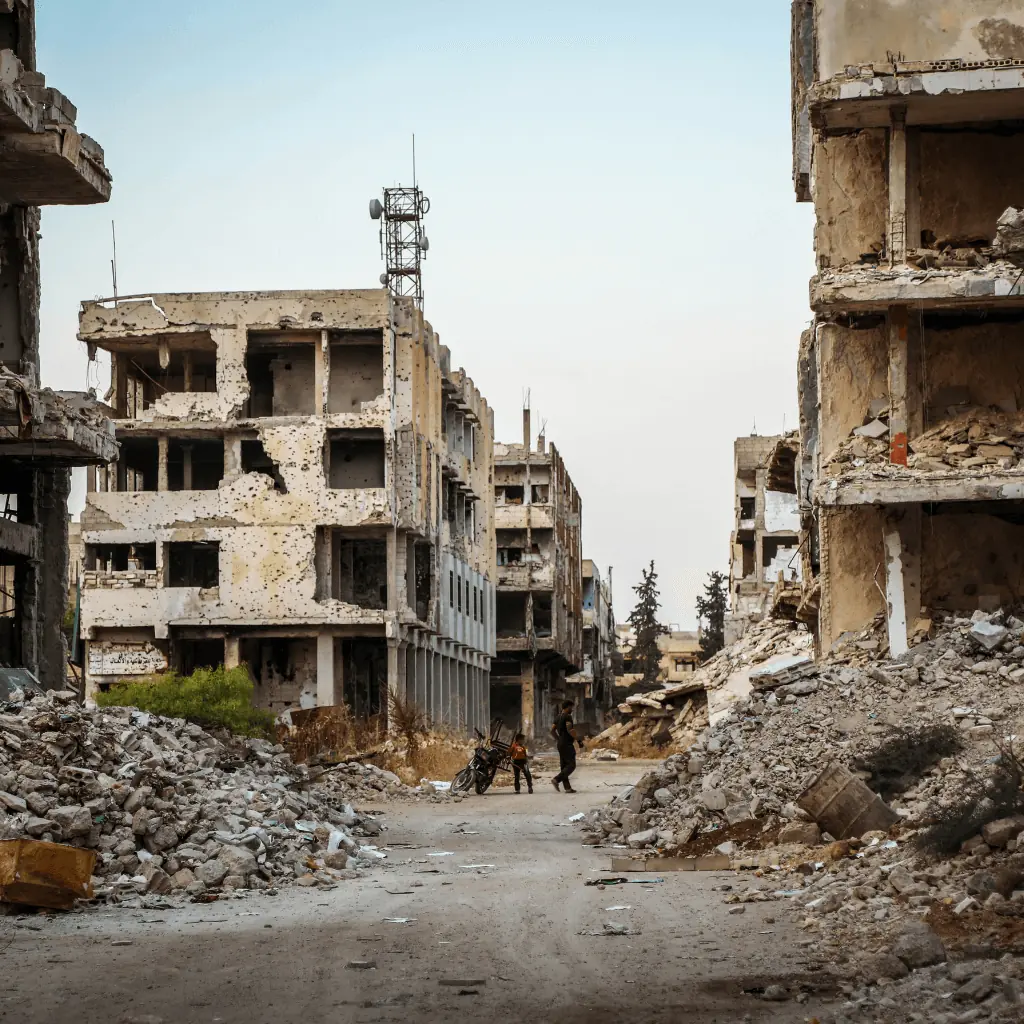
Earthquakes, floods, famines, wars: every new humanitarian disaster triggers a wave of emotion and, often, an immediate outpouring of solidarity. The images broadcast in the media shock, move, and mobilise us—and very often, they prompt action, notably in the form of donations.
Humanitarian emergencies—such as the earthquakes in Turkey and Morocco, Cyclone Chido in Mayotte, or conflicts in Ukraine or Gaza—generate substantial giving. According to a study by the National Institute for Youth and Popular Education, more than one-third of French people report having donated in response to an emergency.[1] In fact, such situations often spark someone’s very first donation.
But what happens when the initial emotion fades? Do these donations really make a difference? And if the goal is to save the most lives or to alleviate human suffering, are they the most effective lever? This article aims to answer those questions using an impact-driven perspective.
What the numbers tell us about humanitarian disasters
Humanitarian disasters have many different causes: some are natural (earthquakes, floods, cyclones, droughts), while others are man-made (armed conflicts, forced displacements, induced famines). Quantitatively, their scope is impressive: according to the EM-DAT (Emergency Events Database), more than 7,000 major disasters were recorded worldwide between 2000 and 2023. Together, they affected over 4 billion people and caused about 1.2 million deaths.[2]
However, these aggregate numbers hide a great diversity of situations. An earthquake like Haiti’s in 2010 killed more than 200,000 people in just a few hours, while a prolonged drought in East Africa might affect millions over several years, undermining harvests, nutrition, health, and social stability. The impacts are thus highly variable and often difficult to anticipate.
It’s also important to put these figures in perspective. For example, malaria kills about 600,000 people every year—mainly children under five in sub-Saharan Africa, according to the World Health Organisation (WHO). This happens year after year, without interruption. Yet the resources allocated to fighting malaria remain much lower than the sums mobilised after a major, media-covered disaster.
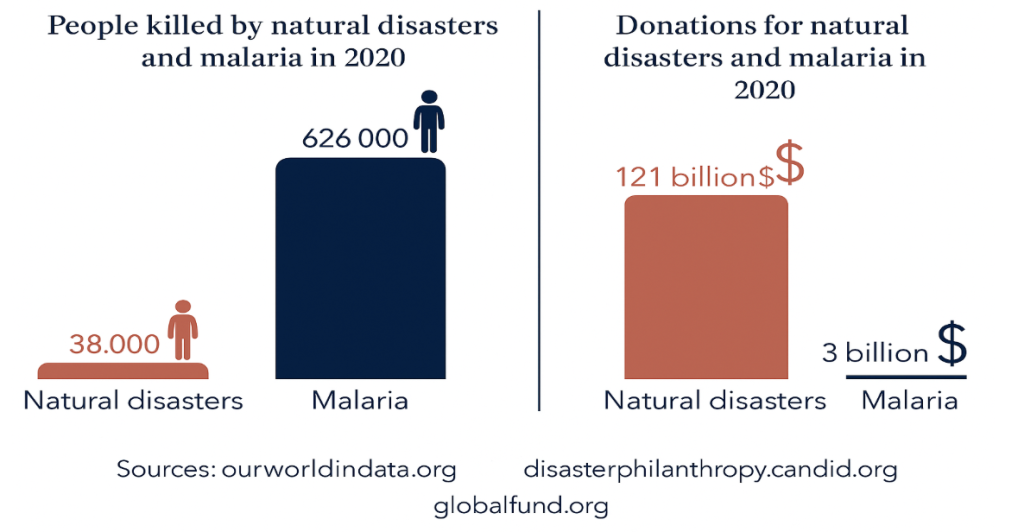
In 2010, the American Red Cross collected nearly $500 million for Haiti in just a few weeks.[3] For comparison, the annual budget of the Against Malaria Foundation—a leading malaria charity—was under $90 million in 2024. This asymmetry shows that some massive, preventable causes still struggle to attract support, while others concentrate donations, sometimes far beyond what is useful.
This trend is all the more concerning because natural disasters are set to become more frequent and severe as climate change advances. The IPCC, in its latest reports, warns of the increasing frequency of extreme events: heat waves, floods, cyclones, and persistent droughts—all shocks that will threaten millions. Faced with this, acting upstream—on the root causes rather than the immediate consequences—is not only more effective but also fairer.
What is an effective donation? And why is this not always the case in emergency situations?
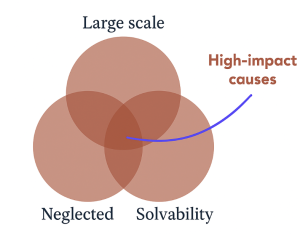
To better guide giving, Mieux Donner relies on three assessment criteria, based largely on the work of GiveWell and other independent evaluators. These criteria are
- The Scale of the Problem. This means estimating how many people are affected, to what extent their lives or health are at risk, and how frequent the problem is. In humanitarian emergencies, the immediate intensity is often high. Still, some highly publicised disasters may impact fewer people than an endemic disease that is less visible but more deadly.
- The Neglectedness of the Cause. An intervention is all the more valuable when it targets an area or problem with few other actors present. Yet humanitarian disasters are rarely neglected: they often benefit from massive attention from governments, media, and NGOs. This means that an individual donation, in this context, is unlikely to unlock help that would not have arrived otherwise.
- The Potential for Improvement. The more effective a donation, the more it can change things—even on a small scale. This requires proven, low-cost interventions with clear impact. On this count, humanitarian disasters are tricky to evaluate. Emergency aid is essential to save lives in the first hours after a crisis, but much giving is sometimes wasted due to poor coordination, restricted access to affected areas, or a lack of tested and standardised solutions.
These limits are even more problematic because funds mobilised in emergencies often come at the expense of long-term, structural causes—such as healthcare prevention, climate resilience, or poverty reduction—that could prevent these disasters or reduce their toll.
Telling examples: the cases of Haiti and Iran
The case of the 2010 Haiti earthquake remains sadly famous. After the disaster, the American Red Cross raised nearly $500 million to help victims. But an investigation by the Washington Post and NPR found that the organisation ultimately built only six permanent homes.[4] Millions were lost to administrative overhead, ineffective partnerships, or projects poorly matched to local needs. The result: disillusionment—for both donors and recipients.
The 2003 Bam earthquake in Iran offers another lesson. The quake killed at least 26,000 people and destroyed most of the city.[5] International aid arrived swiftly, investing about $10.5 million to set up some ten mobile clinics.
But according to a 2006 World Bank report[6], those clinics arrived two to five days after the quake, after the last wounded people had already been evacuated to other provinces. Most notably, the cost of these clinics equalled the estimated cost of rebuilding all the region’s primary and secondary healthcare facilities and schools. In other words, for the same money, a durable health system could have been rebuilt—rather than paying for a temporary and largely useless solution.
The report draws a clear conclusion: relief operations in contexts like these are often among the least cost-effective interventions. Other examples—such as the 2004 tsunami in Indonesia—show that aid sometimes continues to arrive after local communities have already shifted to reconstruction.
The Mieux Donner position: addressing structural causes
In light of all this, Mieux Donner chooses to recommend organisations that deliver not only strong impact but also proven, lasting, and often underfunded results. The point is not to say never to give in a disaster, but to remind us that, if the goal is to save as many lives as possible, other strategies are often more effective.
We specifically recommend three organisations in the fields of health and poverty prevention:
- Against Malaria Foundation, which distributes insecticide-treated bed nets in areas hit hardest by malaria. Each net costs about €2 and saves a life for every €3,000–5,000 invested.
- Helen Keller International, which runs vitamin A supplementation campaigns—a simple, low-cost intervention that drastically reduces child mortality in many poor countries.
- New Incentives, which provides small cash incentives to Nigerian families for vaccinating their children, thus increasing immunisation rates in high-risk regions.
Additionally, we support two organisations working on deep, long-term root causes of human suffering:
- Clean Air Task Force, which campaigns for ambitious policies to cut air pollutants and greenhouse gases, with major benefits for global health.
- The Preservers of the Future Fund, which supports long-term projects in climate, biodiversity, or future pandemics to mitigate major global risks.
These organisations are selected using rigorous criteria and have demonstrated, with supporting studies, that their impact far exceeds that of most emergency initiatives, euro for euro. Most importantly, they help anticipate, limit, or even prevent future humanitarian disasters.
The emotion stirred by humanitarian disasters is entirely legitimate. As climate change increases the frequency and severity of these catastrophes, the challenge is enormous. But we hold a powerful lever: acting proactively on structural causes to prevent such tragedies from happening or recurring. In other words, instead of patching up emergencies, let’s invest in prevention.
This does not mean “never” give when disaster strikes. But for donors who want to save lives—durably and effectively—there are often more powerful, if less visible, alternatives that make a decisive difference.
Notes and references
[1] https://injep.fr/tableau_bord/les-chiffres-cles-de-la-vie-associative-2023-dons-aux-associations/↩︎
[2] https://fr.scribd.com/document/673300804/CRED-Disaster-Report-Human-Cost2000-2019 ↩︎
[3] https://www.npr.org/2015/06/03/411524156/in-search-of-the-red-cross-500-million-in-haiti-relief ↩︎
[4] https://www.npr.org/2015/06/03/411524156/in-search-of-the-red-cross-500-million-in-haiti-relief ↩︎
[5] http://news.bbc.co.uk/2/hi/middle_east/3579173.stm ↩︎
[6] rapport mentionné par Effektiv Spenden https://effektiv-spenden.org/blog/eine-kritische-betrachtung-der-katastrophenhilfe/ ↩︎
Tags : English Article