
Donations to Gaza and Palestine: between urgency, obstacles and real impact

Emilie Combres
Communication officer
Reading time : 15 minutes
Since Hamas’s attack on October 7, 2023, and Israel’s military response, the Gaza Strip has been plunged into a humanitarian crisis of exceptional severity. Entire neighbourhoods have been destroyed; access to food and water is nearly impossible; hospitals are collapsing under bombardment; and more than 85% of the population has been displaced. Month after month, the images loop on screens: mothers weeping amid ruins, wounded children, and long lines for a bit of flour or a litre of water.
Faced with this flood of suffering, many feel powerless. And as so often in these crises, the first, instinctive response is to give. Donation drives surge, crowdfunding campaigns multiply, and NGOs intensify their appeals. Yet questions that are less often voiced linger: Where does this money go? Does it truly have an effect? Is its impact more symbolic or political? Are there other ways to genuinely help?
An unprecedented humanitarian situation
Since October 7, 2023, fighting has caused over 57,000 deaths and nearly 134,000 injuries in the Gaza Strip, according to the latest United Nations estimates.[1] The victims are mostly civilians, including very large numbers of children. Bombardments have levelled entire city districts, and vital infrastructure—hospitals, water networks, schools—is largely out of service.
Since November 2023, several ceasefire attempts have been made, without lasting success. In March 2024, fighting intensified in the south, especially around Rafah. Still, according to the UN, nearly two million people have been displaced inside Gaza, often in dreadful sanitary conditions, without adequate shelter, and with extremely limited access to water, food, or medical care.
The World Bank estimates that 83% of Gaza’s economy contracted in 2024[2], with damages to critical infrastructure totalling $18.5 billion[3]. In some areas, no functional buildings remain. More than two million people face food insecurity in conditions that several international reports describe as bordering on famine.[4]
The UN estimates that 3.3 million people (Gaza and the West Bank combined) need urgent humanitarian assistance. Field reports describe scenes of acute shortages: long queues for a little flour, overcrowded and under-supplied hospitals, and children suffering from acute malnutrition. The International Crisis Group, in a June 2025 report, even refers to the instrumentalisation of hunger as a weapon of war.[5]
What can donations for Gaza achieve?
In this context, humanitarian aid goes far beyond food. It covers a wide array of urgent needs: access to clean water is critical, as are emergency healthcare, paediatric care, vaccination campaigns, and psychological support for a traumatised population. Reconstruction needs also abound: temporary housing, school repairs, restoration of sanitation networks, and more.
Donations also help keep the remaining active services afloat: training and salaries for medical and logistics teams, fuel for generators, and funding for centres supporting displaced people. Between March and April 2025, for example, UNRWA distributed 270,000 sacks of flour—reaching over 700,000 people, despite extreme constraints. Its teams also provided over 1.2 million medical consultations between March and June 2025[6], in an environment where only a third of medical facilities are at least partially functional.[7]
Another, less publicised reality: many crowdfunding campaigns today are used not for survival in Gaza, but to flee. Families attempt to raise sums from a few hundred to several thousand euros for visas, medical evacuations, or to support relatives who have already left. These fundraisers, often shared via social media, reflect another form of emergency: escape.
Extraordinary generosity, but insufficient given global needs
The Gaza crisis has sparked enormous generosity. On online donation platforms, Gaza has become one of the most supported causes since late 2023. Still, there is no precise public data on the amount donated from France specifically for Gaza. Major NGOs mention significant mobilisation, but it was concentrated mostly between October and December 2023. This generosity has thus been substantial but short-lived and rarely sustained.
At the European level, the EU and its member states mobilised €1.56 billion for the Palestinian territories between 2023 and 2024, according to the EU Council[8]. Meanwhile, the UN estimates that $6.6 billion is needed to meet the basic humanitarian needs of 3.3 million people in Gaza and the West Bank in 2025.[9]
Yet these figures should not obscure a broader reality: global aid is declining. The OECD recorded a 7.1% drop in official development assistance in 2024. France, for its part, reduced funding by €2.3 billion, dropping to 5th among world donors.[10]
Other catastrophes—sometimes as devastating, even more deadly—play out in the “shadows” of the media: the civil war in Sudan, spirals of violence in the Democratic Republic of Congo, malaria that still kills half a million children every year… All reflect massive, often competing, and equally urgent needs.
In 2024, the Global Humanitarian Overview estimated $49 billion needed for 186.6 million aid recipients (out of 311.1 million people in need) across 73 countries. Gazans make up about 1.5% of the beneficiaries, yet receive about 7% of global humanitarian needs in funding.[11]
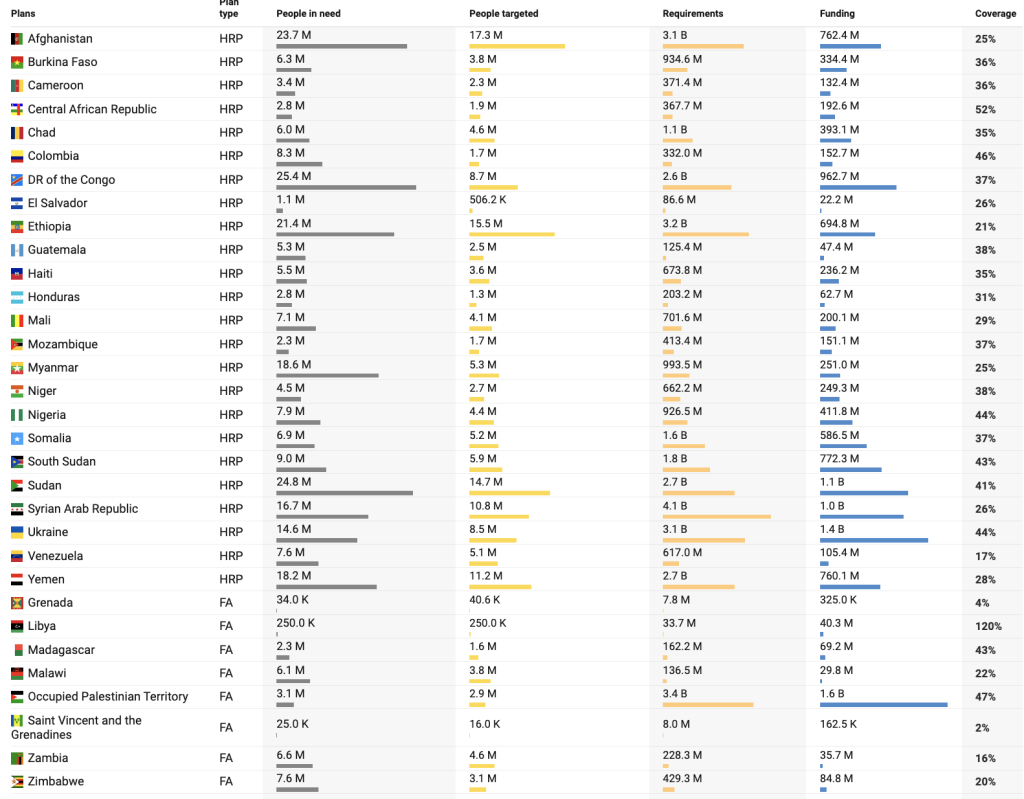
A corresponding table breaks down, for each crisis country in 2024, the number of people in need of humanitarian aid (“people in need”), the number targeted for assistance (“people targeted”), the funds required (“requirements”), the current funding available (as of August 2024, “fundings”), and the percent covered (“coverage”).
The aim of this overview is not to compare the value of human lives but to put needs into perspective, compare scales, and inform our engagement more consciously. Rather than being paralyzed by the scale of tragedy, we can use these figures to:
- Direct our donations to crises where they can have the greatest impact, and to specialized organizations (for example, those focused on maternal health in Sudan, or malaria prevention)
- Support advocacy efforts to remove logistical and political obstacles (such as opening border crossings for Gaza)
- Maintain global solidarity—including for less publicized crises
When donations don’t arrive
Despite generosity, many obstacles prevent humanitarian aid from reaching Gaza. Since March 2025, according to the British Red Cross, no full humanitarian convoy has entered the enclave[12]. Border crossings are tightly controlled, authorisations are arbitrary, and convoys are frequently blocked or delayed. The UN reports that the number of meals distributed fell by 80% between April and late June 2025.[13]
The “Gaza Humanitarian Foundation” platform, set up by Israel with US support, has been condemned for its lack of transparency and effectiveness by more than 170 NGOs[14]. Centralisation around a few distribution hubs triggered crowd surges, causing over 500 civilian deaths, according to Reuters. The Israeli military has acknowledged that Palestinian civilians have been injured at these distributions under military supervision, with no solution found yet.
Aid thus becomes a weapon, or at least a bargaining chip. NGOs on the ground describe an unprecedented situation—donations exist but cannot always become concrete relief. In this context, giving does not guarantee that aid will arrive. But this does not mean we should do nothing. Instead, it calls for carefully choosing channels, understanding current limitations, and exploring other forms of support.
At Mieux Donner, our mission is to help everyone increase the impact of their donations. This means directing donations to places where today, they can save or improve the most lives per euro given. We rely on three criteria: the scale of the need, its neglected status, and the capacity to deliver effective relief.
The Gaza crisis rightly stirs great mobilisation: suffering is extreme and immense. But from a broader perspective, it constitutes only a part of global humanitarian demand. Other crises, sometimes less visible, affect more people, receive less support, and sometimes offer more effective intervention leverage. Further, under current conditions (aid blockades, strict military control, hugely limited humanitarian access), it is difficult to guarantee effective resource use and thus achieve concrete, measurable impact. That is why, at present, we do not actively recommend targeted donations for Gaza, though we understand and respect the solidarity it inspires. This does not mean donations there are useless, but their effectiveness is uncertain and their impact limited by major logistical and political barriers.
Faced with this situation, it is legitimate to ask
do we give to help or to feel less powerless? The intention is honourable. But with overwhelming needs, fragile delivery channels, and explosive political circumstances, it’s hard to know whether every euro donated will save a life or stall at the border.
This does not mean doing nothing. Instead, it means asking the right questions: Who am I giving to? For what purpose? Is this altruism, symbolism, or politics? Are there alternative or complementary ways to support, beyond emergency aid? There is no simple answer. But by better understanding the realities, we can make more informed choices—and truly help.
Notes and references
- OCHA – Humanitarian Situation Update – 30 juillet 2025 ↩︎
- UN & Banque mondiale – Rapid Damage and Needs Assessment (février 2025) ↩︎
- Banque mondiale – Dommages aux infrastructures à Gaza (avril 2024) ↩︎
- Crisis Group – The Gaza Starvation Experiment ↩︎
- UNRWA – Situation Report 178 ↩︎
- OCHA – Humanitarian Response Update (21 juin 2025) ↩︎
- Union européenne – Soutien humanitaire aux Palestiniens ↩︎
- OCHA – Flash Appeal oPt 2025 ↩︎
- OCDE – Aide publique au développement (APD) ↩︎
- Focus2030 – France et engagements d’APD ↩︎
- OCHA – Global Humanitarian Overview – août 2024 ↩︎
- Crisis Group – The Gaza Starvation Experiment (duplicata) ↩︎
- OCHA – Flash Appeal oPt 2025 (duplicata) ↩︎
- OCHA – Global Humanitarian Overview (duplicata) ↩︎
Tags : English Article