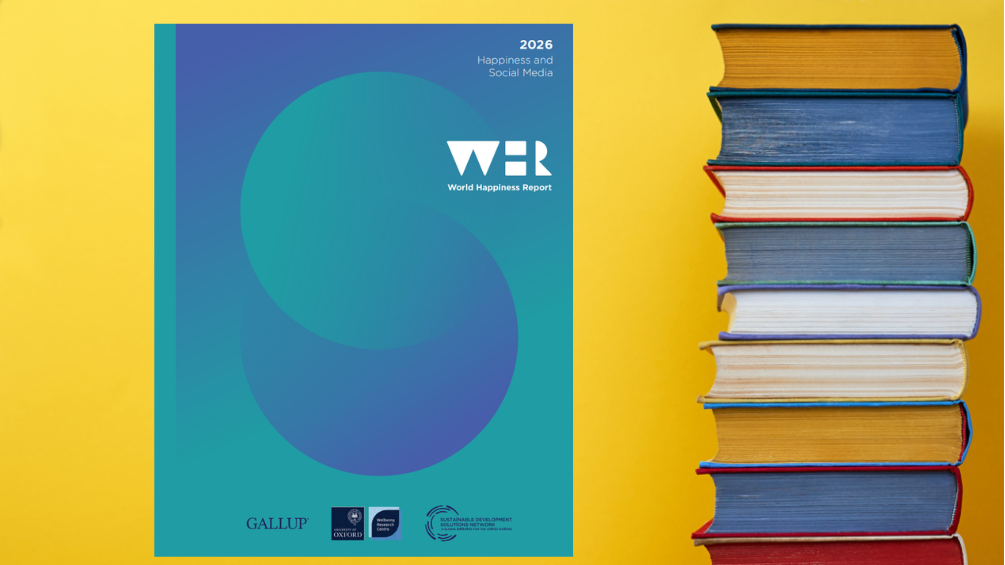
The happiest countries and findings from the World Happiness Report 2026
Finland, Iceland, Denmark lead the 2026 ranking. Full list of 147 countries, key findings on social media and wellbeing, and how your donations create happiness.
Founder and Director of Mieux Donner
Reading time: 25 min.
Ranking of 147 countries by self-reported life satisfaction. Score from 0 to 10, average 2023–2025.
| Rank | Country | Score |
|---|
Data: World Happiness Report 2026, Gallup World Poll (2023–2025).
This thematic edition focuses on the relationship between social media and wellbeing. It covers 147 countries, draws on the Gallup World Poll 2023–2025, and mobilises 9 independent research teams.
Countries analysed
147
Global life satisfaction ranking, 0–10 scale, 3-year average (2023–2025)
Countries gaining vs losing
79 / 41
79 countries have improved significantly since 2006–2010. 41 have declined. The world overall is happier, but the West is falling behind.
Gap: 1st vs last
6.3 pts
Between 1st place (7.764) and last (1.446): a chasm that illustrates the devastating impact of conflict on perceived wellbeing.
Top 6 happiest countries in 2026
2026 theme: social media and wellbeing 9 chapters
7 independent lines of evidence (Haidt & Rausch, ch. 3) collectively show that major social media platforms are causing substantial harm to adolescent mental health at a scale large enough to explain population-level trends.
In North America, Australia and New Zealand, under-25s rank between 122nd and 133rd out of 136 countries for wellbeing change since 2010 — the sharpest youth decline observed globally.
Among girls, life satisfaction declines with each additional hour on social media (PISA, 270,000 15-year-olds across 47 countries). Among boys, this pattern is most visible in Western Europe.
Not all platforms are equal. Tools that facilitate direct communication are linked to higher wellbeing. Algorithmically curated feeds and influencer content are linked to lower wellbeing.
Outside the English-speaking world and Western Europe, links between social media and wellbeing are more nuanced, and even positive in some contexts (Middle East, Latin America).
School belonging has an effect 4 to 6 times larger on girls' life satisfaction than reducing social media use, according to PISA data — pointing to where interventions may have the greatest leverage.
Socioeconomic inequalities amplify negative effects. The link between problematic social media use and poor wellbeing is stronger among adolescents from disadvantaged backgrounds (43 countries, ch. 7).
Negative emotions are rising across all world regions. Positive emotions remain twice as frequent — except among youth in English-speaking countries, where that gap has narrowed significantly.
"The relationship between social media and happiness is contingent upon both platform design and the broader cultural and social context in which social media use takes place."
Chapter 2 — World Happiness Report 2026
Central and Eastern Europe
+1 pt
Most countries that have gained more than one point since 2006–2010 are in Central and Eastern Europe, reflecting a convergence in European happiness levels underway for over a decade.
Countries declining
8 countries
8 countries have lost more than one point. Most are in or near zones of major armed conflict. 15 Western industrialised nations have also seen significant declines.
Not exactly. The report is published by the University of Oxford’s Wellbeing Research Centre, in partnership with Gallup and the UN Sustainable Development Solutions Network. So it can, approximately, be linked to the UN ecosystem. However, it is not an official report expressing the position of the United Nations.
John F. Helliwell, Lara B. Aknin, Haifang Huang, Mariano Rojas, Shun Wang, Vicente Guerra, Adam Danyluk — Universities of British Columbia, Simon Fraser, Alberta, Oxford and Xi'an Jiaotong-Liverpool
How the ranking is calculated
The question
Respondents are asked to imagine a ladder: 0 represents the worst possible life for them, 10 the best possible life. They indicate where they currently stand. This is the Cantril Ladder, the single question at the heart of the entire ranking.
The sample
Typically, around 1,000 responses are gathered annually for each country via the Gallup World Poll. Survey weights are applied to construct nationally representative averages.
The score
Each country's score is the average of those responses over three years (2023–2025). The three-year window increases the precision of the estimates. That average is the only number used to rank countries.
Why "happiness" and why life evaluation rather than emotions?
Why call it happiness?
"Happiness has been a central word in descriptions of a good life since ancient times." The WHR follows that tradition: "happiness" refers to how people evaluate the quality of their lives, not just their moment-to-moment feelings. Respondents give different answers depending on whether the question is about life as a whole or about feelings right now.
Why life evaluation, not emotions?
There are two ways to measure happiness: as an emotion (am I feeling good right now?) and as a judgment (how satisfied am I with my life?). The WHR uses life evaluation because it is more stable and better captures life circumstances as a whole. Positive emotions — laughter, enjoyment, learning — are separately tracked but not used in the ranking. The report notes that positive emotions remain twice as frequent as negative ones, globally.
The six factors: tools for explanation, not calculation
These six variables are used to statistically explain why some countries score higher than others. They do not enter the ranking. As the report puts it: "We much prefer to let the judgements of individual respondents rule the rankings."
GDP per capita
Log scale, PPP-adjusted (World Bank)
Social support
"Do you have someone to count on in trouble?"
Healthy life expectancy
WHO data, extrapolated to 2025
Freedom of choice
"Are you satisfied with your freedom to choose?"
Generosity
"Have you donated money in the past month?"
Perceptions of corruption
Perceived corruption in government and business
"Our happiness rankings are not based on any value of these six factors. Rather, rankings are based on individuals' assessments of their own lives, in particular their answers to the single-item Cantril Ladder life evaluation question."
World Happiness Report 2026, Chapter 2
Finland leads, alone. Finland holds the top spot with a score of 7.764, ahead of a group of three: Iceland, Denmark, and Costa Rica (ranks 2–4 with overlapping confidence intervals). Sweden and Norway complete the top six, followed by the Netherlands, Israel, Luxembourg, and Switzerland.
Costa Rica reaches 4th, an all-time record for Latin America. Costa Rica's rise to 4th marks the highest ever ranking for a Latin American country. This year's top 20 also includes Mexico at 12th. This is consistent with a pattern the WHR has documented: some countries achieve high happiness at a fraction of the cost of others, a chapter of the WHR 2025 on the subject.
No English-speaking country in the top 10 for the first time. In 2013, all top ten countries were western industrial nations. Now only eight are. Canada fell from 6th in 2013 to 25th in 2026. Australia fell from 10th to 15th. The industrial countries pushed out of the top ten between 2013 and 2026 include Canada, Austria, and Australia.
NANZ — US, Canada, Australia, New Zealand
-0.82
points lost for under-25s since 2006–2010. The four NANZ countries rank between 122nd and 133rd out of 136 for youth wellbeing change globally. Sadness rose from 15% to 25% over the same period.
Western Europe
-0.30
points lost for under-25s over the same period. The UK and Ireland show a larger drop (-0.42 pts) than the rest of Western Europe. In 8 of the other 10 world regions, youth wellbeing has not declined.
The WHR 2025 contained a groundbreaking chapter: the first systematic attempt to measure charity effectiveness in units of happiness. The result: the gap between the best and the rest is staggering.
The research
The chapter brought together 24 cost-effectiveness estimates produced by four independent evaluators — all based in the UK, the world leader in wellbeing research.
The unit of measurement
1 WELLBY = an increase of 1 point on the 0–10 scale of the World Happiness Report for one person for one year. This unit makes it possible to compare very different interventions on a common basis.
-0.5
Wellbeing points lost after one year of unemployment
+0.3
Wellbeing points gained from getting married
+0.2
Wellbeing points gained from doubling your income
The impact gap
If your height represented the effectiveness of the least impactful charity on the list (which still has a positive effect), the best charity would tower five times higher than the Eiffel Tower. The top charities are hundreds of times more effective — at no extra cost to you.
Pure Earth
Lead exposure reduction
Awareness and interventions to reduce lead poisoning in low-income countries, improving health and cognitive outcomes.
Taimaka
Treating malnutrition
Distribution of therapeutic foods to treat acute malnutrition in Nigeria.
StrongMinds and Friendship Bench
Mental health — Sub-Saharan Africa
These two organisations provide affordable, scalable mental health support in sub-Saharan Africa, where needs are enormous and care is almost unavailable. To put it in perspective: $20 is what many people spend on a restaurant meal. That same amount directed to the best charity can increase someone's happiness by one point for an entire year — more than the difference between having a job and being unemployed.
Mieux Donner recommendation
The Happier Lives Institute also evaluated AMF, which is not featured in the report. Its impact on wellbeing is significant, primarily through deaths avoided and suffering reduced by malaria prevention. AMF is one of Mieux Donner's top recommendations for health and poverty. Give today and make a measurable difference.
Support effective charitiesMost people assume the best charity is about 1.5 times more effective than a typical one. The reality documented by the WHR 2025 is radically different.
Common intuition
×1.5
What most people estimate as the gap between the best and an average charity
Top 5 vs UK average
×150
The top five charities are ~150 times more effective than the UK average. £1,000 = £150,000 in equivalent impact.
Best vs most popular
×3,500
Pure Earth is ~3,500 times more effective than guide dogs or homelessness housing interventions, yet those remain popular giving destinations.
Before the WHR 2025, there was no standardised method for comparing charities on what truly matters: the wellbeing they create. This new data changes everything. The gap between the best and other charities is far larger than most people believe, as we also document across domains on our recommendations page.
Should I give?
You may not be required to, but you should if you can. And if you decide to give, most people intuitively feel it's better to make a big difference than a small one.
Will giving make me happier?
Yes. The first chapter of the WHR 2025 finds that people who donate benefit more than those who perform other kind acts, such as helping strangers or volunteering. If you're not convinced, you can always try.
Is it wrong to switch charities to help more?
No, not if the goal is to help others more. If it makes it easier for you, consider giving to both the most effective charities and the ones closest to your heart.
How much should I give?
The highest amount you can sustain over time.
At Mieux Donner, we promote the 10% Pledge: giving 10% of your income to high-impact charities. If that's not yet possible, 1% is a great starting point — or try a test commitment of 1% for a limited period.
10% Pledge 🔸
Join the people who have chosen to direct a share of their income to the most effective organisations. Even 1% is a meaningful first step.
Take the pledge
The world can feel full of problems beyond our reach. But it turns out we can act with confidence that we are making a difference: we can now measure the impact of charities on happiness, and that impact varies so dramatically between organisations that choosing the best ones multiplies our contribution at no extra cost.
Even as governments step back from certain causes, we can — collectively and across borders — keep contributing to improving the lives of the most vulnerable. Giving to excellent charities does a great deal of good in itself. It also sends a signal that many of us feel a responsibility to turn our values into action and make the world a better place.
Source: World Happiness Report 2025, chapter on wellbeing and charity effectiveness, Michael Plant, Happier Lives Institute.
Jonathan Haidt and Zachary Rausch, Stern School of Business, New York University
5 hrs
per day on average on social media for US teenagers — including roughly 2 hrs on YouTube, 1.5 hrs on TikTok, and 1 hr on Instagram
25 %
of American teenage girls say social media harms their mental health (Pew Research, 2024)
7 hrs
1 in 4 teenagers aged 13–14 in the US spend 7 or more hours per day on social media. This is not the exception — it is ordinary use.
Seven independent lines of evidence converge on the same conclusion
Haidt and Rausch frame the question as a legal proceeding: is social media "probably safe" or "probably unsafe" for adolescents? Their answer draws on seven independent lines of evidence.
What the victims sayOne-third to one-half of Gen Z young adults regret the existence of certain platforms.
What the witnesses sayThe majority of parents, teachers and clinicians are deeply concerned about the impact of social media on young people.
What company documents revealMeta, TikTok and Snapchat knew their platforms were causing harm to their young users.
Cross-sectional studiesHeavy users (5+ hours/day) consistently show higher rates of depression and anxiety, especially among girls.
Longitudinal studiesDeclining adolescent wellbeing preceded or followed the widespread adoption of smartphones in 40 out of 47 countries (PISA data).
Social media reduction experimentsParticipants in temporary abstinence studies consistently report improvements in wellbeing, including after just one month.
Natural experimentsCountries or regions where social media arrived later show a similar delay in the decline of youth wellbeing.
ConclusionCombining all seven lines of evidence reveals consistent and converging evidence that Facebook, Instagram, Snapchat, TikTok and X, as currently designed and commonly used, are dangerous consumer products that harm adolescents at a massive scale.
Chapter conclusion
"The sudden introduction of always-available social media, made possible by the spread of smartphones in the early 2010s, was a substantial contributor to the sharp increases in mental illness observed in many Western nations, and beyond, in the 2010s."
Haidt and Rausch, Chapter 3, World Happiness Report 2026 — answering the "historical trends question"
% of young adults (ages 18–27) who wish the platform had never been invented — Harris Poll 2024
The collective trap Key point
Individually
People stay on platforms, even reluctantly.
Collectively
Many would prefer a world without those platforms.
A study by Bursztyn et al. (2023) illustrates this clearly: when participants were asked how much they would need to be paid to deactivate TikTok or Instagram for a month, the answer was $59 and $47 respectively. But when asked how much they would pay if everyone else on their campus also deactivated, the answer dropped below zero — they were willing to pay to leave. 58% of US college students would prefer a world without Instagram, and 57% without TikTok.
✏️ A critical look at this chapter | Romain Barbe, Mieux Donner
An assumed framing, not a balanced synthesis
The authors state this explicitly: "We are making the case for the prosecution." They invite readers to apply a civil standard of proof ("preponderance of the evidence") rather than the stricter standard normally required to establish causation in science. They also disclose that they published a book with the same thesis before writing this chapter. This transparency is welcome, but it means the chapter is advocacy-adjacent, not a neutral review. Chapter 4, which follows immediately, documents how exactly this type of framing leads institutional reports to draw conclusions stronger than the underlying data can support.
Two separate questions are conflated
The chapter addresses two distinct questions: does heavy social media use harm individual adolescents, and did social media cause the historical decline in youth wellbeing at the population level? The individual-level evidence is more solid, especially for girls in Western countries. The historical trends question is much harder to answer, and the authors themselves acknowledge this, before proceeding to answer it anyway. The extrapolation from individual effect sizes to population-level trends involves assumptions that are not adequately examined.
The geographic concentration of the decline is left unexplained
The report's own data show that the decline in youth wellbeing is heavily concentrated in English-speaking countries. Adolescents in Asia, Latin America and the Middle East use social media at least as much, yet do not experience the same collapse. If globally available platforms are the primary cause, this asymmetry demands an explanation. The chapter does not provide one.
The authors themselves invite you to read the other side
To their credit, Haidt and Rausch explicitly recommend reading their critics alongside this chapter. Two key references they cite: Candice Odgers' review in Nature, and the evidence review by Amy Orben. The debate in this field is genuinely ongoing, and the authors acknowledge it.
Sophie Lloyd-Hurwitz and Andrew Przybylski — Oxford Internet Institute, University of Oxford
617
unique academic sources analysed across 3 major institutional reports on social media and adolescent mental health
< 1 %
overlap between the sources cited by the three reports — only 4 publications appear across all three documents simultaneously
17 %
of cited studies use methodology that could plausibly establish causal relationships. The remaining 83% are correlational.
Three institutional reports, same evidence, opposing conclusions
Published between 2023 and 2024, all three reviewed the same scientific literature — and reached radically different recommendations.
APA (American Psychological Association)
6 pages
Social media are not inherently beneficial or harmful for young people.
Recommends industry standards and parental monitoring. Few limitations acknowledged. 20% of citations are self-referential.
NASEM (National Academies of Sciences)
287 pages
The literature does not support concluding that social media causes population-level changes in mental health.
Cautions against blanket restrictions. Acknowledges methodological limitations. The most rigorous of the three.
OSG (US Surgeon General's Office)
25 pages
Evidence is insufficient to conclude that platforms are sufficiently safe for young people.
Advocates age-based access restrictions and strengthened protections. More alarmist tone, less nuanced.
The central finding of this chapter
What is identical
The three reports cite statistically comparable types of research, with similar methodological and thematic characteristics. No significant difference in the methods of the studies selected.
What diverges
Citation accuracy, acknowledgement of limitations, treatment of contradictory evidence, and the strength of conclusions. Some reports convert correlations into causality; others do not.
6 practices that distinguish good scientific evidence synthesis
Lloyd-Hurwitz and Przybylski identify six markers of rigour in translating evidence into policy recommendations.
Citation accuracy
Each claim must correspond precisely to the cited study, without interpretive drift.
Appropriate contextualisation
Specify the population studied, the national context, and the conditions under which results were obtained.
Acknowledgement of limitations
Explicitly state the methodological constraints that affect the interpretation of results.
Engagement with disconfirmatory evidence
Present mixed findings honestly rather than constructing apparent consensus through selective emphasis.
Language calibrated to actual certainty
Avoid definitive claims on still-contested questions. Use appropriately probabilistic language.
Process transparency
Document how evidence was identified, selected, and evaluated, and disclose conflicts of interest.
"Selecting high-quality evidence is only part of the challenge. 'Good evidence' must be paired with the 'good governance of evidence'."
Lloyd-Hurwitz and Przybylski, Chapter 4, World Happiness Report 2026 — citing Parkhurst (2016)
Jean M. Twenge, Alexis Diomino, Alana Rio — San Diego State University
270,000
15–16-year-old students in 47 countries surveyed through the OECD PISA 2022 study
47
countries and territories covered, with nationally representative samples across 6 major world regions
78%
of adolescents worldwide are active social media users (international HBSC study)
Girls — worldwide
Life satisfaction declines with each additional hour on social media
Light users (less than 1 hour/day) report the highest life satisfaction. It declines once use exceeds one hour per day. This pattern holds in 5 out of 6 regions — the Middle East is the only exception.
Boys — mixed results
The negative effect is concentrated in Western Europe and English-speaking countries
For boys, light users also report the highest life satisfaction — but only in Western Europe and English-speaking countries. In Asia, Latin America and the Middle East, the association is not statistically significant.
Girls' life satisfaction by social media use and region (0–10)
PISA 2022. Peak satisfaction consistently corresponds to light users (<1 hr/day); the lowest value to heavy users (7+ hrs/day).
| Region | None | <1 hr | 1–2 hrs | 3–4 hrs | 5–6 hrs | 7+ hrs |
|---|---|---|---|---|---|---|
| Worldwide | 6.40 |
6.71 |
6.64 |
6.40 |
6.26 |
6.07 |
| Western Europe | 6.41 |
6.60 |
6.57 |
6.35 |
6.09 |
5.75 |
| English-speaking | 5.93 |
6.37 |
6.29 |
5.85 |
5.69 |
5.22 |
| Central & Eastern Europe | 6.95 |
7.11 |
6.91 |
6.61 |
6.48 |
6.44 |
| Latin America | 6.53 |
6.73 |
6.65 |
6.50 |
6.37 |
6.16 |
| Asia | 6.29 |
6.34 |
6.44 |
6.21 |
6.20 |
5.85 |
Relative risk of low life satisfaction — heavy users vs. light users
+63%
Girls in Western Europe — heavy users are 63% more likely to report low life satisfaction than light users
+49%
Girls worldwide — heavy users (7+ hrs) are 49% more likely to report low life satisfaction
+84%
Boys in Western Europe — heavy users are 84% more likely to report low life satisfaction than light users
"Among girls worldwide, non-users and light users of social media were more satisfied with their lives than heavy users."
Twenge, Diomino and Rio — Chapter 5, World Happiness Report 2026
Cass R. Sunstein — Harvard Law School, Harvard University
The value paradox
Users are willing to pay far less to use social media than they would demand to stop. Many privately believe they are wasting their time.
A month without Facebook
People who deactivated Facebook for a month were happier, less anxious, less depressed — yet after that good month, they still demanded money to go through a second one without it.
The collective trap
Many students would demand money to leave Instagram or TikTok individually — but would be willing to pay for the platform to disappear from their entire community.
What you'd pay vs what you'd demand — by platform
Sunstein (2018), representative US sample (n = 828). WTP = willingness to pay to use. WTA = willingness to accept to stop. Median ratio typically 1:20.
| Platform | Median WTP $/month | Median WTA $/month | WTA/WTP ratio |
|---|---|---|---|
| $5 | $99 | ×20 | |
| $5 | $100 | ×20 | |
| TikTok / Snapchat | $5 | $100 | ×20 |
| $10 | $100 | ×10 | |
| $10 | $99 | ×10 | |
| YouTube | $5 | $88 | ×18 |
Allcott et al. (2020) — 2,743 randomised Facebook users
HappierLife satisfaction up
Less anxiousAnxiety down
Less depressedDepression down
Less lonelyLoneliness down
The paradox: after that good month, participants still demanded a median of $86 to go through a second month without Facebook — barely less than the $100 demanded before the experiment. Why pay to suffer more? The most likely answer is fear of missing out on social interactions when you are the only one who has left.
The concept of a "product trap" Key concept
Bursztyn and colleagues introduce the idea of a "product trap": a product people consume precisely because others consume it, and whose abolition they would be willing to pay for if everyone could leave simultaneously. This is not strictly addiction: even without it, the trap exists as long as a product's value depends almost entirely on collective use.
The party analogy illustrates this: you would go to a party you don't want to attend because your friends will be there — but you'd prefer the party not happen at all. If users could coordinate and agree to leave Instagram or TikTok together, many of them would be better off. The barrier is not individual willpower but the absence of any coordination mechanism.
58 %
of US students would prefer a world without Instagram
57% say the same about TikTok. Among active users, roughly a third of TikTok users and over half of Instagram users share this preference. The figure turns negative when users are asked how much they would pay to leave if all their peers left too: they would be willing to pay to get out. (Bursztyn et al., 2023)
"Many users stay on the platform for just one reason: other people are on the platform. For that reason, they are essentially trapped. They would like to find a way out."
Cass R. Sunstein — Chapter 6, World Happiness Report 2026
Pablo Gracia, Roger Fernandez-Urbano, Maria Rubio-Cabañez, Seyma Celik, Beyda Cineli — Universitat Autònoma de Barcelona, Trinity College Dublin, University of Turku
43
countries analysed across 6 regions, using the HBSC 2018 and 2022 surveys (Health Behaviour in School-aged Children). Total sample: 331,240 adolescents.
100%
of all 43 countries show a significant association between Problematic Social Media Use (PSMU) and lower wellbeing. Without exception.
2018–22
The association strengthened over this period in almost all regions, across all socioeconomic groups, likely amplified by Covid-19.
Key finding of the chapter
Psychological complaints
The negative effect is slightly stronger among lower-SES adolescents. The difference is modest but consistent, and most pronounced in Anglo-Celtic countries.
Life evaluation (Cantril)
Socioeconomic gaps are larger and more consistent for life evaluation. Higher-SES adolescents are partially protected, likely through better digital parenting strategies and stronger family resources.
Strength of the association between PSMU and lower wellbeing by region
The most affected region differs depending on the outcome measured. The Caucasus-Black Sea region consistently shows the weakest associations.
Lower-SES backgrounds
More exposed, less protected
Problematic use is more strongly associated with lower life satisfaction and psychological complaints. Families have fewer resources to buffer negative effects: less parental guidance, fewer digital skills, less access to mental health support.
Higher-SES backgrounds
Partially protected
The effect is still negative, but attenuated. Higher-SES families appear better able to mobilise digital parenting strategies and alternative resources to offset the impact of PSMU on life evaluation.
The situation worsened between 2018 and 2022 across all socioeconomic groups
Psychological complaints (correlation)
Life evaluation (correlation)
The gap between lower- and higher-SES groups did not widen over this period: the worsening affected all groups equally. The most plausible explanation is the impact of Covid-19, which intensified digital dependency across all adolescents through remote schooling and reduced in-person interaction.
Younger adolescents are the most vulnerable
Across almost all regions, the association between PSMU and lower wellbeing is strongest among 11–12-year-olds and gradually weakens among 13–14-year-olds and 15–16-year-olds. In Anglo-Celtic and Nordic regions, 11–12-year-olds experience an additional reduction in life evaluation of around 0.06 points compared to older adolescents. Early adolescence represents a particularly sensitive developmental window when it comes to compulsive digital behaviour.
"Low-SES adolescents bear the greatest costs of compulsive or addictive digital behaviours, while their more advantaged peers are relatively more protected from these harms."
Gracia et al., Chapter 7, World Happiness Report 2026
Zeynep Ozkok, Jonathan Rosborough, Brandon Malloy — St. Francis Xavier University
200,000
European respondents — European Social Survey (ESS), 30 countries, 2016–2024
4
generations compared — Gen Z, Millennials, Gen X, Baby Boomers, using an instrumental variable approach (regional internet speed)
7
channels analysed — institutional trust, interpersonal trust, safety, social activity, meeting frequency, attachment to country, attachment to Europe
Main finding — causal effect of internet use on wellbeing
Gen Z
-0.43
Strongly negative effect. Greatest exposure and highest susceptibility.
Millennials
-0.25
Moderately negative effect, attenuated compared to Gen Z.
Gen X
~0
Near-zero effect. Internet neither degrades nor improves wellbeing.
Baby Boomers
+0.24
Slightly positive. Internet reduces isolation and facilitates family connections.
The social foundations of wellbeing are eroding — especially among young Europeans
Causal models show that internet use has a positive effect on trust and perceived safety in isolation, but a negative effect on real social connections and attachment to country. Paradoxically, trust has still declined over the period — other factors (post-Covid, political polarisation) have weighed more heavily than the internet's own effect.
Institutional trust in decline
Trust in parliament, the judiciary, and politicians has fallen across all generations since 2016. The sharpest drop concerns Gen Z, particularly Gen Z women in Western Europe.
Interpersonal trust: a universal decline
No demographic group shows an increase in trust towards others. The sharpest drop affects Gen Z women, both in Western and Central Europe.
Perceived social activity: the strongest predictor
The feeling of being "as socially active as one's peers" has declined everywhere and is one of the strongest predictors of wellbeing loss. Digital environments amplify social comparison.
In-person meeting frequency falling in Western Europe
Western Europe has seen the steepest contraction in face-to-face meetings, especially among Gen Z and Millennials. In Central and Eastern Europe, changes are more modest.
One decade, two opposing trajectories
Gen Z and Millennials — what is deteriorating
Gen X and Baby Boomers — what holds or improves
Ozkok et al. show that the impact of internet use on wellbeing varies dramatically depending on the level of social media saturation within one's peer group (same country, same gender, same age bracket). When fewer than 50% of peers use social media, an extra hour online improves wellbeing. When over 90% of peers are on social media, the effect becomes strongly negative. Among 16–24-year-olds in Europe, this rate exceeds 90% in almost every country.
Figure 8.17, WHR 2026. IV coefficient of the effect of internet use on wellbeing (HapSat), by social media saturation bracket within the peer group.
"The digital environment is ecological: individuals are affected not only by their own online habits, but by the online habits of their peers."
Ozkok, Rosborough and Malloy — Chapter 8, World Happiness Report 2026
Martijn Burger, Talita Greyling, Stephanie Rossouw, Francesco Sarracino, Fengyu Wu — Erasmus University Rotterdam, University of Johannesburg, STATEC Luxembourg
20–40%
of MENA adults report spending more than 5 hours per day on social media. In Lebanon, this share reaches 45%. This is among the highest rates of heavy use in the world.
63%
of MENA social media users interact with influencers (Arab Barometer 2023–2024). Top topics: sports, beauty, arts, food, and politics.
35–70%
depending on the country, the share using social media as their primary news source. Social media has already overtaken television in Lebanon and Palestine.
The MENA paradox
Unlike in the United States, Canada and Western Europe, youth wellbeing in the MENA region has not seen a marked decline despite very high social media use. This is partly explained by cultural factors: the strength of family ties, community norms, and religion as a protective factor. Heavy use is nonetheless consistently associated with higher stress, more depressive symptoms, and a greater likelihood of feeling worse off than one's parents.
Depressive symptoms
Moderate users: 28.1%
Heavy users: 34.5%
+7.5 pts
After sociodemographic controls. More than twice the gap between employed and unemployed individuals.
Frequent stress
Moderate users: 33.8%
Heavy users: 39.1%
+6.6 pts
Comparable in magnitude to the gap between employed and unemployed respondents in the region.
Feeling worse off than parents
Moderate users: 31.6%
Heavy users: 36.1%
+4.5 pts
(+2.2 pts after sociodemographic controls.) Amplified among heavy users who follow influencers (+6 controlled pts on top).
Who are the heavy users in MENA?
38%
of Gen Z spend more than 5 hrs/day on social media
80%
of men use social media, vs 73% of women
92%
of single individuals use social media, vs 73% of married respondents
60%
use Facebook (the most widespread platform), followed by WhatsApp (51%)
33%
of non-Muslims are heavy users, vs 13% among the most religiously observant
45%
heavy users in Lebanon in 2023–2024 (up from 22% in 2018–2019)
Not all platforms have the same effect on wellbeing
Associated with maintaining family connections and intellectual engagement. Perceived positively by users.
Mostly positiveVisual, passive platforms linked to body dissatisfaction, lower self-esteem and family conflict. TikTok is perceived as the most harmful.
Negative effectMixed results: active use associated with higher social capital; passive or excessive use linked to depression, anxiety and academic distraction.
MixedClassified as passive entertainment consumption. Heavy use is associated with negative social comparison, particularly through lifestyle and fitness content.
Negative effect (heavy use)Significantly associated with higher stress, more depressive symptoms, and a greater likelihood of feeling worse off than one's parents — across all models.
Negative effectWhat distinguishes the MENA region
The protective role of religion
More religiously observant individuals report less stress, fewer depressive symptoms and more moderate social media use. Religiosity is a robust predictor of wellbeing across all models.
Gender norms and online visibility
Women use social media less but more for private communication. Cultural norms around online visibility, fear of social disapproval and the risk of harassment limit their public participation.
The influencer effect
Following influencers alone is not problematic. It is the combination of heavy use and promotional interaction (trying endorsed products) that increases by 8 percentage points the probability of feeling worse off than one's parents.
The intergenerational "tunnel" effect
Young people in MENA are better educated and more connected than their parents, but face fewer economic opportunities. Exposure to idealised success stories on social media amplifies frustration when the promised mobility remains out of reach.
"Social media neither uniformly harms nor benefits wellbeing. Rather, outcomes depend on the intensity and mode of use, as well as the social environments in which digital life unfolds."
Burger, Greyling, Rossouw, Sarracino and Wu — Chapter 9, World Happiness Report 2026
Choose communication over passive consumption
The report distinguishes two types of online activity: those that support communication, learning and creation are associated with higher wellbeing. Passive scrolling of images, influencer videos and algorithmic feeds is associated with lower wellbeing.
Invest in in-person connection
School or community belonging has an effect 4 to 6 times larger on adolescent wellbeing than reducing social media use. In-person interactions are not replaceable by online exchanges.
Under one hour a day appears to be the protective threshold
PISA data on 270,000 adolescents shows that life satisfaction peaks among light users (under 1 hour per day) and declines progressively beyond that. This holds for girls in five out of six world regions.
Be wary of platforms designed to capture attention
Algorithmically driven platforms with influencer content (TikTok, Instagram) are consistently more associated with poor wellbeing than direct communication tools (WhatsApp, messaging apps). The very design of these products creates collective traps that are hard to exit individually.
This report measures happiness in 147 countries on a 0–10 scale. The gap between Finland (7.76) and Afghanistan (1.45) is not an abstraction: it represents millions of people exposed to malnutrition, preventable disease, lead poisoning, and a lack of mental health care. These are documented, measurable problems — and ones we can act on.
The WHR 2025 provided the first systematic comparison tool: WELLBYs. The finding: the best charities are 150 to 3,500 times more effective than typical giving destinations. Choosing with evidence means massively multiplying your impact without spending more.
Mieux Donner identifies and recommends the most effective charities for improving wellbeing worldwide — in mental health, malnutrition treatment, and malaria prevention. Give today and make a measurable difference.
Enjoy these topics? Receive our analyses on the most effective charities, global happiness data, and the latest from the effective giving world.
Subscribe to the newsletterMieux Donner identifies the charities that make the greatest difference, helping you put impact at the heart of your giving. Feel free to get in touch if you have any questions.

Finland, Iceland, Denmark lead the 2026 ranking. Full list of 147 countries, key findings on social media and wellbeing, and how your donations create happiness.

Human life is precious. It is natural to want to mobilise all our resources to save a life, even if it only prolongs a life by a week. But what happens when other people are also in danger, and our resources are not enough to help them all? As a society, we face practical limits that force us to make difficult decisions.

It’s easy to feel discouraged by the dramatic retreat of glaciers in the Alps and the scale of climate change can easily leave us feeling powerless. This article will equip you with the knowledge to take meaningful climate action, in both your personal life and through your charitable donations.
Assessing the climate impact of donations: between modelling and uncertainty At Mieux Donner, we sometimes use a calculation that is strikingly simple: “€1 = 1

When Greenpeace celebrated a court ruling against Golden Rice, scientists warned of thousands of preventable deaths. What this case reveals about evidence-based giving.

You want to donate to support biodiversity. You’re thinking about a rewilding project near you. However, in some cases, these local restoration efforts can do five times more harm to global biodiversity than good. So how can you avoid causing harm, and where will your donation have the greatest impact on the planet?