Mieux Donner

The happiest countries and findings from the World Happiness Report 2025

"Illustration World Happiness Report : lien entre bonheur, générosité et impact des dons efficaces
Picture of Romain Barbe

Romain Barbe

Co-Founder and Director of Mieux Donner
Reading time: 17 min.

Table of Contents

Key insights:

  • Top happiest countries in 2025: Finland retains its title as the world’s happiest country, with Nordic countries dominating the top spots. The UK and the United States barely make the top 25, while France drops to 33rd.

  • Generosity and happiness: The happiest countries are also among the most generous. A positive correlation exists between international aid and happiness, suggesting that countries spreading happiness beyond their borders are not only happier but also more benevolent.

  • Some countries buy wellbeing more efficiently: Latin American countries like Costa Rica and Mexico outperform wealthier nations in terms of life satisfaction, even though their income levels are lower;

  • Trust and kindness: People’s perceptions of others’ generosity tend to be pessimistic. In reality, acts of kindness, like returning a lost wallet, happen more often than expected, which significantly boosts happiness. Trust in others is strongly associated with wellbeing, even more so than factors like income or employment.
  • There is a specific chapter of the report dedicated to giving to others:
    • The cost-effectiveness of charities can be measured and compared with a standardised metric of value: Wellbeing-Years (WELLBYs).
    • This is the first global review of published evidence about the cost-effectiveness of charities at increasing happiness.
    • The cost-effectiveness of charities varies dramatically. The best charities in our sample are hundreds of times better at increasing happiness per euro than others. The most effective ones may even surprise you, as they tend to outperform larger, more well-known organizations.
    • The message for donors is: you can make a far greater difference at no extra cost by funding more cost-effective charities; you can also give with the confidence that researchers have impartially evaluated the charities for you and compared them by something that really matters: their impact on people’s happiness.

What are the top 25 happiest countries in 2025?

The World Happiness Report, the world’s foremost publication on global wellbeing and how to improve it, have just shared their 2025 rankings, based on self-reported happiness. The report is published by the Wellbeing Research Centre at the University of Oxford, in partnership with Gallup, the UN Sustainable Development Solutions Network. The Happier Lives Institute, a research organisation about wellbeing, also wrote a chapter for the report! Read on to learn more.

Once again, the Nordic countries claim the top spots, with Finland retaining its title as the world’s happiest country. These wealthy, homogenous, high trust states with generous welfare systems continue to dominate the rankings (we assume it doesn’t have to do with the pickled fish).

The UK and United States may be countries that pride themselves on their exceptionalism, but they are not exceptionally satisfied with life – barely making the top 25, France is ranked 33rd, losing 6 ranks compared to the previous edition.

Happier Lives Institute figure, based on data presented in the 2025 World Happiness Report. The happiness levels are an average of the years 2022, 2023, and 2024. The error bars are 95% confidence intervals.
Complete list
1Finland7,736
2Denmark7,521
3Iceland7,515
4Sweden7,345
5Netherlands7,306
6Costa Rica7,274
7Norway7,262
8Israel7,234
9Luxembourg7,122
10Mexico6,979
11Australia6,974
12New Zealand6,952
13Switzerland6,935
14Belgium6,910
15Ireland6,889
16Lithuania6,829
17Austria6,810
18Canada6,803
19Slovenia6,792
20Czechia6,775
21United Arab Emirates6,759
22Germany6,753
23United Kingdom6,728
24United States6,724
25Belize6,711
26Poland6,673
27Taiwan Province of China6,669
28Uruguay6,661
29Kosovo6,659
30Kuwait6,629
31Serbia6,606
32Saudi Arabia6,600
33France6,593
34Singapore6,565
35Romania6,563
36Brazil6,494
37El Salvador6,492
38Spain6,466
39Estonia6,417
40Italy6,415
41Panama6,407
42Argentina6,397
43Kazakhstan6,378
44Guatemala6,362
45Chile6,361
46Viet Nam6,352
47Nicaragua6,330
48Malta6,316
49Thailand6,222
50Slovakia6,221
51Latvia6,207
52Oman6,197
53Uzbekistan6,193
54Paraguay6,172
55Japan6,147
56Bosnia and Herzegovina6,136
57Philippines6,107
58Republic of Korea6,038
59Bahrain6,030
60Portugal6,013
61Colombia6,004
62Ecuador5,965
63Honduras5,964
64Malaysia5,955
65Peru5,947
66Russian Federation5,945
67Cyprus5,942
68China5,921
69Hungary5,915
70Trinidad and Tobago5,905
71Montenegro5,877
72Croatia5,870
73Jamaica5,870
74Bolivia5,868
75Kyrgyzstan5,858
76Dominican Republic5,846
77Mongolia5,833
78Mauritius5,832
79Libya5,820
80Republic of Moldova5,819
81Greece5,776
82Venezuela5,683
83Indonesia5,617
84Algeria5,571
85Bulgaria5,554
86North Macedonia5,503
87Armenia5,494
88Hong Kong SAR of China5,491
89Albania5,411
90Tajikistan5,411
91Georgia5,400
92Nepal5,311
93Lao PDR5,301
94Türkiye5,262
95South Africa5,213
96Mozambique5,190
97Gabon5,120
98Côte d’Ivoire5,102
99Iran5,093
100Congo5,030
101Iraq4,976
102Guinea4,929
103Namibia4,911
104Cameroon4,887
105Nigeria4,885
106Azerbaijan4,875
107Senegal4,856
108State of Palestine4,780
109Pakistan4,768
110Niger4,725
111Ukraine4,680
112Morocco4,622
113Tunisia4,552
114Mauritania4,542
115Kenya4,510
116Uganda4,461
117Gambia4,423
118India4,389
119Chad4,384
120Burkina Faso4,383
121Benin4,357
122Somalia4,347
123Mali4,345
124Cambodia4,341
125Ghana4,340
126Myanmar4,321
127Togo4,315
128Jordan4,310
129Liberia4,277
130Madagascar4,157
131Zambia3,912
132Ethiopia3,898
133Sri Lanka3,891
134Bangladesh3,851
135Egypt3,817
136Tanzania3,800
137Eswatini3,774
138Lesotho3,757
139Comoros3,754
140Yemen3,561
141DR Congo3,469
142Botswana3,438
143Zimbabwe3,396
144Malawi3,260
145Lebanon3,188
146Sierra Leone2,998
147Afghanistan1,364

Some of the world’s happiest countries buy wellbeing for WAY cheaper than others

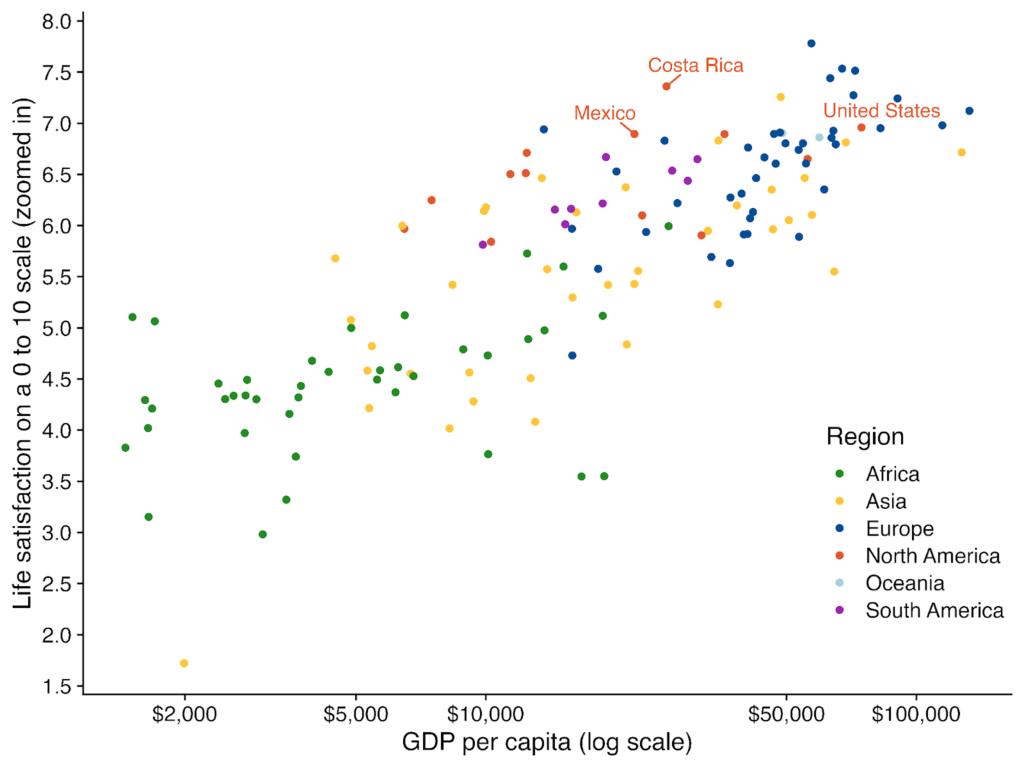
Richer countries tend to be happier. Nevertheless, several Latin American countries continue to outperform expectations based on income alone. Residents of Costa Rica report higher life satisfaction than Americans (and Mexican life satisfaction is very close to that of the US), despite having less than half the income.

Scatter plot showing life satisfaction in relation to GDP per capita.
Happier Lives Institute figure. The life satisfaction data is from 2024 (or 2023 for countries missing 2024 data). The GDP data is from 2023 (the World Bank has not yet released 2024 data). The GDP data from Our World in Data.

Some of the world’s happiest countries in 2025 are also the most generous

Being a happy country is good. But spreading that happiness beyond one’s borders is even better. This year’s World Happiness Report [2] highlights the often-overlooked role of benevolence in improving the lives of  the giver and receiver.

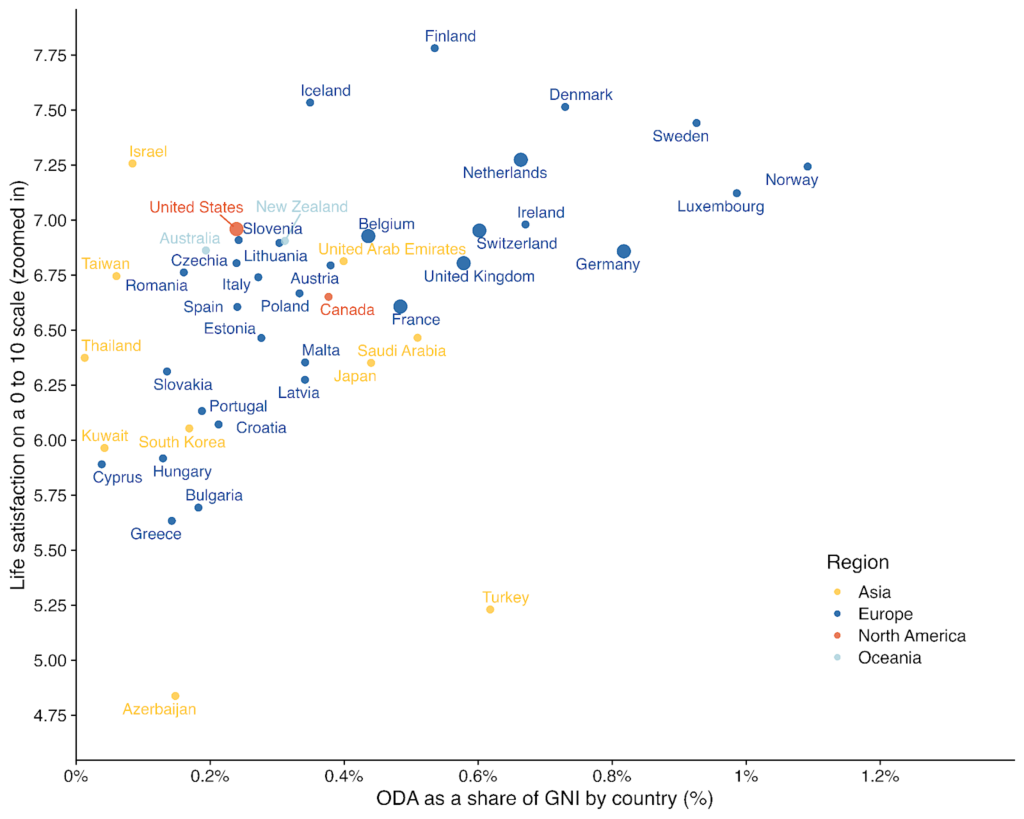
One clear way to measure a country’s generosity is through its levels of international aid. In the World Happiness Report (Chapter 2, p. 46), they found a positive correlation between international aid and a country’s happiness. 

Indeed, when we visually look at foreign aid as a share of national income, an interesting pattern emerges: the world’s happiest countries also tend to be among the most generous. 

Scatter plot showing life satisfaction in relation to donations as a percentage of gross national income
Happier Lives Institute figure. The life satisfaction data is from 2024 (or 2023 for countries missing 2024 data). The Official Development Assistance (ODA) data is from 2023 (the OECD has not yet released 2024 data). The ODA data is from Our World in Data [3]. Some countries that have recently announced cuts to their foreign aid (USA [4], UK, etc.) are represented with larger points.

The connection between helping others and happiness is mirrored on the individual scale. Being more generous is correlated with being happier. Among the generous acts surveyed, donating gives double the happiness boost compared to volunteering or helping strangers (p. 40). Luckily, acts of benevolence may be more common than we imagine.

People are kinder than we think

One of our favorite findings from this year’s report suggests that people are worthier of our trust than we realize. 

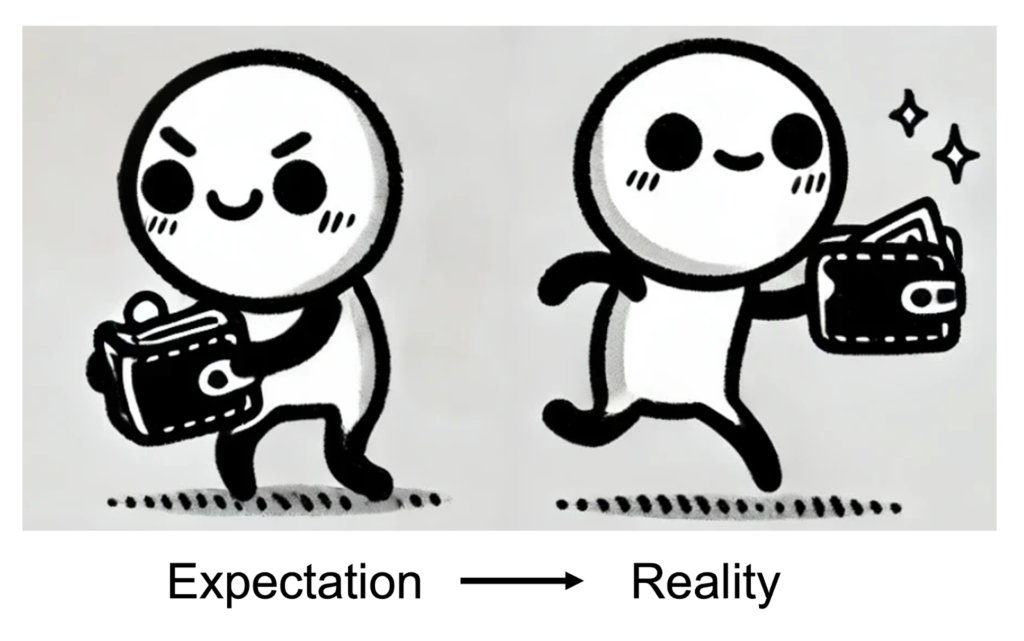
In Chapter 2 (p. 31), the authors compared survey results about people’s expectations for how often a dropped wallet would be returned with actual return rates from a 40 country experiment. 

They found that the actual return rate across the world was about twice as high as people expected. 

These expectations are also strongly and positively related with wellbeing. Having confidence that a wallet would be returned had a much higher associated effect on happiness than most other factors. 

Believing a wallet would be returned was twice as related to happiness as unemployment and it was correlated with nearly 8 times as much happiness as having one’s income double.

The authors draw out the implication: 

“People may be made needlessly unhappy by their unwarranted pessimism.” (p. 31)

Giving to others: How to convert your money into greater happiness for others

The impact charities have on people’s happiness varies hugely. Your donations to charity can go much further – at no extra cost to you – if you contribute to the best organisations.

Let’s unpack this.

1) The first ever review of how much happiness charities can create with a donor’s money

A new chapter of the report aimed to find and review all pre-existing estimates of how much happiness charities produce. The review found 24 charity cost-effectiveness estimates by four different evaluators (interestingly, these evaluators are all UK-based, so the UK is a world-leader in happiness research, if not happiness). 

Logo du Happier Lives Institute, Lond School of Economics, Pro Bono Economis, et State of Life

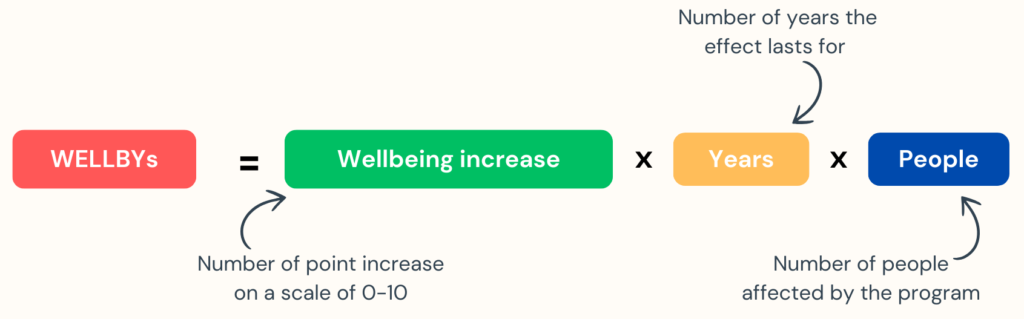
Wellbeing-years (WELLBYs) [5] are an increasingly accepted method of comparing the value of different interventions, charities, and policies. 1 WELLBY = A 1-point increase on a 0-10 self-reported wellbeing scale (like the one used in the World Happiness Report ranking!) for one person for one year. 

For context, after a year [6] :

  • Being unemployed reduces life satisfaction by 0.5 points (on a 0-10 scale).

  • Marriage increases life satisfaction by 0.3 points (on a 0-10 scale).

  • Doubling income raises life satisfaction by 0.2 points (on a 0-10 scale).
  •  
WELLBYs = wellbeing increase x years x people

2) The best charities are hundreds of times better at increasing happiness per euro.

There’s a huge variation in the wellbeing you can buy per euro donated across charities. 

To put this in perspective, you’re as tall as the average person, and your height represents the cost-effectiveness of the least good charity on the list (this still has a positive impact), the charity on the top of the list would be 5x times taller than the Eiffel Tower! [7]

What’s driving the differences in impact across charities?
The short answer is that most cost-effective charities are cheaply providing effective solutions to serious problems faced by people in low and middle income countries (LMICs). Whereas the least cost-effective charities operate in high-income countries (HICs). It costs charities much more to provide the same service in high income countries, and these may have smaller impacts because the need is less and better met by existing services. The report discusses this, and caveats, more in the chapter itself.

Note that the task was to bring together all the work that had already been done. All the research had the same output (WELLBYs per dollar) but the inputs were ‘lumpy’: some analyses were much deeper than others. It was out of scope to renanalyse and to update all the pre-existing estimates. So take this as the first word on the topic, not the last!

3) What are the most cost-effective charities identified so far?

The most cost-effective charities found so far focus on mental health, malnutrition, and lead exposure reduction in low-income countries:

Logo de Pure Earth

Pure Earth (Lead Exposure Reduction)

Cost per WELLBY : 9$

Advocacy efforts to reduce lead poisoning, improving health and cognitive function.

Logo de Taimaka

Taimaka (Malnutrition Treatment)

Cost per WELLBY : 15$

Delivers life-saving therapeutic food to treat acute malnutrition in Nigeria.

Logo de Friendship Bench

StrongMinds & Friendship Bench (Mental Health Therapy)

Cost per WELLBY : 21 à 25 dollars

Both charities provide low-cost, scalable mental health support in sub-Saharan Africa where the need is great but there is very little provision.

We recognise “Dollars per WELLBY” is not very intuitive. To get a feel for what this means, consider that $20 will, for many, be the cost of a meal out. If you know of a restaurant that will raise your happiness by 1-point for a whole year – more than the difference between being employed and unemployed – then let us know so we can go there! By supporting the best charities, we can make an incredible difference to others at a very small cost to ourselves.

Using the Happier Lives Institute latest research, we published about the charities you can support to increase wellbeing in the world. While not mentioned in this report, the Happier Lives Institute has evaluated  the Against Malaria Foundation (AMF). Its impact on well-being is significant, mainly due to the deaths avoided and suffering reduced as a result of malaria prevention. Its effectiveness can vary depending on the philosophical approach adopted. AMF is one of Mieux Donner’s recommendations in our health and poverty category. You can donate and benefit from the associated tax reduction.

4) Why aren’t there any charities I’ve heard of at the top of the list?

In the chapter, what stood out as a gap in the current research is that it didn’t include any well-known charities. The Happier Lives Institute wanted to add some estimates of well-known charities, but they found it surprisingly hard.

Why? Lots of big charities are what they call ‘MANGOs’, standing for ‘Multi-Armed NGOs’. For instance, Oxfam runs hundreds of different programmes. In the chapter, they explain the ‘MANGO problem’ is that it is effectively impossible for us to assess these sorts of organisations. So, donors are really guessing about how much good their money does.

Well-known charities don’t necessarily have a big impact, even if they do more or less one thing. For instance, Happier Lives Institute did a quick estimation of the cost-effectiveness of Guide Dogs UK, not because they wanted to pick on them, but simply because they were one prominent charity that was easier to assess. They estimate that Guide Dogs UK produces a WELLBY for ~$41,000 (i.e., ~2,200 less cost-effective than the average of the top 5 charities, see below). Even though Guide dogs do have a huge impact on the lives of their beneficiaries, training each guide dog costs around $200k [8], making it less cost-effective than other charities that have the same impact for fewer costs.

The HLI did quick cost-effectiveness analyses based on studies of housing (~$35,000 per WELLBY) and cash (~$20,000 per WELLBY) interventions to aid the homeless. These came in at ~2,000 less cost-effective than the top 5 charities, indicating it’s very, very hard to help the homeless cost-effectively.

5) Fund the best charities and centuplicate (or more) your impact at no extra cost!

When the HLI compares the top 5 charities in the sample to the average of the UK charities [9], le(not including Guide Dogs), the top 5 are around 150 times better. The implication is that donating €1,000 to a top charity can have the same impact as donating ~€150,000 to a more typical one. This means that a donation of €1,000 to a leading charity can have the same impact as a donation of around €150,000 to a more traditional charity.

The most cost-effective charity in the analysis (Pure Earth) is around ~1,000 times better (942 times to be precise) at increasing happiness than the least effective evaluated charity (Football Beyond Borders).

But all the charities in their sample had chosen to be evaluated by researchers, so they are probably much better than average. When compared to the average of our quick analyses of Guide Dogs and helping the homeless, the best charity is ~3,500 times better than these popular destinations for our charitable euros. 

Does this mean I have to give? The philosopher Dr. Michael Plant, Happier Lives Institute Director and main contributor to this chapter, addresses these questions and more about charitable giving:

  • Do I have to give? You may not be obligated to give, but you should, if you can. However, if you do decide to give, many have the intuition that we should make a bigger, rather than smaller, difference. 

  • Will giving make me happier? Yes [10]. Indeed, in the opening chapter of the world happiness report, they estimate that people who donate tend to get more benefit than performing other benevolent acts such as helping strangers or volunteering. But if you’re not sure if giving will make you happier, you can always try it out!

  • I already give to charity – is it wrong for me to switch to something that would help more? No, not if the point is to help others. But if it makes it easier, consider giving to both the best charities and the ones closest to your heart. 

  • How much should I give? The largest amount that you can sustain.

At Mieux Donner, we promote the 10% pledge, where individuals commit to giving 10% of their income to high-impact charities. We invite people in a variety of situations to consider taking this commitment. While we understand it may not be for everyone, 1% could be a good starting point. If you’re still unsure about pledging, you can try a trial pledge of 1% for a limited period of time.

See the full chapter [11] for more advice.

6) You can do a lot of good, maybe more than you imagined.

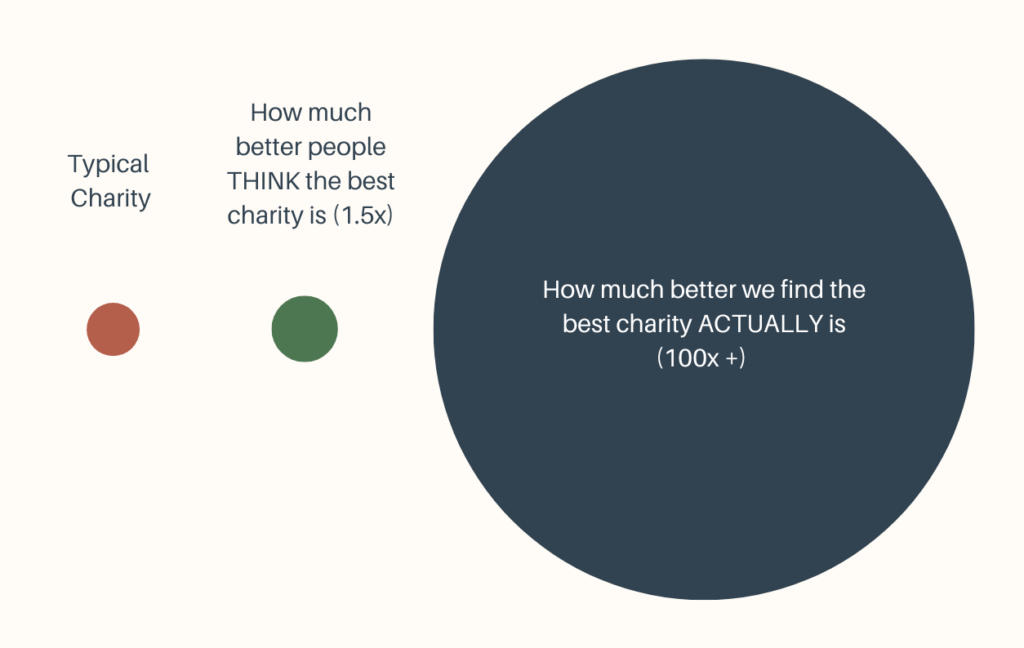
Most people [12] think the best charity to help the global poor is around 1.5x as good as the typical charity. 

Based on the evidence presented, the difference between the best and the rest of charities is much, much larger (coarsely illustrated below). We (Mieux Donner) have published an article showing similar evidence on other areas.

Before this recent innovation to evaluate charities in terms of wellbeing – using a standardised, scientific approach, that really captures what matters – it was very hard to compare charities, or know how much impact you were having. Before this report, there wasn’t much hard evidence of how big the differences in charity impact were, per euro or per dollar.

But these developments, and what we’ve found, gives us heart. The world feels full of problems that we can do nothing about. But it turns out that we can do something and feel confident we’re making a difference: we can (now) capture charity’s impacts on happiness. What’s more, because impact varies so much between charities, this means we can have a huge, and vastly greater impact, at no extra cost to ourselves – simply by following the evidence and supporting the best charities found so far.

As we write this, the world we thought we knew seems to be falling apart around us. Even if our governments are taking their eye off the ball, we, the citizens of the world, can still do our bit to help the people of the world. Donating to excellent charities not only does a lot of good in itself, but it is also a way of showing that many of us do care, and we are willing to put our money where our mouths are to make the world a better place. 

What You Can Do Today

Your donations have the power to transform lives. You’ve probably heard this for years, maybe your whole life. We think the evidence supports this – IF you choose wisely. By donating to the most effective charities, you can centuplicate (100x – or more!) your impact without spending an additional euro.

What can you do? You can do a lot! Hopefully much more than you imagined.

  • Donate to highly impactful charities to maximize the good you do.

  • Read the full chapter to learn more about the research behind these comparisons.

  • Share this article with others! Spread the word! Tell a friend who you think might be interested and share this on social media. When people find out there are large differences between charities’ impact, they give more effectively! [14] Giving to higher impact causes is a real way we can reach out and meaningfully improve the world.

  • Stay informed by following the Happier Lives Institute’s newsletter and Mieux Donner’s newsletter.

And reach out, if you have any questions.

For Media

If you work in the media, check out the Happier Lives Institute’s press release [15]. Please share these findings and get in touch. Mieux Donner’s team is also happy to answer your questions and put you in contact with different experts.

For researchers

The best may be yet to come. We need much more research into wellbeing cost-effectiveness. Wellbeing cost-effectiveness is an unusual area where barely any work has been done and it has huge, direct practical implications. We hope researchers take up the challenge and use their skills to make a difference.

For policy makers

Use WELLBYs to design and evaluate public programs that maximize societal wellbeing. For more, see this recent research [16] from the London School of Economics.

For foundations

Focus on funding interventions with the greatest potential to transform lives. We offer personalised donation advice, so get in touch if you’re after tailored research to increase your impact. 

This post is informed by the work of the Happier Lives Institute, whose original pieces can be found here and here.

[1] https://ourworldindata.org/grapher/gdp-vs-happiness?zoomToSelection=true
[2] https://worldhappiness.report/ed/2025
[3] https://ourworldindata.org/grapher/foreign-aid-given-as-a-share-of-national-income
[4] https://www.happierlivesinstitute.org/2025/02/18/happier-lives-institute-responds-to-trump-administration-shutting-down-usaid/
[5] https://www.happierlivesinstitute.org/2025/02/26/what-is-a-wellby/
[6] See Clark et al. (2018, Chapters 2 and 4); Frijters and Krekel (2021, Table 2.2); and Clark et al. (2008).
[7] The best charity evaluated (Pure Earth) is 942 times more cost-effective than the least cost-effective charity evaluated (Football Beyond Borders). Assuming an average height of 1.65m, that means a height of 1554.3m. Which is 1554.3/330 = 4.71 times higher than the tour Eiffel.
[8] In 2023, the Guide Dogs reported £74m in costs and formed 469 new guide dog partnerships, which gives an average of £157k per new partnership.
[9] The Happier Lives Institute explain that the UK charities are more representative of ‘typical charities’, at least for people living in high-income countries, as few donations go overseas (between 5% and 15%).
[10] https://journals.sagepub.com/doi/full/10.1177/09637214221121100
[11] https://happiness-report.s3.us-east-1.amazonaws.com/2025/WHR+25_Ch8.pdf
[12] https://www.cambridge.org/core/journals/judgment-and-decision-making/article/donors-vastly-underestimate-differences-in-charities-effectiveness/B7455AC3708440D10454BA2FD6B3F332
[13] https://www.happierlivesinstitute.org/#subscribe
[14]See page 32 of Schubert and Caviola (2024).
[15] https://drive.google.com/file/d/1B5c7ulDyQ107U4kSA-f4IGFOW30NdvO5/view?usp%3Ddrive_link
[16] https://cep.lse.ac.uk/_new/publications/abstract.asp?index=11099

You might also want to read...

Valeur d’une vie en France
Romain Barbe

What is the cost of a human life?

Human life is precious. It is natural to want to mobilise all our resources to save a life, even if it only prolongs a life by a week. But what happens when other people are also in danger, and our resources are not enough to help them all? As a society, we face practical limits that force us to make difficult decisions.

Read More »