
What are impactful charities and how can we recognise those that really make a difference?
Thursday 15th August 2024, Reading time: 10 mins

Definition: An impactful charity is distinguished by its motivation to improve people’s well-being by using rigorous approaches and tools to assess the impact of its actions in an objective and verifiable way.
High impact charities, also known as effective charities, stand out for their excellent cost-benefit ratio. Various indicators can be used: the cost per life saved, the improvement in well-being or the amount of CO2 avoided per euro spent. However, beyond these tangible measures, an effective charity must also demonstrate that it follows a rigorous and proven methodology to achieve significant change. It is also important that it is prepared to readjust its strategy if another action could help even more.
Characteristics of effective charities
Outcome orientated : Effective associations focus on the final, significant outcome of their actions. They aim for concrete results that enable individuals to live healthy, happy and fulfilled lives, while eliminating avoidable suffering and promoting overall well-being.
When talking about impact, it is essential to focus on the desired final outcome, such as improved school grades, rather than focusing on intermediate outcomes such as the number of books distributed.
Typically, I’m sceptical about a charity that distributes 1 million books and assesses its impact solely in terms of “1 million books distributed”. What percentage of these books were read? Has the distribution of books really given more people access to reading? Has this improved access to reading contributed to better reading skills, better chances of success at school, or a better quality of life? If the majority of books are not read, and the people who read them would have read other books anyway, the real social impact of this association is minimal.
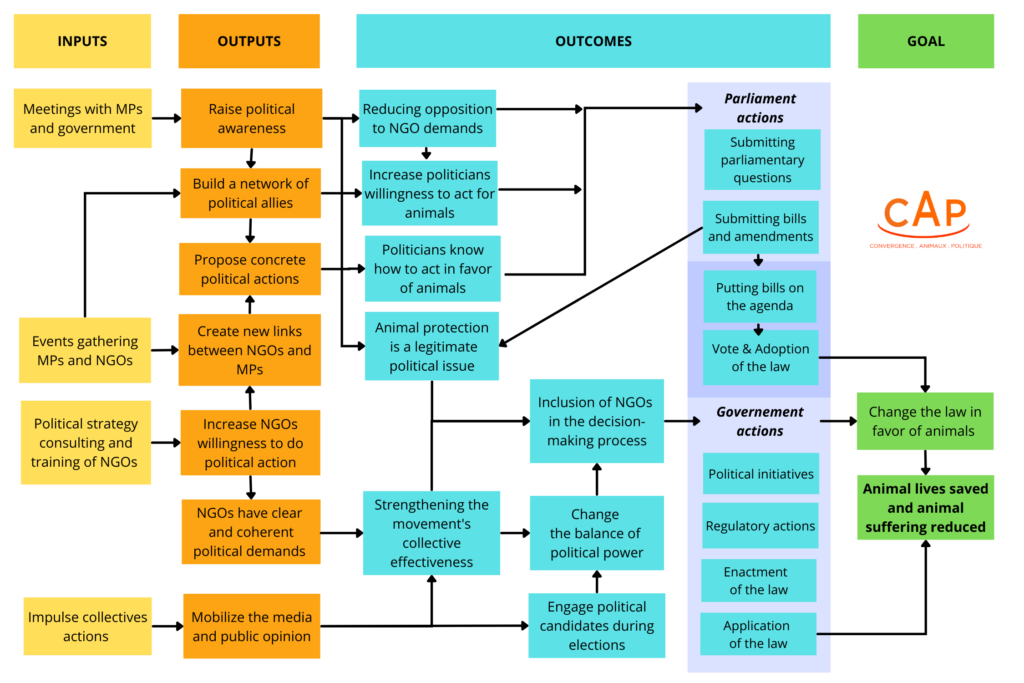
Theory of change: Effective charities have a clear theory of change. This is a well-defined strategy that explains how its actions will lead to specific improvements in overall well-being. This theory is crucial because it guides all of the charity’s actions and provides a logical path from problem to solution.
In this (very complete) example, we can see that the ultimate objective is not to have meetings with members of parliament but to reduce animal suffering and the number of animals killed:
Validation of hypotheses: Effective charities actively test their hypotheses and are prepared to adapt their strategies according to the results obtained, demonstrating an ability to evolve and constantly improve without changing their final objectives along the way.
Counterfactual reasoning: Effective charities continually question the difference they are making to the world. They ask themselves what would have happened if they didn’t exist. This is known as counterfactual reasoning. It’s not a question that many organisations ask themselves, but it’s crucial to understand whether they are making a real difference.
Transparency and collaboration: Effective charities are transparent about their methods, results and finances. They actively collaborate with other organisations which strengthens their overall effectiveness.
Measuring impact: Effective charities use scientific methods to evaluate the results of their actions, ensuring that their interventions produce the desired effects. Some actions, such as political advocacy, may at first sight seem unmeasurable, but there are often ways of assessing their impact, such as modelling what would have happened without the advocacy and comparing the difference between the two scenarios.
High impact on well-being: The actions of effective charities have significant and positive effects on the lives of the individuals they help. They do significantly more good than other interventions. The bar for charities being considered as ‘effective’ is very high and they must considerably improve wellbeing.
Independent assessments: Their results are validated by independent assessors, adding an extra layer of credibility and reliability to their claims.
Conclusion
Giving to high impact charities means ensuring that your resources are used as effectively as possible to improve global well-being. Donating to these organisations not only achieves more good, but also promotes a healthier philanthropic ecosystem in which altruistic decision making is based on evidence and reason and aims to do the most good possible.
We’ve gathered thousands of hours of research on the most effective charities in the fields of global health and development, climate change and animal welfare. You can see all these organisations here.

Romain Barbe
Romain is a co-founder of Mieux Donner and philanthropy advisor. You can contact him at romain@mieuxdonner.org.
Tags : English Article