

The Humane League
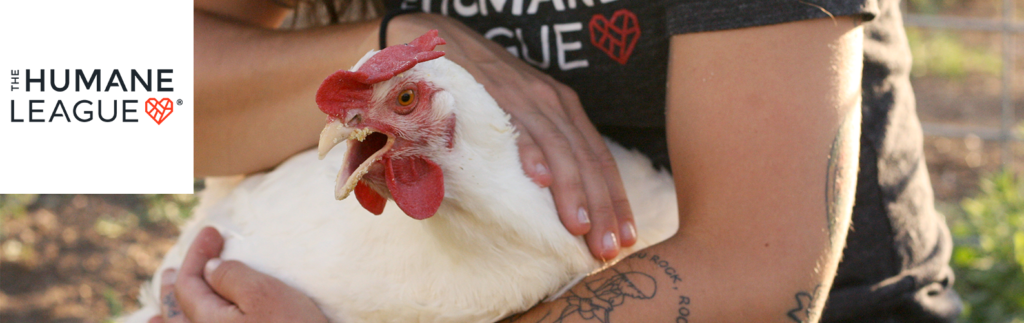
Works to end animal abuse in the food industry by advocating for humane practices, corporate reform and stronger legal protections.
Last updated: 7th November 2024
The Problem with Factory Farming
The global demand for meat and animal products has created an industry where 80 billion land animals are raised and slaughtered annually.
- 99% of animals in the US [1] and 80% of animals in France [2] are factory farmed.
- Chickens, pigs, and cows endure cruel conditions, confined to tiny spaces with limited ability to express natural behaviors.
- 700 million chickens are raised each year in France. 81% of them are confined in intensive farms, facing overcrowding, dark and unsuitable buildings, and daily health problems [3].
- Factory farming lobbies continue to push for legislative changes that would dismantle protections for farm animals. Without intervention, factory farming’s inhumane practices will continue unchecked.
The Humane League’s Fight Against Factory Farming
The Humane League advocates for higher animal welfare standards, corporate reform, and stronger legal protections. The Humane League has:
Secured commitments from 400+ companies to eliminate battery cages [4] and a further 2,000 comitments through their partners in their Open Wing Alliance.
Successfully lobbied over 220 companies to sign their Better Chicken Commitment to improve the welfare of chickens raised for meat. Of these companies, 140 have implemented the changes. These companies include Burger King, Starbucks, Subway and Nestle [5]. The Better Chicken Commitment reduces overcrowding, improves environmental conditions, and eliminates live-shackle slaughter.
- Opposed harmful amendments to the U.S. Farm Bill that would remove animal protections.
- Provided resources and advocacy tools to promote plant-based diets and reduce reliance on factory farming.
The Humane League’s Impact
2,400+
companies worldwide commited to go battery cage-free
140 +
companies raised welfare standards for broiler chickens
> 1 billion
animals helped
The Humane League has been recognized as one of the most effective animal welfare organizations in the world. Every year since 2013, it has been recommended as a top charity by independent charity evaluators including: Animal Charity Evaluators, EA Animal Welfare Fund and Giving What We Can.
Donations to The Humane League are one of the most cost effective ways to help improve the lives of farmed animals and reduce animal suffering:
- Each €0.85 donated saves one animal from factory farming [6].
- The corporate cage-free campaign has directly prevented millions of hens from living in extreme confinement [6].
- In the U.S., the percentage of cage-free hens rose to 40% in 2024, compared to 6% in 2012, in large part thanks to corporate lobbying from THL [7].
- Over 220 companies have committed to improving chicken welfare, benefiting billions of birds worldwide [5].
- THL’s ongoing advocacy ensures that legislative protections for farm animals are upheld and strengthened.
By supporting The Humane League, donors contribute to a future where factory farming is no longer the norm. Their work continues to drive industry-wide reforms, improve the lives of billions of animals, and challenge a system that prioritizes profit over ethics.

Donate 100 euros to the Humane League and you can spare 118 chickens from lives in battery cages [6]
The Humane League’s Key Achievements
The Humane League is one of the most effective charities in the world dedicated alleviating animal suffering.
The end of battery cages
The eradication of battery cages will considerably reduce animal suffering. It is also a strategic measure in the fight against factory farming as a whole. By convincing food companies to source only eggs from cage free hens, and by leveraging their commitments to their competitors, organisations like The Humane League can create a domino effect and bring about rapid and radical change in entire sectors of the food industry.
Studies show that the ‘critical size’ to tip us towards large-scale social change is only 25%. In the United States, where 40% of hens live in cage-free farms, we have already passed the tipping point. In the UK, where 77% of eggs are free-range, we are nearing the finish line. Globally, we still have some way to go, with only 16% of industrially reared hens being cage-free. But we’re getting there.
In the United States alone, there are around 310 million laying hens. In February 2024, for the first time since the advent of factory farming, 40% of them – nearly 125 million birds – will never have to endure the brutality of life in a cage the size of a microwave. In other words, for every 5 hens in the egg industry, 2 will be spared extreme confinement. This represents almost half of all the hens confined in the American food system.
In 2023, The Humane League obtained brand new commitments from 7 cage-free poultry companies, which would eventually prevent 2.5 million hens from being kept in cages. Also in 2023, The Humane League asked 62 companies to respect their own commitments in order to avoid keeping 42 million hens in cages. By focusing on battery cages, the Humane League is laying the foundations for future reforms in agriculture.
Better chicken commitment
The Humane League has successfully lobbied over 220 companies to sign their Better Chicken Commitment to improve the welfare of chickens raised for meat. These companies include Burger King, Starbucks, Subway and Nestle [3].
In the U.S, over 88% of all animals raised for food are chickens—representing close to 9 billion chickens raised and killed for meat each year. This commitment improves animal welfare by setting a maximum stocking density ensuring each bird has space to sit or stand without being trampled, providing enhanced environments for the birds including better lighting and litter, and enforcing more humane slaughter practices. [4]
See the full list of companies that The Humane League has convinced to uphold higher welfare standards .
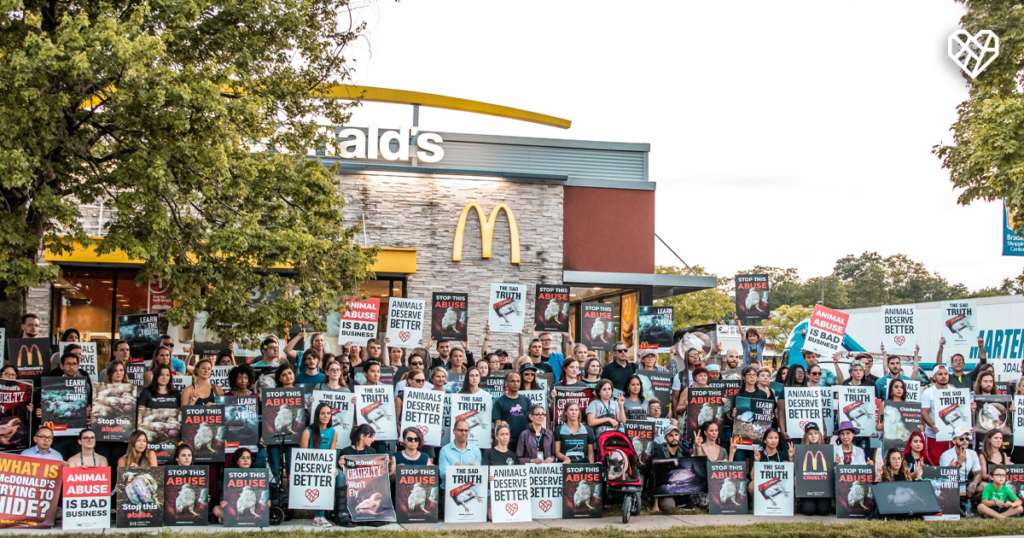
Your donations can support these campaigns
By donating to The Humane League, you can support their work taking on large corporations and the meat lobby to end abuse of farmed animals. These are the current campaigns your donations could support:
Corporate cage free campaign: Millions of egg laying hens currently live a life of extreme suffering, packed into tiny wire cages, with barely enough room to raise their heads or turn around. They suffer from extreme psychological distress and cannot fulfil their basic instincts of perching, foraging, nesting or mothering their chicks. Most develop osteoporosis which leads to broken bones. After laying hundreds of eggs for just a year or two, they are sent to slaughter and often boiled alive.
Better chicken commitment to end live-shackle slaughter: Almost every single chicken raised for meat in the US is killed in an incredibly inhumane way. Live chickens are slammed into metal shackles, often breaking their legs. Hanging upside down, struggling to breathe, they are dragged through an electrified stun bath before an automatic blade cuts their throats. After bleeding out, their bodies are submerged in scalding tanks to loosen their feathers. This is the standard method of live-shackle slaughter.
For many birds, it doesn’t end this way. Some chickens miss the stun bath, remaining fully conscious and sensitive to pain when their throats are cut. Others die in scalding tanks if they avoid the blade. This practice causes immense suffering. A Tyson employee described, “The chickens scream, kick, and their eyeballs pop out of their heads.”
Live-shackle slaughter aims for efficiency but often fails. USDA inspectors have documented numerous instances of improper slaughter. One inspector in 2021 reported a live bird entering a scald tank without being stunned or bled, which violates the Humane Methods of Slaughter Act. Death by live-shackle slaughter is brutal; death by botched live-shackle slaughter is even worse and illegal.
The Humane League has successfully lobbied over 220 companies to sign their Better Chicken Commitment and stop the practice of live shackle slaughter. [5].
US Farm Bill: Factory farming lobbies in the US are currently pushing for language in a Farm Bill that would dismantle state laws designed to prevent extreme cruelty to farm animals. The proposed change to the farm bill would remove protection from cage confinement for egg laying chickens, mother pigs and baby veal calves.
The Humane League are currently lobbying to ensure that the final Farm Bill doesn’t include language that would undo current protections for animals.
Tax Deduction: Maximise the impact of your generosity
Tax deductions in France are currently only available for donations to four of our recommended charities: Against Malaria Foundation, Good Food Institute, Helen Keller International, and Centre pour la Sécurité de l’IA
If you are taxable in France, you will benefit from a tax reduction of 66% of the amount of your donation up to the limit of the tax due or 20% of your taxable income.
In practice, this means that if you were planning to donate €100, you can triple this amount to reach a donation of €300 that you will declare, with a real cost of only €102 after tax reduction. This allows you to multiply the impact of your donation without increasing your planned expenditure.
You can read our full article on tax relief in France for more information.
We are able to offer tax deductibility for this association and all the organisations we recommend through our partners, Effektiv Spenden. If your tax residence is in Switzerland, please make your donations via this link, so that you can receive your tax receipt at the end of the tax year.
We work with partners around the world and can offer tax deductibility in many countries. Please contact us if you would like to make a donation from another country and we will discuss the tax options available to you. If you would like to donate and do not require a tax receipt, you can make a donation via Mieux Donner regardless of your country!
FAQs
Yourdonations will go towards three possible campaigns:
- The end of caged rearing of laying hens for large companies
- An end to live-shack slaughter
- The fight against legislation in the United States threatening animal welfare gains.
Cage farming causes many problems for the animals concerned: their instincts to perch, forage for food, or in the case of hens, nest, are prevented. Many cage-reared laying hens develop osteoporosis, and are killed after one or two years.
Live-shack slaughter aims for efficiency, but often fails. In the United States alone, USDA inspectors have noted numerous cases of inappropriate slaughter: this often involves birds that miss the electrified bath stunning stage. As a result, they remain sensitive to pain when their throats are slit. Others die in the scalding vats used to de-feather them, if they avoid the throat-cutting blade.
We recommend charities that
Focus on final outcomes:
Charities that prioritise the final outcome of their action and not indicators of impact. When talking about impact, it is essential to focus on the desired final outcome, such as improved opportunities and quality of life, rather than focusing on intermediate outcomes such as the number of books distributed.
Measure their impact
It’s surprising how few charities measure their impact. Our top recommended charities use scientific methods to evaluate the results of their actions, ensuring that their interventions produce the desired effects.
Are cost-effective
They save or improve the most lives per euro donated to them. Eg) our top recommended global health charities can save a life for as little as 3,000 euros, our top climate charities can avoid one ton of carbon emissions for just 1 euro and our top animal welfare charities can spare thousands of animals from factory farming for the same price of saving one animal in a refuge.
Are independently evaluated
All of our top charities are independently evaluated by world leading charity evaluators. See more information below.
We do NOT recommend charities based on their:
Location
A life is valuable whether it is based in France or the developing world.
Tax deductibility
Our top recommended charities are all tax deductible in Switzerland, but not in France. This is because French tax law dictates that a charity must operate from France in order to be tax deductible. We always prioritise the impact of a charity over its tax deductible status.
Overhead costs
Some of our charities such as Against Malaria Foundation have very low overhead costs, and some such as Clean Air Task Force – have much higher overhead costs. To explain why we don’t take overhead costs into account in our recommendations, imagine two charities:
- Charity A spends 10,000 euros a month on it’s operations and saves 1 life
- Charity B spends 20,000 euros a month on it’s operations and saves 6 lives
In the above examples Charity A saves 1 life for every 10,000 spent on it, whereas Charity B saves 1 life for every 3,300 euros spent on it. In this example – it’s clear to see that it’s not overhead costs that are important – but in fact the ratio of overhead costs to the desired impact. Research suggests that there is not much of a correlation at all between overhead and effectiveness.
Our recommendations are based on the research of independent experts
Finding the best aid organisations isn’t that easy. That’s why we work closely with experts who have been conducting extensive and in-depth research on the subject for many years. These experts are completely independent and work at the cutting edge of charity evaluation in their respective cause areas. They conduct rigorous tests on hundreds of charities to find out as precisely as possible how much good their programs achieve per euro spent. By comparing the cost effectiveness of so many charities, they are able to short list the most effective charities to donate to in order for your donations to have the biggest impact.
The charity evaluators whose research we primarily rely on are:
GLOBAL HEALTH AND DEVELOPMENT: GiveWell
GiveWell is the world’s leading research organisation that studies global health and development charities.
‘We search for the charities that save or improve lives the most per dollar. Our goal is to produce the world’s top research on where to give. Free, for everyone. We recommend a small number of charities that do an incredible amount of good’ (GiveWell)
GiveWell was founded in 2007 by Holden Karnofsky and Elie Hassenfeld, two former hedge fund employees. They wanted to do as much good as possible with their donations and found that there was little solid information available on how to do this. GiveWell invests more than 40,000 hours of research each year and has raised more than €1 billion for high-impact charities, saving an estimated 150,000 lives.
ANIMAL WELFARE: EA Animal Welfare Funds
The EA Animal Welfare Fund was rated as the top animal charity evaluator by GWWC’s ‘evaluating the evaluators project’ in 2024. They are therefore the primary charity evaluator we defer to in order to choose our top animal charities. We meet with them every few months to get up to date recommendations. They conduct thorough research into various animal welfare organisations to find those that help the most animals per dollar.
CLIMATE CHANGE: Giving Green
Giving Green is a nonprofit organisation that spends thousands of hours each year reviewing studies and climate charities to find the most cost effective interventions to combat climate change. From this research, they publish their top recommendations each year. Their team is made up of climate scientists, economists and impact evaluation experts with decades of experience working at the intersection of evidence-based policy and the environment. We meet regularly with Giving Green to discuss our climate recommendations and run climate workshops in collaboration with eachother.
Other evaluators
Although we primarily defer to GiveWell, Giving Green and EA Animal Welfare Fund, we also read the research of other top charity evaluators including LongView Philanthropy, Founders Pledge and Animal Charity Evaluators to ensure we are not overly-reliant on any one source of research. When choosing our top charities we prefer organisations whose effectiveness is corroborated by multiple independent evaluators.
Yes, the team at Mieux Donner offers free donation advice for both english and french speakers. You can book an appointment here.
Donate to The Humane League
Your donation is paid directly to the organisations you support, and only transaction costs apply.
Mieux Donner does not deduct any money for its own operations.
1
Charity/fund
2
Donation amount
3
Payment details
4
Personal details
5
Confirm donation
[1] How many animals are factory farmed? (Our World in Data) [Accessed 11/07/2024]
[2] Élevage intensif : plus de 8 animaux sur 10 en France (L214) [Accessed 07/11/2024]
[3] Animaux d’élevage, Poulets de chair (CIWF France) [Accessed 25/02/2025]
[4] Our Impact (The Humane League) [Accessed 25/02/2025]
[5] The Humane League Better Chicken Commitment (The Humane League) [Accessed 11/07/2024]
[6] How do we calculate the cost-effectiveness of The Humane League’s work?
We use calculations from animal welfare organisation, FarmKind. They have calculated the cost per animal helped by dividing the number of animals affected by commitments they achieved in that year by the cost of those campaigns. We place fair confidence in this number as it is based on past performance of THL’s work and is more conservative that the estimates of other evaluations. However it is an average estimation and the true cost could vary. Full calculations can be viewed on FarmKind’s cost effectiveness spreadsheet for The Humane League, 2024 [Accessed 04/09/2024]
[7] Unpacking the Data: Tracking US Hens spared from cages (The Humane League, Dec 2024) [Accessed 25/02/2024]
Other animal welfare charities we recommend
Good Food Institute
GFI aims to create a fairer, healthier food system, while reducing animal suffering and the ecological footprint of food production. They do this by promoting the development and marketing of alternatives to conventional meat, such as plant based meat and lab grown meat.
In 2024 GFI’s success included a $100 million partnership with the Bezos Earth Fund, halal recognition for cultivated meat in Singapore, and a new office in Japan. Ongoing efforts focus on public funding, national support, and overturning cultivated meat bans.
In 2024 GFI’s success included a $100 million partnership with the Bezos Earth Fund, halal recognition for cultivated meat in Singapore, and a new office in Japan. Ongoing efforts focus on public funding, national support, and overturning cultivated meat bans.