
Everything you need to know about charity fundraisers
Friday 08 January 2025, Reading time: 8 mins

Calls for donations: an introduction
Let’s start with a definition: a call for donations is an action that encourages people to give money to a cause.
Generally speaking, this involves soliciting the public for online donations. This form of participatory financing is essential for associations and non-profit organizations to fund projects or support a specific cause.
To be successful, an online donation drive must be based on convincing motivations for future donors. Shared values, evidence-based arguments, touching stories and clear communication are needed to mobilize the public. However, a successful campaign requires much more than a simple request. It also involves understanding the needs and type of expenditure, planning an effective strategy and complying with regulations.
An equally important question is: how can we ensure that these collections have a real impact and that donations are used effectively? At Mieux Donner, we believe it’s crucial for individuals to understand the mechanisms behind public calls for generosity, in order to maximize their contribution to collective well-being.
Why are calls for donations important?
Fundraisers collect donations for a variety of causes, from global health and animal welfare to climate change and education. They offer everyone the chance to contribute to projects that have a positive impact on the world.
However, not all fundraisers are created equal. Some projects have a measurable and significant impact, while others may have limited effectiveness. It is therefore essential to know how to evaluate these fundraisers so that you can direct your donations towards the most effective initiatives.
How do you evaluate a fundraising campaign?
1. Transparency and use of funds
A good donation request must clearly explain how the funds will be used. Associations must provide detailed information on how the donations will be used, the types of expenditure planned and the objectives to be achieved.
Questions to ask:
Does the charity provide activity or impact reports?
Is expenditure justified and in line with the stated mission?
2. Impact mesurable et preuve d’efficacité
Choose campaigns that are based on evidence and rigorous evaluation. Effective associations use impact indicators to demonstrate the effectiveness of their actions.
Example: An organisation that states that “each donation of €30 enables 15 children to receive vitamin A supplements for 1 year”. A proven and effective intervention shows a concrete and measurable impact.
3. Alignment with your values
Choose causes that resonate with your personal convictions. Whether you care about fighting poverty, protecting the environment or improving global health, it’s important that your donation reflects your priorities.
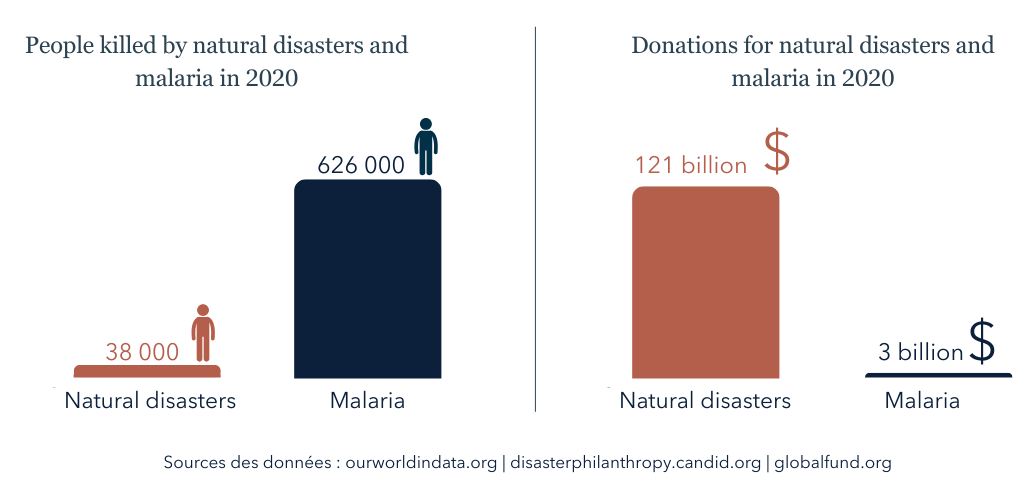
4. Urgence vs Importance
While some situations require an immediate response, it is also crucial to consider the long-term importance of the causes supported. Sometimes, a donation to a less high-profile cause can have a more significant impact.
Legal requirements for launching a fundraising campaign in France
Making a call for donations in France involves complying with strict rules. If an association asks for the generosity of the public, it must comply with these requirements, which aim to protect future donors while guaranteeing the transparency of fund-raising operations.
1. Necessary authorisations
For collections organised in public places, such as markets or festivals, associations must obtain prior authorisation from the local authorities, such as the town hall or prefecture. According to Service Public, this is essential to avoid administrative penalties. In general, including on the internet, a declaration must be made if the amount exceeds €153,000 over the last two calls for donations or the current one.
2. Information on the use of donations
Provide transparent information on how donations will be used
Associations must clearly explain how the funds raised will be used. This builds trust with the target audience and encourages larger contributions. For example, for our campaigns to protect children from malaria, we specify the number of mosquito nets that will be distributed for each donation, as well as the number of people protected.
For just 5 euros, a mosquito net protects up to two people against malaria for two years [1].
It is important that there is no significant discrepancy between the use made of the donations and the objectives set out in the declaration.
3. Take advantage of tax benefits
Eligible associations can offer tax reductions for donations received, which is a powerful argument for attracting donors. However, these benefits must be communicated in detail, including the ceilings and specific rules.
As an individual, how do you start a fundraiser whose donations are effective?
Even as an individual, you can play an active role in promoting important causes.
1. Organise a fundraising event
Use dedicated platforms to organise a collection in aid of an association recognised for its effectiveness. Make sure you clearly communicate the potential impact of the donations. You can launch an online fundraising campaign for the charities recommended by Mieux Donner.
Online donation platforms
When you decide to make a donation or launch a fundraising campaign, the choice of platform is important. Here are the criteria to consider:
Transaction fees: Some platforms charge commission on donations.
Access to information: If you wish to contact people again and thank them, will you be able to do so?
Ease of use: An intuitive interface makes the donation process easier.
Transparency: The platform must be clear about the destination of funds and any charges.
2. Sensitize those around you
Share information about high-impact causes and associations with your friends, family or on social networks. Your voice can encourage others to take action.
Write an effective call for donations
Promote your fundraiser effectively
An effective call for donations relies above all on a message that is meaningful and captivating, sent out for example in a newsletter. The presentation text must be clear, captivating, informative and inspire immediate action.
Understanding how donations are used
Clarity is essential. Avoid jargon or complex explanations when presenting your project. For example, you could write something like: “A donation of €20 enables a child to be vaccinated against serious illnesses”. This has much more impact than a long paragraph detailing complex statistics.
3. Making a long-term commitment
Consider making regular donations. Recurring contributions allow associations to plan for the long term and increase their effectiveness.
Maximising the impact of your donations
1. Find out more
Take the time to research charities, their mission and their real impact. Resources such as Mieux Donner can help you do this.
2. Think at a global scale
Some causes, although less visible, have a huge potential impact. For example, disease prevention in developing countries can save lives at relatively little cost.
3. Look at the cost-effectiveness
Consider how much your donation can achieve. Sometimes the same amount can have a much greater impact, depending on the charity or project chosen.
The role of Mieux Donner in calls for donations
At Mieux Donner, we are committed to helping donors find the most effective charities, based on scientific evidence and rigorous evaluation.
1. Selection of high-impact associations
We recommend associations that have demonstrated a significant and measurable impact in their areas of intervention. For example, organisations that fight preventable diseases in low-income countries or work to reduce CO₂ emissions effectively.
2. Transparency and trust
We prefer charities that are transparent about how their funds are used and that regularly publish impact reports. This allows donors to know exactly how their money is being used.
3. Personalised advice
We offer donation advice to help you focus your contributions on causes that will maximise your impact while reflecting your personal values.
Conclusion: Acting for a better world
Understanding calls for donations is essential to ensure that your generosity has maximum impact. By informing yourself and choosing carefully where and how you give, you can make a significant contribution to causes that are close to your heart.
At Mieux Donner, we’re here to help you along the way, offering tools and advice on how to give effectively. Together, we can make every donation count.

Jennifer Stretton
Jennifer is co-founder and co-director of Mieux Donner. She can be contacted at jennifer@mieuxdonner.org or by using the contact form.
Tags : Content