
Is ChatGPT bad for the planet?


Emilie Combres
Chargée de communication
Temps de lecture : 15 minutes
TL;DR - Key Takeaways:
Observation: Generative AI consumes electricity and water, mainly through model training and the operation of data centers (particularly for cooling).
Order of magnitude: A typical query is around 0.3 to 3 Wh, depending on the model, infrastructure, and task complexity; the individual impact remains moderate and often secondary compared to other factors like transportation, heating, or food.
Issues: The impact becomes primarily collective and structural, mainly depending on the location of data centers, the electricity mix, local water stress, the transparency of the actors, and the materiality of the infrastructure (GPUs, servers, semiconductors).
Actions: Usage moderation, better measurement (PUE, WUE, carbon scopes, efficiency metrics), technical optimization (smaller models, caching, RAG), and regulatory and industrial oversight.
Generative artificial intelligence, like ChatGPT, has emerged at breakneck speed. In just two years, it has gone from a technological curiosity to a tool used daily by millions to write, learn, program, or create.
However, this technological revolution also raises environmental questions: should we be concerned about its carbon footprint, energy, and water consumption, or the opacity of the infrastructure that makes it possible?
In brief: Does generative AI have a significant ecological cost, and if so, at what level does it actually stand: individual, industrial, or political?
Order of magnitude: A typical query is around 0.3 to 3 Wh, depending on the model, infrastructure, and task complexity; the individual impact remains moderate and often secondary compared to other factors like transportation, heating, or food.
Issues: The impact becomes primarily collective and structural, mainly depending on the location of data centers, the electricity mix, local water stress, the transparency of the actors, and the materiality of the infrastructure (GPUs, servers, semiconductors).
Actions: Usage moderation, better measurement (PUE, WUE, carbon scopes, efficiency metrics), technical optimization (smaller models, caching, RAG), and regulatory and industrial oversight.
Generative artificial intelligence, like ChatGPT, has emerged at breakneck speed. In just two years, it has gone from a technological curiosity to a tool used daily by millions to write, learn, program, or create.
However, this technological revolution also raises environmental questions: should we be concerned about its carbon footprint, energy, and water consumption, or the opacity of the infrastructure that makes it possible?
In brief: Does generative AI have a significant ecological cost, and if so, at what level does it actually stand: individual, industrial, or political?
I – The Environmental Impact of AI in a Few Numbers
Even though the technology is recent and complex, the environmental impact of generative AI is becoming better measured. It’s not a purely virtual world: each query and each model training requires electricity, computing power, and often water to cool servers.
A key phrase to remember: the footprint of AI depends both on the infrastructure (data centers) and the model itself (size, usage frequency, training method, efficiency).
Beyond usage, materiality matters: GPUs, servers, and semiconductors involve a life cycle assessment (extraction, manufacturing, transport, maintenance, and end-of-life e-waste), which adds to operational impacts.
For example:
A query in ChatGPT typically consumes between 0.3 and 3 Wh, according to available estimates and assumptions (model used, query length, infrastructure, and level of optimization).
This corresponds to about 0.2 to 3 grams of CO₂ emitted, depending on the electricity mix and assumptions made.
Training a large AI model requires considerable computing power, involving thousands of GPUs (a type of specialized processor designed for performing a very large number of calculations in parallel) over weeks or months. This accounts for a significant part of its total environmental footprint, often concentrated during the initial training phase.
In other words, the environmental “cost” often lies more in the training, infrastructure, and scaling than in a single occasional use.
Water: A Major Issue
The issue isn’t limited to electricity: water is also a major concern for AI.
According to a report by Food & Water Watch (2025), data centers in the United States consume billions of liters of water each year, sometimes in drought-affected areas. The rise of AI contributes to increasing this demand, in a context where actual usage and locations often remain opaque.
This water aspect is particularly sensitive as it can create local tensions, especially in regions where water is already a strained resource.
This is precisely what a key indicator measures (when published): WUE (Water Usage Effectiveness), which relates the water consumption of a data center to the energy used by its IT equipment.
According to a study by the University of California Riverside, Making AI Less Thirsty (2023), each kilowatt-hour of electricity used by an AI model can indirectly lead to the consumption of about 3.1 liters of water, primarily linked to electricity production itself (Scope 2).
*These categories come from the GHG Protocol, the international standard used to measure environmental impacts.
- Scope 1: direct impacts (e.g., on-site combustion)
- Scope 2: indirect impacts related to consumed electricity
- Scope 3: indirect impacts related to manufacturing, transport, end-of-life, etc.
In addition, depending on the infrastructure, there is direct on-site consumption for cooling, which varies greatly according to location, climate, and technologies used. For example, some estimates indicate about 1 liter of water per kWh for certain data centers operated by Google, and up to about 8 to 9 liters per kWh in high heat conditions, as observed in some regions of the United States.
In practice, this means that the location, season, type of cooling, and electricity mix can significantly vary the water footprint of the same usage.
More broadly, this variability reflects an important point highlighted by Hannah Ritchie: the environmental impact of an individual query strongly depends on factors invisible to the user, such as the location of the data center, its energy efficiency, and the source of electricity used. This explains why estimates can vary significantly from case to case, even for a similar query.
Energy: PUE
On the energy side, another key indicator of infrastructure is PUE (Power Usage Effectiveness), which reflects the overall energy efficiency of a data center by comparing the total energy consumed by the site to that actually used by IT equipment.
This indicator is particularly important because, as Hannah Ritchie highlights, a significant portion of the energy consumed by AI systems comes not only from the computation itself but also from the infrastructure needed to power, cool, and operate the servers. Therefore, the overall efficiency of the data center plays a crucial role in the final environmental impact.
Not All Queries Are Equal
Finally, it’s important to remember that not all queries are equal. A complex task can consume up to several dozen Wh, with estimates reaching about 40 Wh in some extreme cases, which is more than 100 times the energy of a simple query (Epoch AI, 2024).
These variations make it difficult to have a single, stable assessment of the impact of generative AI, and they explain why estimates may seem contradictory depending on the sources.
Hannah Ritchie also points out that some widely cited estimates (such as 3 Wh per query) are based on cautious assumptions and extrapolations, and might overestimate the actual impact in some cases. More recent estimates suggest that a simple query might consume around 0.3 Wh, approximately ten times less. These values heavily depend on the model used, the infrastructure, and the complexity of the query.
This illustrates the current uncertainty and the importance of interpreting these numbers as orders of magnitude rather than fixed values.
A good approach is to think in terms of orders of magnitude, rather than as a “definitive” number.
Methodology & Assumptions (to Keep in Mind When Reading the Numbers)
Carbon Scope: Distinguish between Scope 2 (purchased electricity) and Scope 3 (hardware: GPU/server manufacturing, e-waste; upstream chains). Most “per query” estimates primarily cover operational impact (Scope 2) and undercapture impacts related to complete life cycle analysis (LCA).
Type of Query: Short text vs. long conversation; presence of tools (web search, coding, etc.); number of regenerations; output length. These factors directly influence the amount of computation needed and thus the energy consumed.
Model & Provider: Model size and architecture, optimization level (quantization, batching, caching), and orchestration policies (e.g., using smaller models when sufficient). These technical choices can greatly influence the energy footprint per query.
Location & Time: Electricity mix, temperature and season (which affect cooling needs), local water stress, and execution time (the carbon intensity of the power grid varies by hour and demand).
Infrastructures: Data center energy efficiency (PUE) and water consumption (WUE), as well as the hardware used (GPUs, semiconductors), their lifespan, and renewal, contribute to the overall environmental footprint via LCA.
As Hannah Ritchie points out, one of the main challenges in assessing the environmental impact of AI is the lack of transparency and standardization of data published by companies. In the absence of uniform methodologies and comprehensive data, estimates should be interpreted cautiously, considering assumptions, technical choices, and infrastructure context.
II – Putting These Numbers in Context
These numbers, in isolation, might be impressive. But they need to be placed in the context of individual consumption, and especially compared to other sources of emissions.
The key is to distinguish between two scales: the marginal impact of a single user (low) and the cumulative impact of millions of uses and rapidly growing infrastructure (potentially significant).
With a cautious estimate of about 3 Wh per query, a user querying ChatGPT 10 times a day would use about 0.2% of their daily electricity consumption and account for around 0.1 to 0.2% of their personal CO₂ emissions, according to estimates presented by Hannah Ritchie (Sustainability by Numbers, 2024).
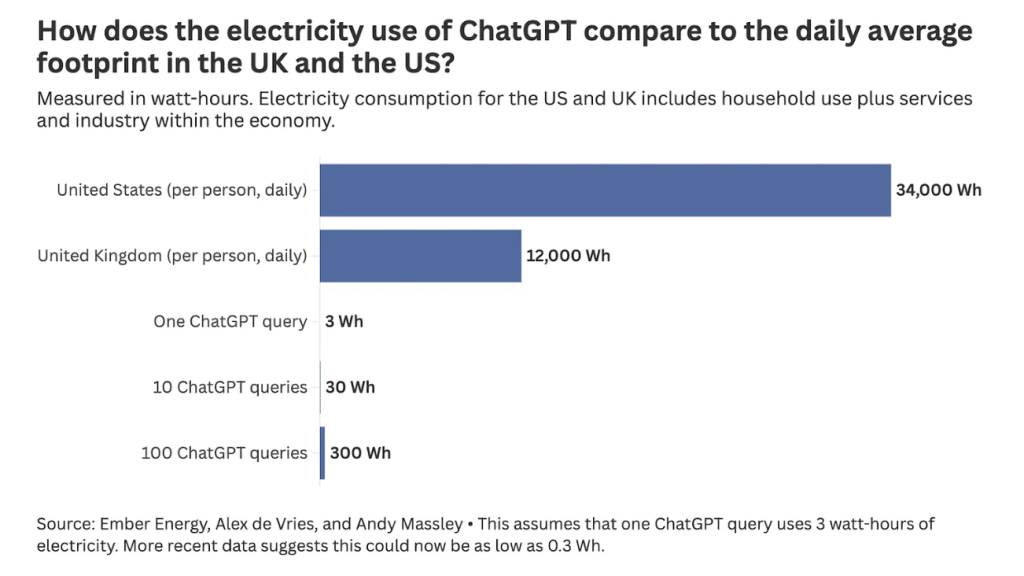
This also corresponds to an extremely small fraction of a person’s annual electricity consumption, illustrating how the impact of an individual query remains very low on a personal scale.
This comparison shows that for an individual, digital sobriety matters, but it doesn’t replace major factors like transportation, heating, or food.
Some estimates suggest that ChatGPT might sometimes consume only about 0.3 Wh per query, barely more than a typical search (Epoch AI, 2024; Hannah Ritchie, 2024).
The real impact largely depends on the task requested, the length of the responses, the model used, and production optimizations.
As Hannah Ritchie points out, even with intensive use, such as 100 queries per day, the portion would remain modest on the scale of individual daily electricity consumption and significantly lower than the primary energy uses in daily life.
At this stage, the best approach is to adopt “useful” practices (more targeted queries, fewer unnecessary regenerations) rather than a complete halt guided by guilt.
To give an order of magnitude: 0.3 Wh is roughly what a LED bulb consumes in about 1 minute and 30 seconds, or what an electric oven consumes in less than half a second.*
A change in certain practices, such as car use or dietary choices, has a much greater environmental impact than stopping the use of AI, even though the cumulative impact on a global scale remains an industrial and political issue.
Hannah Ritchie also notes that even over an entire year, the regular use of ChatGPT represents an order of magnitude of a few kilograms to about ten kilograms of CO₂ per year, depending on usage assumptions. This remains extremely low compared to the average annual emissions of an individual, which count in several tons of CO₂.
* A LED bulb has a power of between 4 and 20 W, with an average of 12 W. It therefore consumes 0.3 Wh in 0.3 / 12 = 0.025 h = 1.5 min = 90 sec.
The same calculation applies to an electric oven, which has a power range of 2000 to 3000 W: it consumes 0.3 Wh in 0.3 / 2500 = 0.00012 h = 0.432 sec.
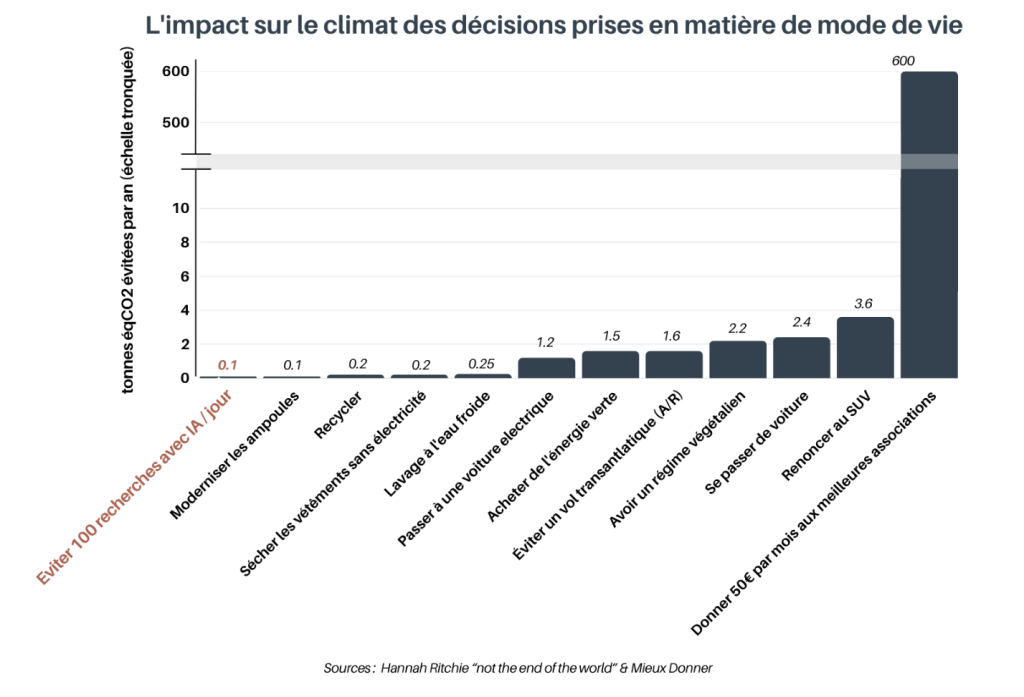
This graph summarizes the impact of several actions to reduce one’s carbon footprint. Donating to organizations working for systemic changes in environmental and energy policy, such as the Clean Air Task Force or Good Food Institute, can have a potentially much greater climate impact than reducing individual micro-uses, such as occasional use of digital tools, including AI.
The key idea is that the leverage effect of collective and structural actions far exceeds the optimization of individual micro-uses.
Some studies, such as the one published in Scientific Reports (2024), estimate that generating a text or illustration via AI can, in some cases, produce less CO₂ than equivalent human processes, especially when the latter involve prolonged use of computers and digital infrastructure.
This result heavily depends on assumptions (work time, equipment used, number of iterations, type of infrastructure), but it highlights an important point: the environmental footprint is not always intuitive, and AI can sometimes replace more energy-consuming processes.
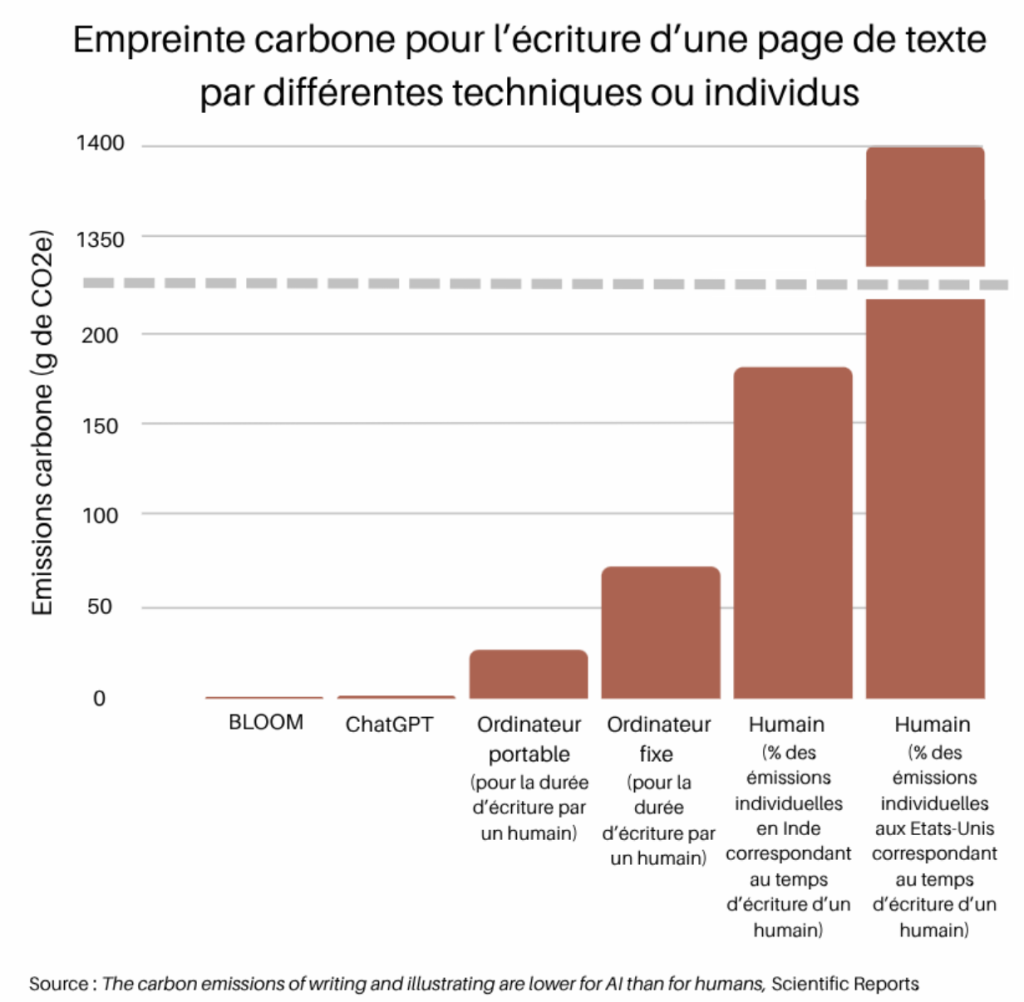
This figure compares the CO₂e emissions of AI and humans tasked with writing a page of text. According to the study (Scientific Reports, 2024), AI (via BLOOM or ChatGPT) can, in some cases, produce between approximately 130 and 1500 times less CO₂e per page than equivalent human processes involving computer use.
The study also shows that AI can produce less CO₂e than prolonged computer use for writing text, due to the speed of execution and shorter duration of resource use.
Although the exact differences heavily depend on assumptions (work duration, equipment, infrastructure, model used), the general trend suggests that the ecological “overcost” of AI is not systematically higher than that of human digital alternatives.
Water: Orders of Magnitude
Regarding water, some estimates suggest that a generative AI query may indirectly consume about 7 to 47 ml of water, depending on the location of the data center, the electricity mix, and the cooling system used. This estimate mainly includes water used for electricity production and, in some cases, cooling infrastructure.
Doing 10 queries per day for a year would represent an order of magnitude of about 25 to 170 liters of water, roughly equivalent to a shower or a bath, or still a very small fraction of the water footprint associated with food products like beef.
The study also shows that AI can produce less CO₂e than prolonged computer use for writing text, due to the speed of execution and shorter duration of resource use.
Although the exact differences heavily depend on assumptions (work duration, equipment, infrastructure, model used), the general trend suggests that the ecological “overcost” of AI is not systematically higher than that of human digital alternatives.
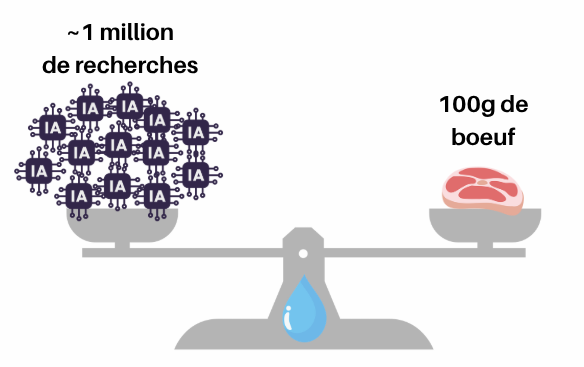
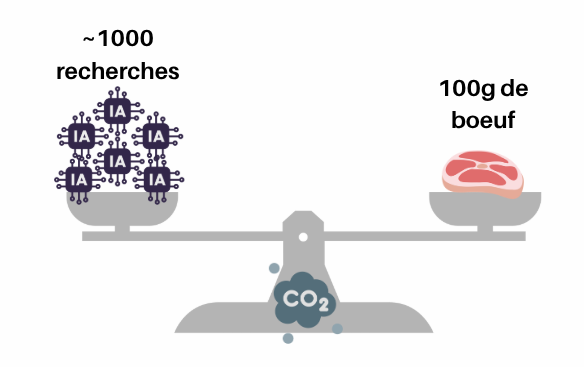
This comparison helps put the orders of magnitude into perspective. It is based on an assumption of about 1 to 50 ml of water indirectly consumed per AI query, mainly through electricity production and data center cooling (Li et al., 2023). At this scale, the water impact of individual use remains very low: it would take several hundred thousand to about one million queries to match the water footprint of a single 100 g beef steak. The main issue, therefore, lies less in individual occasional use than in the cumulative impact of large-scale infrastructure.
III – A Rapidly Evolving Technology
Generative artificial intelligence is still a young technology. However, it is evolving rapidly, and concrete strategies are emerging to reduce its environmental impact.
Efficiency gains (hardware, models, orchestration) will likely play a decisive role, provided they are not entirely offset by the rebound effect (more usage, more queries, more automation).
As Hannah Ritchie points out, computer systems, including AI models, generally become more efficient over time due to improvements in hardware, software, and infrastructure optimization. This means that the energy consumed per query could decrease as technology advances, even if total consumption increases with the growing adoption of these tools.
Certain technical advancements are already allowing optimization of when and where queries are executed to reduce their energy footprint, particularly by aligning them with low-carbon electricity availability or improving system efficiency.
Better orchestration (choosing the smallest possible model, caching, routing, query optimization) can also significantly reduce the footprint without degrading usability.
Efforts are also underway to better measure and manage the water impact of infrastructures, which depends on the type of cooling, the local electricity mix, and the location of data centers.
This monitoring becomes crucial because, according to the Lawrence Berkeley National Laboratory (2024), the electricity consumption of data centers could increase significantly by 2030 due to the growth of AI and digital usage, in the absence of major efficiency improvements.
Without public and comparable metrics, it remains difficult to balance performance, cost, and efficiency. In this logic, publishing indicators like PUE and WUE, along with their evolution, would make impacts measurable and comparable.
It’s also important to ensure a better distribution of impacts. Some data centers are located in regions where electricity is more carbon-intensive or where water is a stressed resource, which can shift environmental impacts to certain geographic areas.
The question is not only “how much” AI consumes, but also “where” and “under what conditions” this consumption occurs.
As Hannah Ritchie points out, the environmental impact of AI heavily depends on structural factors such as data center efficiency, electricity mix, and infrastructure choices. These factors can significantly influence the actual footprint, regardless of individual usage.
Materiality: LCA of Hardware, GPU, and End of Life (E-Waste)
An important part of the ecological debate comes from the “invisible” layer: hardware. Generative AI models rely on fleets of GPUs and servers, thus on a hardware value chain (semiconductors) that involves:
- extraction and processing of resources;
- manufacturing of components and assembly;
- transport, installation, and maintenance;
- end-of-life management (e-waste).
As AI becomes more widespread, the issue of infrastructure efficiency, equipment lifespan, and the optimization of material resources becomes an important lever, just like energy and water.
This point is consistent with Hannah Ritchie’s analysis, which emphasizes that the environmental impact of digital systems, including AI, depends not only on their direct energy consumption but also on the physical and energy infrastructure that makes them possible.
But above all, AI is not only an environmental problem: it is also a lever.
According to the United Nations Environment Programme (UNEP), artificial intelligence can already contribute to:
- Better predicting climate risks, droughts, or floods;
- Optimizing energy production and distribution networks;
- Improving environmental monitoring through satellite image analysis;
- Identifying sources of pollution or deforestation on a large scale.
The challenge, therefore, largely consists of steering innovation towards uses that have a net positive environmental benefit.
The United Nations Environment Programme also emphasizes that some uses of AI could increase energy or resource consumption if they lead to an overall increase in usage, particularly due to rebound effects or increased automation.
For example, some applications like autonomous vehicles or computing-intensive digital systems could contribute to an increase in overall energy demand, depending on how they are deployed.
In other words, the final impact largely depends on the technological, energy, and regulatory choices that accompany the development of these systems.
This aligns with Hannah Ritchie’s analysis, which highlights that the environmental impact of AI mainly depends on structural factors such as the energy mix, infrastructure efficiency, and energy choices, rather than isolated individual uses.
However, it should not be overlooked that AI poses other more concerning risks, which the international report on advanced AI safety categorizes into three main types:
- Malicious use risks (harm related to the intentional use of AI to cause damage, such as mass disinformation or the facilitated development of biological weapons)
- Malfunctions (dangers resulting from a gap between the expected operation of an AI system and its actual behavior, such as the loss of control over future advanced AI systems)
- Systemic risks (various threats posed by AI to society and the environment, including unprepared job destruction, exacerbation of inequalities, and excessive resource consumption)
Here, we focus on the emissions linked to queries made by individuals to conversational artificial intelligences, like ChatGPT. However, a significant portion of AI’s resources is currently used by content farms: flooding YouTube feeds, massively generating web pages, or producing deepfakes, both in photos and videos. The majority of these deepfakes are, unfortunately, pornographic in nature and created without the consent of the individuals whose images are used.
Some organizations we recommend, such as CesIA or the Future Preservation Fund, are precisely working to better regulate the development of AI and mitigate associated risks. This is also where collective responsibility for these emerging technologies comes into play.
France / EU: Local Benchmarks (Mix, Data Centers, Reporting)
In France and the EU, the environmental footprint of AI usage strongly depends on the electricity mix and the location of data centers, which directly influence emissions associated with electricity consumption as well as water usage for cooling.
As Hannah Ritchie emphasizes, the environmental impact of the same query can vary significantly depending on the infrastructure used, its energy efficiency, and the electricity source mobilized.
Moreover, the European framework is gradually strengthening the requirements for environmental transparency and reporting for organizations, which helps improve the availability of indicators related to energy, emissions, and the efficiency of digital infrastructures.
In this context, the benchmarks developed by institutions like ADEME, as well as environmental reporting obligations at the European level, contribute to improving the measurement, comparability, and understanding of the environmental impacts of digital technology and AI.
Using ChatGPT Consciously
The use of ChatGPT or other generative AIs is not environmentally neutral. However, to date, its impact remains very limited on an individual scale, and optimization prospects are real.
As highlighted by Hannah Ritchie, even regular use of ChatGPT represents an extremely small fraction of annual individual energy consumption and emissions. As an order of magnitude, even daily use may account for only a few kilograms of CO₂ per year, which remains very low compared to the average annual emissions of an individual.
The heart of the matter is not to misunderstand the scale: a reasoned use makes sense, but the main focus is on the efficiency of infrastructures, the electricity mix used, and the technical choices of the companies that develop and operate these systems.
Hannah Ritchie particularly emphasizes that the overall environmental impact depends more on structural factors, like the efficiency of data centers and electricity sources, than on isolated individual user choices.
The important thing is to remain clear-headed without falling into counterproductive guilt.
Using these tools in a moderate, conscious, and useful way is still compatible with a coherent ecological approach.
Having a sense of scale mainly helps to avoid overestimating the impact of certain uses and better identify the actions that truly matter for reducing one’s environmental footprint.
If you want to make a real difference for the climate, you can visit our page on this topic.
Measure / Check Your Impact (Quick Checklist)
To move from general debates to something verifiable:
- Qualify your usage: short text, long conversation, image/video generation, frequency, regenerations.
- Estimate in ranges: apply brackets (e.g., 0.3–3 Wh per “standard” query, more for complex tasks) and count the number of actions over a week.
- Request metrics (if company/tool): PUE, WUE, location (country/region), electricity mix (or carbon intensity), and covered scopes (Scope 2/3).
- Reduce at the source: more targeted prompts, limit iterations, avoid generation “just to see”, and prefer the smallest model that suffices (when possible).
Mini Case Study: Usage Audit over 7 Days
Over 7 days, you make 140 text requests (≈ 20/day) and 20 image generations.
Conservative assumptions: 1 Wh per text request on average (an intermediate magnitude consistent with available estimates, generally ranging from about 0.3 to 3 Wh) and 10 Wh per image (a plausible illustrative assumption, as image generation typically requires more computation than text).
Calculation: 140 × 1 Wh = 140 Wh; 20 × 10 Wh = 200 Wh; total = 340 Wh over 7 days, or 0.34 kWh.
Even by doubling these assumptions, we remain at a modest scale on an individual level. For comparison, this amounts to less than one kilowatt-hour per week, which is a very small fraction of a household’s weekly electricity consumption.
The main interest of this exercise is to identify where the usage is concentrated, often dominated by the most computationally intensive tasks, such as image generation, video creation, or long conversations.
This order of magnitude is consistent with available analyses, notably those by Hannah Ritchie, showing that the individual energy impact of typical generative AI usage remains low compared to other everyday energy expenses.
Calculation: 140 × 1 Wh = 140 Wh; 20 × 10 Wh = 200 Wh; total = 340 Wh over 7 days, or 0.34 kWh.
FAQ
Does a ChatGPT query pollute more than a Google search?
On average, yes, according to several estimates, but the gap depends significantly on the complexity of the task, the model, and production optimizations. Hannah Ritchie also notes that these estimates vary greatly depending on the assumptions and should be interpreted with caution.
On average, yes, according to several estimates, but the gap depends significantly on the complexity of the task, the model, and production optimizations. Hannah Ritchie also notes that these estimates vary greatly depending on the assumptions and should be interpreted with caution.
Does AI primarily consume electricity or water?
Both: electricity powers computation, and water is involved both directly and indirectly. The impact strongly depends on the infrastructure used.
Should I stop using AIs to be eco-friendly?
For moderate individual use, the impact is generally low compared to other areas. Hannah Ritchie highlights that the main emission reduction levers at the systemic level lie elsewhere, particularly in energy systems and infrastructures.
Why does the impact vary so much across studies?
Because the assumptions change: model size, infrastructure, location, and methodology. The lack of transparency also contributes to these uncertainties.
How can I concretely reduce AI’s environmental impact?
At the individual level: optimize usage. At the collective level: improve energy efficiency, electricity mix, and transparency.
Does a long text chat consume more than several short queries?
Often yes, because processing depends on the amount of context.
What do PUE and WUE mean (and why is it important)?
They measure the energy and water efficiency of data centers.
What concrete actions can companies take?
Model optimization, more efficient infrastructure, transparency, and measurement.
These levers correspond to the structural factors identified by Hannah Ritchie as determinants for AI’s real environmental impact.
Notes and references
MIT News (2025) — Explained: Generative AI’s environmental impact
URL : https://news.mit.edu/2025/explained-generative-ai-environmental-impact-0117
Accès : 2026-02-17
Hannah Ritchie (2024) — The carbon footprint of ChatGPT and generative AI — Sustainability by Numbers
URL : https://www.sustainabilitybynumbers.com/p/carbon-footprint-chatgpt
Accès : 2026-02-17
Li et al. (2023) — Making AI Less “Thirsty”: Uncovering and Addressing the Secret Water Footprint of AI Models — University of California Riverside
URL : https://arxiv.org/pdf/2304.03271.pdf
Accès : 2026-02-17
Epoch AI (2024) — How much energy does ChatGPT use?
URL : https://epoch.ai/gradient-updates/how-much-energy-does-chatgpt-use
Accès : 2026-02-17
Luccioni et al. (2024) — The environmental impact of AI-generated text and images — Scientific Reports, Nature
URL : https://www.nature.com/articles/s41598-024-54271-x
Accès : 2026-02-17
Dodge et al. (2023) — Reducing AI’s environmental impact — Association for Computing Machinery (ACM)
URL : https://dl.acm.org/doi/10.1145/3581784.3607034
Accès : 2026-02-17
Harvard Business Review (2024) — The Uneven Distribution of AI’s Environmental Impacts
URL : https://hbr.org/2024/07/the-uneven-distribution-of-ais-environmental-impacts
Accès : 2026-02-17
United Nations Environment Programme (UNEP) — AI has an environmental problem. Here’s what the world can do about it
URL : https://www.unep.org/news-and-stories/story/ai-has-environmental-problem-heres-what-world-can-do-about
Accès : 2026-02-17
International Energy Agency (IEA) — Data Centres and Data Transmission Networks
URL : https://www.iea.org/reports/data-centres-and-data-transmission-networks
Accès : 2026-02-17
ADEME (France) — Le numérique : quels impacts environnementaux ?
URL : https://www.ademe.fr/presse/communique-national/le-numerique-quels-impacts-environnementaux
Accès : 2026-02-17
Lawrence Berkeley National Laboratory (2024) — United States Data Center Energy Usage Report
URL : https://eta.lbl.gov/publications/united-states-data-center-energy
Accès : 2026-02-17
Food & Water Watch (2025) — The environmental impact of data centers
URL : https://www.foodandwaterwatch.org/2025/01/16/data-centers-water-use-energy/
Accès : 2026-02-17
Tags : English Article