
398
individuals and companies donated


Director of Communications
Reading time: 45 minutes
In 2025, Mieux Donner pursued a clear and demanding ambition: to ensure that every donation creates the greatest possible impact.
In a context where global challenges are intensifying, information is often conflicting, and good intentions alone do not always translate into meaningful results, Mieux Donner acts as a trusted point of reference.
We support individuals who wish to give by directing their resources toward the most effective charities, based on scientific evidence, independent evaluations, and a rigorous methodology.
This 2025 activity report presents what was concretely achieved, the strategic choices that shaped our work, and, above all, the measurable impact generated.
Key figures from the 2025 Activity Report.
398
individuals and companies donated
330
first-time donors
944 753 €
directed to high-impact charities in 2025
1 019 112 €
directed since Mieux Donner was founded
10.5
gross giving multiplier
5.3 to 6.2
estimated counterfactual giving multiplier
In 2025 Mieux Donner received donations from 398 individuals and companies and directed 944 753 € to high-impact charities.
Available research shows a striking fact:
the same euro can have up to 100 times more impact depending on the charity supported
.
Yet this information remains difficult to access, and donation decisions are still largely driven by reputation, emotion, or habit.
Mieux Donner was founded in response to this observation. Its role is not to collect as much money as possible, but to
structure the giving decision, so that generosity translates into
concrete, lasting, and measurable results, in the service of the common good.
Knowledge & evidence
Tools & clarity
Donation process
In 2025, the Mieux Donner team chose to focus its efforts on the levers identified as the most impactful.
Through the production of content, opinion pieces, events, and editorial projects.
By improving the donation platform and user experience.
Through giving pledges and follow-up with donors over time.
Three focus areas shaped the year
Editorial projects · op-eds · events
Platform · donation processes
Giving pledges · donor follow-up
252,684
people supported
133
lives saved
978,367
animals supported
86,574
tonnes of CO₂ avoided
€132,778
resources in 2025
€90,261
expenses in 2025
€127,276
cash balance at end of 2025
In 2025, Mieux Donner continued along the path of its founding commitment: to make generosity a concrete lever to improve lives and reduce suffering, with the same level of rigor applied to clarity, methodology, and real impact.
Amid contradictory information, the proliferation of causes, and the lack of reliable reference points, it is easy to want to do good and not know how to do it in the most effective way.
Mieux Donner was born from this observation: generosity is very much present, but it often lacks the tools, clarity, and guidance needed to translate into real impact. Our ambition is to help move from generosity driven primarily by intention to generosity that also equips itself to truly make a difference.
Month after month, as more generosity was donated to highly effective charities, we saw the number of lives meaningfully improved increase, suffering decline, and living conditions change.
Thank you to all those who make this journey possible: the people who act and those who support them.
2025 taught us one essential lesson: giving is most effective when it is guided by meaning, method, and commitment.
2026 opens as a new stage to deepen this standard, refine our tools, and continue directing generosity toward what truly helps the most.
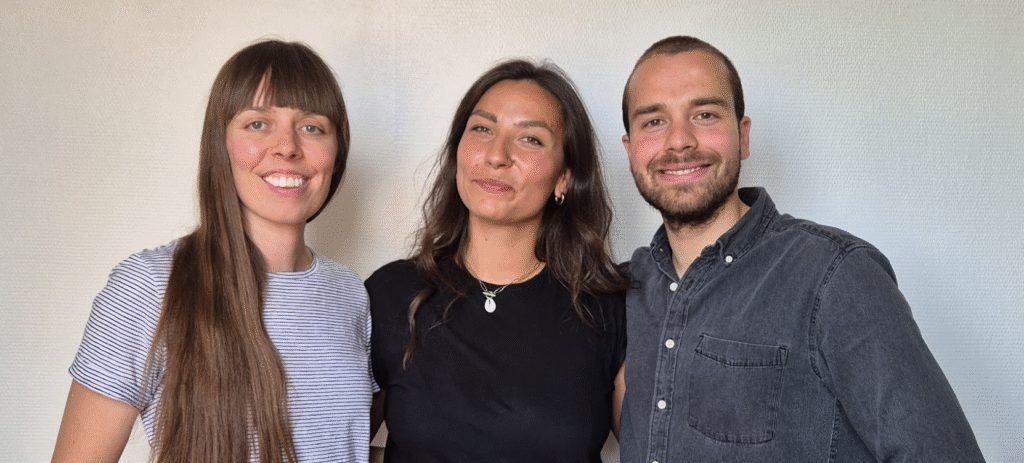
Jennifer, Ombline and Romain
This diagram illustrates two distinct pathways: funds directed to nonprofits and voluntary support for operating costs.
Mieux Donner’s theory of change explains how and why our model produces real impact: it connects the actions we take to the transformations we aim to generate, both for people who give and for those who are supported.
Many people express a strong desire to take action, to give, or to support causes that matter to them. However, this intention often encounters several obstacles:
In this context, uninformed generosity can lead to very different outcomes depending on the causes supported and the charities chosen—sometimes with far less effectiveness than one might expect.
Mieux Donner works to ensure that every act of generosity is grounded in reliable, comparative, and contextualized knowledge, so that donations can generate the greatest possible impact for the people and causes supported.
This ambition translates into two main transformations:
Our model is based on a logical chain of effects structured around three main stages:
1. Rigorous analysis of available evidence
We collect and analyze scientific research, evaluations conducted by recognized independent organizations, and comparative impact data. This stage makes it possible to identify interventions and charities with documented effectiveness, supported by robust evidence. It allows us to move beyond visibility or reputation and focus instead on actual effectiveness.
2. Production of accessible resources
The knowledge identified is translated into resources usable by everyone:
These resources are designed to be understood without prior technical expertise, making impact analysis accessible to a broad audience.
3. Supporting generosity decisions
Beyond public resources, Mieux Donner provides concrete infrastructure to turn information into action, including:
The goal is not only to inform, but to make generosity decisions simple, traceable, and aligned with what evidence shows about real impact.
This process aims to generate several interconnected transformations:
As more people adopt structured giving and direct their donations toward high-impact actions, the effect compounds: individual choices become more effective, and norms around generosity evolve toward a focus on real impact.
In summary: Mieux Donner’s theory of change is based on a simple hypothesis: if donors are better informed, and if their donations are directed toward charities with demonstrated impact, then generosity will produce more real good for those supported.
Mieux Donner offers personalized support, which may include:
For example, someone wishing to support a cause may discover, through the content provided, that very different approaches exist to address the same issue—and that their effectiveness can vary considerably. The comparisons presented help convey orders of magnitude of impact and guide generosity toward actions with documented effects.
Similarly, the recommendations available on the site go beyond listing charities: they explain the methods used, expected results, and uncertainties, enabling more thoughtful giving.
Finally, educational resources support this approach by helping structure choices, prioritize actions, and embed giving within a long-term perspective.
These elements illustrate Mieux Donner’s purpose: transforming generous intent into conscious, structured action that is genuinely useful for those being helped.
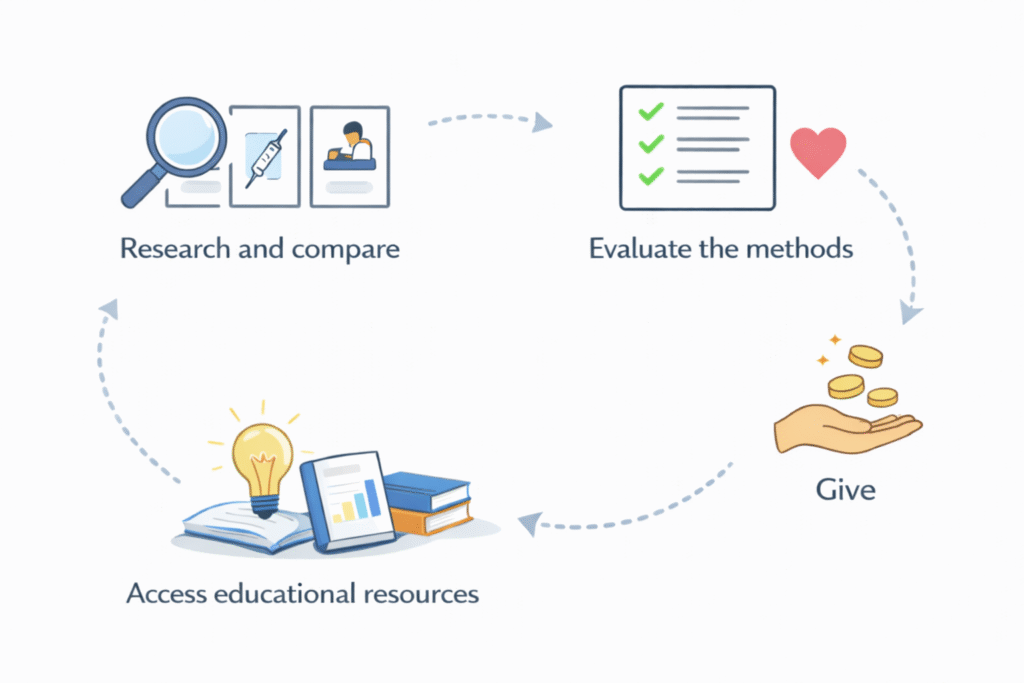
Beyond the volume of donations raised, 2025 was above all marked by a sustained focus on the levers that genuinely amplify the impact of generosity.
Throughout the year, the team regularly reflected on what needed to be prioritized, adjusted, or sometimes set aside, in order to remain aligned with what produces the greatest real impact.
In 2025, we sought to grow the impact of generosity while staying true to what makes Mieux Donner distinctive.
Our decisions were guided by a few simple principles:
These principles structured all of our choices and the trade-offs made throughout the year.
A single logic: expand reach, convert interest, retain engagement, and anchor commitment over time.
This funnel structures all of our decisions: growing our audience, turning intention into action, and building lasting relationships with people who give.
What this enabled in 2025:
What this enabled in 2025:
What this enabled in 2025:
2025 objective: Improve the donation experience to make it smoother, clearer and more reliable, while laying the foundations for an infrastructure capable of supporting future growth.
Investing in robust foundations requires time and iteration, but it is an essential prerequisite for sustainable growth.
2025 objective: Increase the donations raised through Mieux Donner, while remaining mindful of how these donations are made.
Reaching €1 million in 2025 marks a major step for Mieux Donner. More people are donating to charities with proven impact, and by tracking donations over time, we can see how giving grows in meaningful ways.
2025 objective: Provide a well-argued and accessible contribution to public debates on the effectiveness and allocation of international aid.
Some actions generate systemic impact: their effects are indirect and delayed, but potentially decisive in the long term.
2025 objective: Expand the audiences exposed to the challenges of generosity and real impact.
Projects with strong relational and editorial intensity require clear trade-offs, but play a key role in the sharing of ideas.
68 people are still giving (out of 117 active donors in 2024)
53 people still give €100 or more (out of 75 donors giving €100+ in 2024)
Among the 330 new people who donated via Mieux Donner in 2025, 209 gave at least €100, while 121 made a smaller donation.
In other words, more than 60% of total amounts come from large individual donations. But nearly a third also comes from around a hundred mid-sized donations, and a meaningful share relies on smaller contributions—often recurring.
At Mieux Donner, our goal is not to raise as much money as possible, but to generate the greatest possible impact.
Focusing on the charities with the greatest potential for impact is not about reducing generosity to numbers; on the contrary, it is about seeking to turn every donation into tangible outcomes for the people, animals and causes that need it most.
Romain Barbe · Founder of Mieux Donner
Mieux Donner deliberately focuses its work on a small number of cause areas for which we have strong reasons to believe that the positive impact per euro donated is the highest. This prioritization is based on the same criteria used to select the recommended charities.
Based on data from international partner evaluators and the impact estimation methods used, the directed funds allow us to estimate the following effects:
252,684
people helped
133
lives saved
978,367
animals helped
86,574 t
tonnes of CO2 avoided
These figures provide an order of magnitude of the effects generated by directed generosity through Mieux Donner. They help move beyond a purely financial view of giving and instead focus on what truly matters: the tangible consequences for people, animals, and ecosystems.
These figures come from some of the most rigorous cost-effectiveness analyses available and aim to cautiously represent real-world impact. Estimates are available on the charities’ pages.
The impact of Mieux Donner is not limited to donations. It also includes the spread of ideas, the mobilization of a structured debate around effective generosity, and influence on public discourse about giving.
In 2025, Mieux Donner benefited from regular coverage in national and specialized media outlets, helping to bring a more demanding and better-informed approach to generosity into the public debate.
These contributions made it possible to highlight key messages about the effectiveness of giving, the role of research and data in philanthropic decision-making, as well as the geopolitical, humanitarian, and environmental challenges related to resource allocation.
Main publications in 2025:
In 2025, Mieux Donner was invited and featured in several audiovisual formats distributed on mainstream platforms, helping to broaden the reach of its ideas and make the challenges of informed generosity more accessible.
These interviews, published on YouTube and Spotify, provided an opportunity to present Mieux Donner’s approach, principles, and methods in long, conversational formats that are designed to encourage in-depth discussion and sharing.
They represent an important lever for visibility and education, complementing written content and media contributions, and helping to promote a more thoughtful and demanding approach to generosity among diverse audiences.
In 2025, Mieux Donner also invested in events, public talks and live formats to promote effective generosity and make its ideas accessible to new audiences.
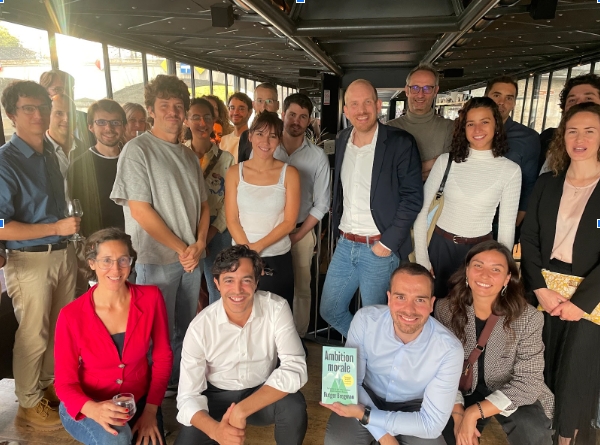
One of the highlights of the year was supporting the French launch of Moral Ambition by Rutger Bregman in September.
In just ten days, the team organized a launch event on a boat in Paris, including:
Although the event was not intended to generate donations, it played a crucial role for Mieux Donner: it helped introduce the concept of moral ambition and the principles of effective generosity to a broader and more diverse audience.
It served as a key moment to disseminate these ideas among media professionals, influential figures and nonprofit actors, and to position Mieux Donner within a broader ecosystem of reflection and action around real-world impact.
The event also led to several editorial publications (book summary, quotes, event recap) on the Mieux Donner website, strengthening its role as a leading French-language reference on these topics.
Effective altruism is a movement that seeks to combine compassion, reason and scientific evidence to determine the most effective ways to help others with the resources available.
In this context, Mieux Donner participated in 2025 in the Effective Altruism Summit. This participation enabled Mieux Donner to:
Several webinars were organized throughout the year, including:
These formats were used as tools for education, conversion and retention, particularly among pledgers and individuals already interested in impact.
2025 marks an important milestone in the financial consolidation of Mieux Donner.
The organization successfully combined strong institutional support with growing individual contributions, while maintaining rigorous and prudent resource management.
As of January 1, 2025, Mieux Donner held €84,759 in cash reserves. As of December 31, 2025, these reserves amount to €127,276, representing a net increase of €42,517 over the year and enabling preparation for team growth.
This positive development reflects both the trust of funders, the team’s budgetary discipline, and the strength of the organization’s economic model.
In 2025, Mieux Donner mobilized €132,778 in resources, exceeding initial projections.
| Source of funds | Amount |
|---|---|
| Foundations and funds | €109,147 |
| Individual contributions | €22,193 |
| Financial income (interest) | €1,438 |
| Total | €132,778 |
Foundations and philanthropic funds form the primary funding base of Mieux Donner. They ensure the organization’s ability to invest in its tools, research and team, while preserving its independence from the charities it supports. The two largest funders are supporters connected to the Ambitious Impact incubator, notably through their Seed grant which enabled our launch, as well as Coefficient Giving.
Individual contributions represent a growing share of resources. While still a minority in volume, they play a strategic role: they reflect the endorsement of those supported by Mieux Donner and strengthen the legitimacy of the model.
Financial income, generated from treasury management, complements these resources and contributes to the organization’s stability.
Total expenditure in 2025 amounted to €90,261, below the initial budget, partly explained by a planned 10% margin. This spending discipline, combined with incoming support, allowed the organization to strengthen its cash reserves.
| Use of funds | Amount |
|---|---|
| Salaries and social charges | €65,674 |
| Service providers and freelancers | €11,665 |
| Tools, marketing and communications | €6,121 |
| Events and travel | €4,898 |
| Operational expenses | €1,904 |
| Total | €90,261 |
The majority of resources are allocated to human capital. This reflects the nature of Mieux Donner’s model: an organization built on analysis, knowledge production, guidance and the spread of ideas, relying primarily on the expertise of its team.
Spending related to service providers and digital tools supports the donation platform, payment security, tracking tools and content production.
Events and travel contribute to community-building, strategic exchanges and Mieux Donner’s visibility.
The difference between resources and expenditures results in a surplus of €42,517, which strengthened cash reserves and improved the association’s financial outlook for the coming year.
Mieux Donner does not aim to accumulate funds unnecessarily in its reserves, especially considering that some charities need funding immediately to make a significant difference. We aim to maintain sufficient reserves for the next 6 to 18 months. Expenses in 2026 are expected to be higher than in 2025, and the current reserves prepare the organization for the coming year, including potential recruitment.
The giving multiplier is a way of assessing the impact of an organization like Mieux Donner. Various effective giving promotion organizations use this metric. Founders Pledge’s report defined the main measurement methods, and Giving What We Can provides tools on the topic that we use.
Mieux Donner is an independent organization whose mission is to guide generosity so that available resources are directed toward charities capable of producing the greatest real-world impact.
In this context, the operating budget alone is not a meaningful indicator of impact. The central question is the extent to which Mieux Donner’s existence and actions redirect financial flows toward highly effective charities, compared to what would have happened in its absence.
This is precisely what the giving multiplier seeks to measure: how many euros are directed toward high-impact causes, truly attributable to Mieux Donner, for each euro invested in its operations?
This evaluation covers the 2025 calendar year and aims to:
The giving multiplier is a leverage indicator of generosity. It evaluates an organization’s ability to generate a much larger financial flow toward high-impact charities.
Unlike purely financial or accounting indicators, the giving multiplier:
It therefore does not measure “all the money that passes through,” but rather the money whose trajectory was altered due to Mieux Donner’s existence.
(1) A donation has strategic value only if it is counterfactual: that is, if it would not have occurred, or not in the same way, without Mieux Donner. This includes in particular:
In 2025, the amount of donations directed toward very high-impact charities per euro invested in Mieux Donner’s operations was 10.5. Our most likely counterfactual giving multiplier is estimated between 5.3 and 6.2, depending on the calculation method used.
The first estimate (5.3) includes all donations directed by the organization during the evaluation period, adjusted for impact, without distinguishing between long-term commitments and other donations. It does not account for the future value of commitments secured during the year, which are incorporated into impact assessments of subsequent years.
The second estimate (6.2) explicitly incorporates giving commitments into Mieux Donner’s theory of impact. It combines donations made outside commitments and the estimated long-term value of commitments secured during the period. This method aims in particular to avoid double counting by distinguishing between donations from already committed individuals and those genuinely generated by the organization’s action.
In 2025, each euro invested in Mieux Donner generated between €5.3 and €6.2 in additional donations toward high-impact charities that would not have occurred without its action.
Some of the directed donations might have occurred even without Mieux Donner. The purpose of the evaluation is therefore to estimate what proportion of the directed amounts would not have existed, or would not have been directed toward these charities, without its intervention.
This adjustment aims to measure the share of funds truly transferred in a counterfactual manner — that is, specifically thanks to Mieux Donner’s influence.
Concretely, this involves estimating the proportion of donations that:
in the absence of Mieux Donner.
This proportion is then applied to the total amount of directed funds to estimate the volume of donations genuinely attributable to the organization’s action.
The estimate is based notably on:
Responses to the question: “Which option best describes what you would probably have done with the money you gave us if you had not encountered Mieux Donner?”
Two main biases can nevertheless be identified:
Influence of the tax deduction on donation amounts
Responses to the question: “To what extent did the tax deduction influence the amount you donated?”
Estimate of the theoretical adjustment linked to the share of donations that would have been directed to non-recommended charities.
This correction is not included in the final calculation, in line with Giving What We Can and Founders Pledge practices.
| Origin of donations | Conservative estimate | Expected value |
|---|---|---|
| Person linked to, or mentioning, effective altruism or one of the affiliated organizations | 40% | 55% |
| Contact directly initiated by Mieux Donner | 100% | 100% |
| Podcast, press articles, social media, and word of mouth | 50% | 75% |
| Share of 2025 donations that are counterfactual | 55% | 58% |
We estimate that 58% of the donations collected by Mieux Donner in 2025 would not have been allocated to highly effective charities without Mieux Donner’s actions.
Around 80% of the estimate relies on self-reported survey data.
Small gap between conservative estimate and expected value because responses are used as-is.
International analyses show a tendency to overestimate one’s ability to give effectively.
Selection bias among respondents, impossible to reliably correct for non-respondents.
In the calculation of the counterfactual multiplier, Mieux Donner includes an adjustment related to the opportunity cost of work. This aims to estimate the alternative impact that the team members could have generated if they had not worked for the organization. It is assessed by considering a higher-paying activity on the labor market and the corresponding donations. However, volunteer work time is not taken into account for 2025.
The salaries retained correspond to employer payroll costs (gross-up), for a total amount of €65,674.
€65,674 × 2.0 × 50% = €65,674
This amount is subtracted from the calculation in order not to overestimate the net impact attributable to Mieux Donner’s action.
The amounts taken into account include:
To make the giving multiplier rigorous, we use the amount actually directed during the 2025 calendar year.
| Indicator | Amount |
|---|---|
| Cumulative total end of 2024 | €74,359 |
| Cumulative total end of 2025 | €1,019,112 |
| Amount directed in 2025 | €944,753 |
The expenses taken into account correspond to Mieux Donner’s actual operating costs for the 2025 financial year.
| Expense item | Amount |
|---|---|
| Salaries and payroll taxes | €65,674 |
| External services | €11,132 |
| Operating expenses | €13,455 |
| Total 2025 expenses | €90,261 |
The leverage effect, or Gross Giving Multiplier, is calculated as follows:
A leverage ratio of 10.5 means that in 2025: every euro invested in Mieux Donner’s operations directed more than ten euros toward high-impact charities.
This result indicates that Mieux Donner acts as a generosity amplifier by:
This net giving multiplier estimate is based on a method that takes into account the total value of the amounts directed by the organization over the period evaluated, adjusted based on their impact and their counterfactual aspect.
It does not distinguish donations stemming from long-term commitments from other donations: all directed donations are included in the calculation.
However, this method does not take into account the future value of giving pledges acquired during the period. These pledges are generally integrated into impact evaluations in subsequent years, when they effectively translate into realized donations.
A share of the directed donations could have occurred even in the absence of Mieux Donner. The objective is therefore to estimate what proportion of the directed amounts would not have existed, or would not have been directed to these charities, without the organization’s intervention.
This counterfactual proportion is applied to the total amount directed in order to estimate the donations genuinely generated by Mieux Donner over the period.
In other words, each euro invested in Mieux Donner’s operations made it possible to generate an average of €5.3 in additional donations toward high-impact charities, which would not have existed, or not in this form, without its action.
This estimate is relevant only for organizations that include giving pledges in their theory of impact, which is the case for Mieux Donner. For organizations that do not take pledges into account, this value is equivalent to the one obtained by the method based solely on current donations.
This estimate of the counterfactual giving multiplier is based on a method that takes into account:
The calculation explicitly seeks to exclude donations already counted from people otherwise pledged, in order to avoid any double counting between realized donations and future pledges.
This approach makes it possible to estimate not only the short-term impact generated, but also the durable impact associated with donation trajectories that Mieux Donner helps create over time.
The expected value of giving pledges is defined by Giving What We Can.
The year 2025 was an intense year for Mieux Donner — a year in which we continued to build, test, and evolve our model, while observing more and more clearly what works and what needs to be improved.
Rather than following a fixed plan, we moved forward by staying attentive to what reality showed us: how people use our tools, how they make their giving decisions, and how our organizational choices influence the impact we can generate.
In 2025, one thing is certain: people are willing to change the way they give when they are provided with solid information, clear comparisons, and a simple decision-making framework.
Impact-based recommendations, educational content, and support were genuinely used.
People who donate changed their choices, sometimes very significantly, based on what Mieux Donner brought them.
This confirms a key point: many people want to do good, but above all they need help to understand where and how their money is most useful.
Another strong point in 2025 was the trust placed in Mieux Donner. People who commit explain that they do so because they feel the work is serious:
This rigor has become one of the main drivers of commitment: people give because they understand why a given charity is being recommended.
The year 2025 also showed that the giving pledge plays a central role.
It is not only a tool to give more; it is a framework that helps people ask real questions:
Offering both a 10% pledge and a trial progressive version made it possible for very different profiles to find their fit.
This system helped create a core of people who give more regularly and more thoughtfully.
At the same time, we need to:
This forced the team to make difficult choices and accept not moving as fast as desired.
Many people agree with the idea of giving more effectively, but taking action remains a barrier.
This shows that impact depends not only on the quality of ideas, but also on the clarity of the process, reminders, and follow-up.
The challenge is to remain honest and rigorous while speaking in a clear and accessible way.
Rather than trying to produce large volumes of simplified content, the team chose to provide resources that take the time to explain, compare, and nuance.
This more demanding work takes time, but it helps build lasting trust and supports more informed giving decisions.
The giving pledge was confirmed as a central element, while leaving room for different paths.
Rather than locking in a model too early, Mieux Donner chose to learn by moving forward — staying true to its mission while adapting its tools and methods to on-the-ground reality.
After a year in 2025 dedicated to consolidating the model and increasing the generosity directed by Mieux Donner, 2026 fits into a broader trajectory: that of an ambitious project aiming to reach €5 million directed in 2027.
In this trajectory, 2026 is designed as a year of structuring and acceleration.
The challenge is not only to do more, but to give ourselves the means to do much more, sustainably.
One key point emerges very clearly from the strategy: in order to seize new opportunities and sustain a higher level of ambition, Mieux Donner can no longer depend mainly on the time of two people. The organization must build a team capable of operating autonomously and supporting growth.
Corresponds to the minimum expected level, given that the two largest supporters in 2025 are not guaranteed in 2026.
Represents the realistic growth scenario based on current projections.
Aligned with the trajectory toward €5 million directed in 2027.
The ramp-up planned for 2026 relies on a significant strengthening of the team: building a strong and autonomous team capable of managing new opportunities and sustaining growth.
The 2026 strategy sets out a clear principle: when several options are possible, Mieux Donner will choose those with the strongest long-term potential, even if they involve greater uncertainty.
For example, rather than prioritizing the publication of an op-ed, it may be more strategic to convince a new ambassador who can reach their audience on multiple occasions. This principle aims to direct energy toward the levers that can truly change the scale of long-term impact.
The medium-term ambition is summarized by one number: €5 million directed in 2027. Our long-term ambition remains the same: to make effective generosity the norm.
2026 should make it possible to build the team and the relationships needed for Mieux Donner to become a central actor in structured and impact-oriented generosity.
Thank you for reading our annual report and for your interest in the impact of donations. If you would like to explore certain aspects further or discuss effective generosity, we would be delighted to speak with you.