
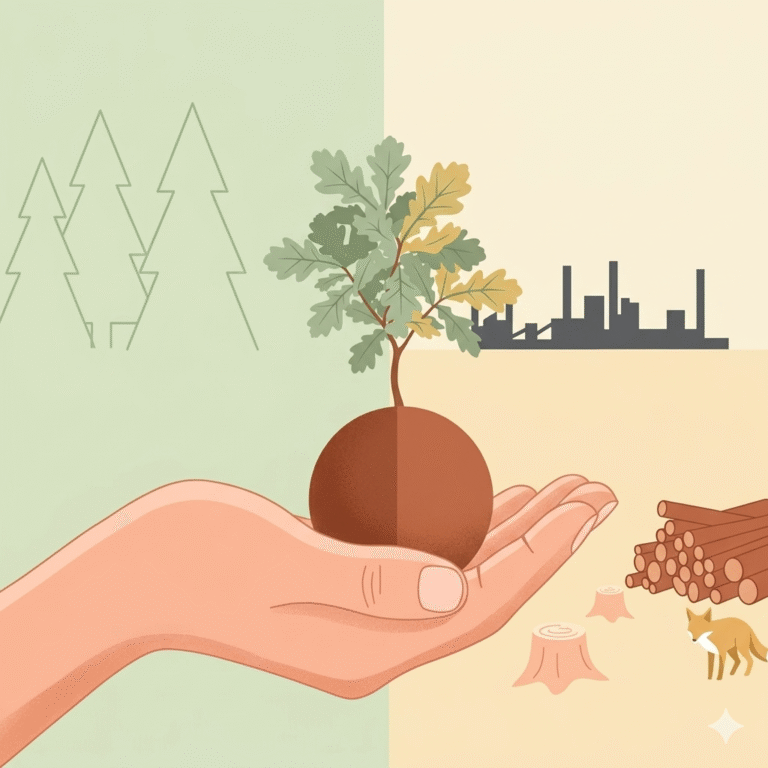
You want to donate for biodiversity. You are thinking about a rewilding project near you, restoring a wetland in your region, or reintroducing a local species. It is a generous and understandable impulse. Yet a study published in 2025 in the journal Science by a team of 22 researchers from Cambridge, Vermont and Stockholm reaches a troubling conclusion: in some cases, these local restoration efforts can cause five times more damage to global biodiversity than they provide in benefits. So how can you avoid doing harm, and where will your donation have the greatest impact on the planet?
1. What exactly is rewilding?
A broad definition, a wide range of practices
Rewilding refers to a set of practices aimed at restoring ecosystems by letting nature take back control, with minimal human intervention. In practice, this can take very different forms: allowing abandoned farmland to return to nature through passive rewilding, reintroducing lost species, restoring ecological corridors between protected areas, or rebuilding complete trophic chains.
What distinguishes rewilding from classical conservation is its ambition: rather than managing nature towards a predefined target state, the goal is to restore the conditions for its autonomy. But some projects aim for a return to a previous "natural" state, such as the reintroduction of apex predators, without necessarily addressing the suffering caused to the animals already living there. The reintroduction of wolves in Yellowstone or bears in the Pyrenees illustrates this tension well: satisfying people's call for "nature" on one hand, and conflicts with existing land uses and animal suffering on the other.
This diversity of practices is itself a difficulty: "rewilding" encompasses projects that sometimes share little more than the name, with highly variable ambitions, locations and impacts.
Rewilding is not an effective solution for climate change
A common misconception deserves to be addressed. Rewilding is often presented as a climate solution, particularly through carbon sequestration by restored forests. The reality is more nuanced.
Its carbon impact may be reported as positive, but it is often overstated, ignores negative secondary effects that can make some projects net-negative for the climate, and is sometimes too slow to materialise at the scale the problem demands. For climate action, organisations focused on policy advocacy and technological innovation are estimated to be around 50 times more effective than funding tree planting.
If your primary goal is climate action, the organisations recommended by Mieux Donner offer an incomparably more powerful lever. If your goal is biodiversity, that is a different question, and a more complex one than it might appear.
The French context: a growing movement
In France, the rewilding movement is organised and active. Rewilding France supports initiatives in the Dauphine Alps, where wild horses, ibex and lynx are gradually returning. Organisations like ASPAS purchase land to place it under total passive rewilding. Others, such as Forets Sauvages or networks like Paysans de Nature, develop intermediate approaches between conservation and rewilding. But these organisations do not necessarily use the best prioritisation methods or impact measurement frameworks.
This abundance of initiatives reflects genuine enthusiasm and growing interest. It deserves to be taken seriously, and it is precisely because it deserves to be taken seriously that it also deserves rigorous scrutiny.
2. The leakage paradox: when protecting here destroys elsewhere
Food demand does not disappear, it shifts
Imagine a large landowner decides to take 500 hectares of arable land out of production and leave it to nature. Good news for local species. But the demand for wheat, rapeseed or soy that this land was meeting does not disappear. It shifts to other land, often elsewhere in the world, in regions richer in biodiversity and less well regulated.
This is what researchers call "biodiversity leakage": the displacement of nature-damaging activities to other territories, caused by setting aside productive land. This phenomenon has been recognised for decades in the field of carbon credits, where it is already acknowledged as a major problem. But in biodiversity conservation, it is almost entirely ignored.
What the study reveals
According to the Cambridge study published in Science in 2025, 37% of managers of tropical conservation projects had never heard of the concept of leakage, and fewer than half of projects were actively trying to limit it.
Even the UN's landmark Global Biodiversity Framework, which aims to protect 30% of land and sea by 2030, makes no mention of this problem.
The Cambridge/Science study: two revealing scenarios
A team of 22 researchers from more than a dozen institutions modelled two hypothetical scenarios, each involving the restoration of 1,000 km² of active agricultural land.
| Country | Land restored | Production displaced to | Global biodiversity outcome |
|---|---|---|---|
| United Kingdom | Arable land (wheat, barley, rapeseed) | Australia, Germany, Italy, Ukraine | Global damage ~5x greater than local benefits |
| Brazil | Soy farms | Argentina, United States | Local gains ~5x greater than displacement harms |
Source: Balmford et al. (2025), Science 387, 720-722. Exploratory analysis based on hypothetical models.
The same conservation logic, two opposite outcomes, depending on the country's biodiversity richness and the destination of displaced production. As Professor Andrew Balmford of the University of Cambridge puts it: production deficits in temperate countries are displaced to regions that are often richer in biodiversity but less well regulated, such as Africa and South America.
What the study does not say: important limitations
Several important clarifications are needed. The authors themselves describe their findings as an "exploratory analysis": these are models applied to hypothetical scenarios, not direct measurements of existing projects.
The study does not say that all rewilding is harmful. It identifies a specific risk: rewilding of active agricultural land in countries with relatively low biodiversity. Two types of projects appear less exposed to this risk, or at least not to the same magnitude of negative effect:
Potentially lower-risk projects
The restoration of land that is already abandoned or degraded, with no active production to displace, carries a much lower leakage risk.
Projects located in areas of high local biodiversity, where on-the-ground gains better offset secondary effects.
These nuances matter. But they do not make the underlying problem disappear: the vast majority of rewilding projects in temperate Europe operate in exactly the highest-risk configuration.
3. What independent evaluators recommend
Giving Green: why local projects are not the priority
Giving Green is one of the rare independent evaluators to have conducted a rigorous analysis of philanthropic strategies for biodiversity. Their report, published in 2026 after several months of research, reaches a clear conclusion: location-specific conservation projects are not the philanthropic priority for those seeking to maximise their impact.
Their reasoning is structural. What has value is funding what no one else funds: systemic solutions that address root causes.
The number one root cause of terrestrial biodiversity loss is land use change: the conversion of nature into farmland. This is where philanthropy can have genuine leverage.
Understanding the logic of marginal impact
The two high-impact levers identified
Giving Green identified two priority strategies for terrestrial and freshwater biodiversity.
Alternative proteins. Livestock production is the primary driver of agricultural expansion in the world's most biodiverse regions. According to Giving Green's modelling, supporting the innovation and adoption of alternative proteins that are competitive on taste and price could reduce agricultural land expansion by up to 82% by 2050.
Wetland protection. Wetlands cover only 10% of global land area, yet support up to 40% of the world's species. They deliver the highest ecosystem service value per hectare of any major natural biome, and rank among the most threatened and most underfunded ecosystems in conservation.
Good Food Institute: the unexpected link between diet and biodiversity
The organisation Giving Green recommends first for biodiversity is not a conservation charity. It is the Good Food Institute (GFI), a global organisation working to make alternative proteins competitive with conventional meat in terms of taste, price and availability.
GFI is already recommended by Mieux Donner for reducing animal suffering and for climate action. Its presence in the recommendations of multiple independent evaluators is an exceptional case. Funding the protein transition means simultaneously acting on biodiversity, animal welfare, climate and public health.
How can GFI be the most effective across multiple causes?
4. What to do for biodiversity
Start by clarifying your actual objective
"Protecting biodiversity" covers very different intentions, which do not call for the same donation strategies. Before choosing where to give, it is worth asking yourself a direct question: what are you really trying to protect or improve?
If your priority is the number of species in the world, the most powerful lever is protecting tropical habitats and high-density wetlands. A word of caution, however: maximising species count as an objective in itself can lead to unexpected contradictions. In biology, there are cases where intermediate populations allow two groups to interbreed indirectly, forming a ring species complex. If the intermediate population disappears, the two extreme groups become distinct species, which mechanically increases the tally. Maximising species numbers as an end in itself can therefore lead to counter-intuitive decisions, even contrary to the conservation of functional ecosystems.
If your priority is the suffering of wild animals, the question is framed differently. Rewilding may improve the living conditions of some local species, but other approaches, focused on wild animal welfare, represent an emerging field of research that specialist organisations are beginning to fund.
If your priority is climate change, look primarily at organisations specialising in energy policy advocacy and climate innovation, whose impact is around 50 times greater than tree planting in terms of tonnes of CO2 avoided.
If your priority is improving human wellbeing and you are thinking about access to nature as a lever for this, there are analyses that highlight charities with far greater impact on human wellbeing.
The three-basket method can help you structure your giving: a first basket for yourself and those close to you, a second for the causes you personally care deeply about, and a third for acting where it is most useful on a global scale. Bear in mind, however, that spreading donations across too many charities can reduce your overall impact.
When rewilding is potentially relevant, and why it is not your first basket
Some rewilding projects likely cause less harm than others. Before supporting a project, here are the questions to ask its promoters:
- Is the land already abandoned or degraded? With no active production to displace, the leakage risk is significantly lower.
- Is the area high in local biodiversity? On-the-ground gains better offset secondary effects in species-rich zones.
- Does the project support local agricultural productivity? Maintaining production levels in the region reduces displacement to more vulnerable areas elsewhere.
- Has leakage been assessed and documented? Does the project promoter have an explicit strategy to measure and limit it?
If a project meets these criteria, its overall balance is probably less negative, or potentially even positive. But "less negative" or even "potentially positive" is not the same as "effective". These projects remain, at best, a second basket: a place to express a connection to local nature, not the lever for having the greatest impact with your generosity on the cause you care about.
If part of your generosity goes towards funding what you love rather than maximising impact, that is a legitimate and human choice. You can acknowledge it clearly and allocate another portion to what, according to the best available evidence, genuinely changes the course of things.
Relying on independent research
The rewilding sector is driven by passionate and sincere people. It is also driven by biases that are hard to avoid: we fund what we can see, what moves us, what we can visit. But sincerity does not protect against leakage, and enthusiasm is no substitute for rigorous evaluation.
Evaluators like Giving Green publish their methodologies and criteria. Mieux Donner is the organisation in France that supports people who want to put impact at the heart of their giving. Find the charities recommended by Mieux Donner following rigorous evaluation.
Why does Giving Green recommend GFI for biodiversity, rather than a conservation organisation?
Because the root cause of terrestrial biodiversity loss is land use change, itself primarily driven by the expansion of agriculture, and in particular livestock farming. Reducing meat demand through competitive alternatives directly addresses this systemic driver, whereas local conservation projects only treat its symptoms. This is the logic of marginal impact: funding what no one else is funding yet, where each pound or euro has the greatest effect.
Is rewilding greenwashing?
Not in the sense of deliberate misleading communication. Rewilding is a sincere practice, carried out by serious actors. But it shares a structural flaw with some forms of greenwashing: visible local impact obscures a global balance sheet that is difficult to measure. A project can genuinely improve biodiversity in a given territory while causing, through the leakage mechanism, greater damage elsewhere in the world. This is not bad faith; it is a collective blind spot that research is only now beginning to document seriously.
Which organisations have the greatest impact for biodiversity?
The question deserves to be considered at two levels. For impact on local biodiversity, organisations like ASPAS or the Conservatoires d'Espaces Naturels in France work seriously, even if their effect on global biodiversity remains limited. For impact on the systemic causes of global biodiversity loss, Giving Green identifies the Good Food Institute and Wetlands International as the most powerful levers currently available. These two levels correspond to two distinct baskets: supporting what you love locally, and supporting what actually changes things on a planetary scale.
What is "leakage" in terms of biodiversity, and why does it matter?
Biodiversity leakage refers to the displacement of harmful activities from a protected area to another area. When agricultural land is set aside, its production does not disappear: it is met elsewhere, often in regions richer in species and less well regulated. This is the same phenomenon as carbon leakage in forest credits, already well documented and recognised as a major problem. A study published in Science in 2025 shows that this mechanism can entirely reverse the balance of a rewilding project: what appears locally beneficial can cause five times more damage to global biodiversity.
You want to give for biodiversity with real impact?
Mieux Donner helps you identify the most effective levers for your values and objectives.