


Saving the animals: beyond endangered species
Saving animals: beyond endangered species 29 Janvier 2025. Temps de lecture : 7 min. The idea of saving animals often conjures up images of threatened
Worldwide, 23 billion animals are raised for meat on factory farms. 99% of animals in the USA [1] and more than 80% of animals in France [2] are raised on factory farms. The scale of suffering on factory farms is incomprehensible.
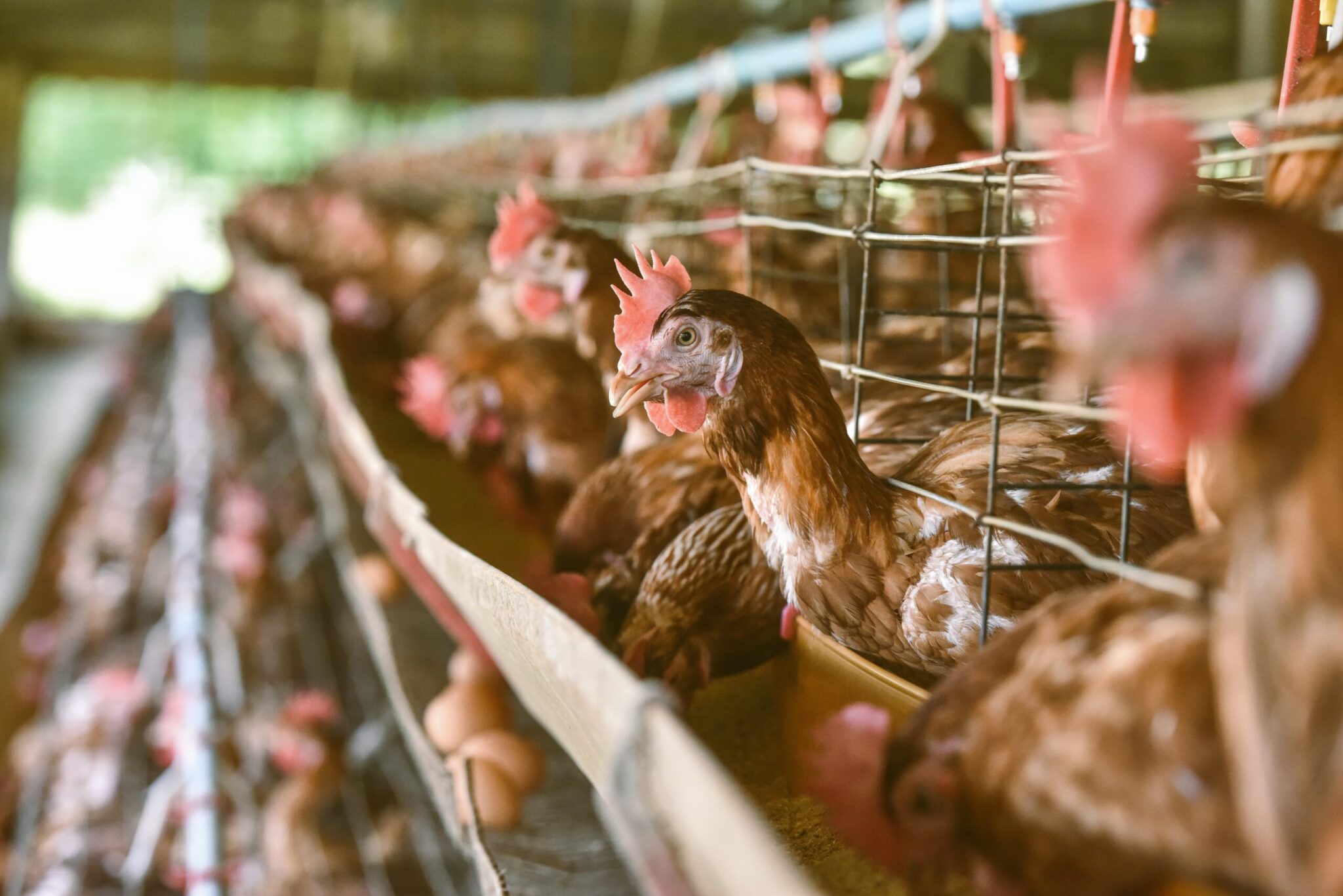
Pigs are often confined to spaces so small they can’t turn around, and chickens are bred to grow so abnormally fast that they become too heavy to stand and die of organ failure. Despite the scale of suffering endured by farmed animals, only 3% of donations earmarked for animal protection goes to farmed animals, compared with 95% for companion animals [3].
All animals, whatever their species, know fear, pain and suffering, and are capable of happiness. By donating to the world’s most effective charities for improving the lives of farm animals, you can help thousands of animals live a better life, for just a fraction of the cost of helping pets in shelters.
The most impactful associations stand out for their ability to generate significant change in the reduction of animal suffering. Thanks to a rigorous scientific approach and well-planned strategies, these organizations achieve concrete results that improve the lives of millions of animals every year. They lead advocacy campaigns to improve the living conditions of animals on factory farms, securing significant commitments from major corporations to adopt more humane practices. They also support innovation in plant-based alternatives and laboratory-grown meats, reducing reliance on intensive livestock farming and the associated suffering.
The Humane League (THL) aims to end the abuse of food animals by persuading companies to adopt higher animal welfare standards. Over the past decade, THL has successfully secured commitments from more than 400 companies to cease battery egg production. Every year since 2012, Animal Charity Evaluators has recommended THL as a leading organization [4].
Cost effectiveness
Using the success metrics of The Humane Leagues corporate campaigns in 2022, we conservatively estimate that The Humane League is able to spare one chicken from a life in a battery cage for just 0.85 euros [5]. This makes The Humane League one of the most cost effective charities in the world at alleviating animal suffering.
Donate 50€: Save 59 chickens from a life spent in a battery cage.
Donate 200€: Save 235 chickens from a life spent in a battery cage.
Donate 500€: Save 588 chickens from a life spent in a battery cage.

The Good Food Institute aims is to create a fairer, healthier food system, while reducing animal suffering and the ecological footprint of food production. They believe that the most effective way to do this is by promoting the development and marketing of alternatives to conventional meat, such as plant based meat and lab grown meat. In order to establish these alternatives on the market, The Good Food Institute is working with partners worldwide to develop products that are least equal in terms of taste, price and availability.
Cost effectiveness
The animal protection organization, FarmKind, estimates that 5.3 animals are helped for every euro donated to GFI [6].
Donate 50 € : Spare 265 animals from factory farming
Donate 200 €: Spare 1060 animals from factory farming
Donate 500 € : Spare 2650 animals from factory farming
[1] How many animals are raised on factory farms? (Our World in Data) [Accessed 11/07/2024]
[2] Élevage intensif : plus de 8 animaux sur 10 en France (L214) [Accessed 07/11/2024]
[3] Why farm animals? (Animal Charity Evaluators) [Accessed 11/07/2024].
[4] Charity Review : The Humane League (Animal Charity Evaluators) [Accessed 11/07/2024]
[5] How do we calculate the cost-effectiveness of The Humane League’s work?
We use caclulations from animal welfare organisation, FarmKind. We use a conversion of 1 dollar:1 euro from their estimates. They have calculated the cost per animal helped by dividing the number of animals affected by commitments they achieved in that year by the cost of those campaigns. We place fair confidence in this number as it is based on past performance of THL’s work and is more conservative that the estimates of other evaluations. However it is an average estimation and the true cost could vary. Full calculations can be viewed on FarmKind’s cost effectiveness spreadsheet for The Humane League, 2024 [Accessed 04/09/2024]
[6] Cost-effectiveness analysis calculations for animal protection organizations (FarmKind) [Accessed 12/07/2024]
Please note that the figure of 5.3 animals helped per dollar is highly uncertain, and we wouldn’t be surprised if the true figure was an order of magnitude different. Full details of the assumptions and figures used in FarmKind’s calculations can be found in their impact calculation spreadsheet. Please note we use a conversion of 1 euro: 1 dollar on our website from their estimations.
Tax deductions in France are currently only available for donations to four of our recommended charities: Against Malaria Foundation, Good Food Institute, Helen Keller International, and Centre pour la Sécurité de l’IA
If you are taxable in France, you will benefit from a tax reduction of 66% of the amount of your donation up to the limit of the tax due or 20% of your taxable income.
In practice, this means that if you were planning to donate €100, you can triple this amount to reach a donation of €300 that you will declare, with a real cost of only €102 after tax reduction. This allows you to multiply the impact of your donation without increasing your planned expenditure.
You can read our full article on tax relief in France for more information.
We are able to offer tax deductibility for this association and all the organisations we recommend through our partners, Effektiv Spenden. If your tax residence is in Switzerland, please make your donations via this link, so that you can receive your tax receipt at the end of the tax year.
We work with partners around the world and can offer tax deductibility in many countries. Please contact us if you would like to make a donation from another country and we will discuss the tax options available to you. If you would like to donate and do not require a tax receipt, you can make a donation via Mieux Donner regardless of your country!
Charities that prioritise the final outcome of their action and not indicators of impact. When talking about impact, it is essential to focus on the desired final outcome, such as improved opportunities and quality of life, rather than focusing on intermediate outcomes such as the number of books distributed.
It’s surprising how few charities measure their impact. Our top recommended charities use scientific methods to evaluate the results of their actions, ensuring that their interventions produce the desired effects.
They save or improve the most lives per euro donated to them. Eg) our top recommended global health charities can save a life for as little as 3,000 euros, our top climate charities can avoid one ton of carbon emissions for just 1 euro and our top animal welfare charities can spare thousands of animals from factory farming for the same price of saving one animal in a refuge.
All of our top charities are independently evaluated by world leading charity evaluators. See more information below.
A life is valuable whether it is based in France or the developing world.
Our top recommended charities are all tax deductible in Switzerland, but not in France. This is because French tax law dictates that a charity must operate from France in order to be tax deductible. We always prioritise the impact of a charity over its tax deductible status.
Some of our charities such as Against Malaria Foundation have very low overhead costs, and some such as Clean Air Task Force – have much higher overhead costs. To explain why we don’t take overhead costs into account in our recommendations, imagine two charities:
In the above examples Charity A saves 1 life for every 10,000 spent on it, whereas Charity B saves 1 life for every 3,300 euros spent on it. In this example – it’s clear to see that it’s not overhead costs that are important – but in fact the ratio of overhead costs to the desired impact. Research suggests that there is not much of a correlation at all between overhead and effectiveness.
Finding the best aid organisations isn’t that easy. That’s why we work closely with experts who have been conducting extensive and in-depth research on the subject for many years. These experts are completely independent and work at the cutting edge of charity evaluation in their respective cause areas. They conduct rigorous tests on hundreds of charities to find out as precisely as possible how much good their programs achieve per euro spent. By comparing the cost effectiveness of so many charities, they are able to short list the most effective charities to donate to in order for your donations to have the biggest impact.
GiveWell is the world’s leading research organisation that studies global health and development charities.
‘We search for the charities that save or improve lives the most per dollar. Our goal is to produce the world’s top research on where to give. Free, for everyone. We recommend a small number of charities that do an incredible amount of good’ (GiveWell)
GiveWell was founded in 2007 by Holden Karnofsky and Elie Hassenfeld, two former hedge fund employees. They wanted to do as much good as possible with their donations and found that there was little solid information available on how to do this. GiveWell invests more than 40,000 hours of research each year and has raised more than €1 billion for high-impact charities, saving an estimated 150,000 lives.
The EA Animal Welfare Fund was rated as the top animal charity evaluator by GWWC’s ‘evaluating the evaluators project’ in 2024. They are therefore the primary charity evaluator we defer to in order to choose our top animal charities. We meet with them every few months to get up to date recommendations. They conduct thorough research into various animal welfare organisations to find those that help the most animals per dollar.
Giving Green is a nonprofit organisation that spends thousands of hours each year reviewing studies and climate charities to find the most cost effective interventions to combat climate change. From this research, they publish their top recommendations each year. Their team is made up of climate scientists, economists and impact evaluation experts with decades of experience working at the intersection of evidence-based policy and the environment. We meet regularly with Giving Green to discuss our climate recommendations and run climate workshops in collaboration with eachother.
Although we primarily defer to GiveWell, Giving Green and EA Animal Welfare Fund, we also read the research of other top charity evaluators including LongView Philanthropy, Founders Pledge and Animal Charity Evaluators to ensure we are not overly-reliant on any one source of research. When choosing our top charities we prefer organisations whose effectiveness is corroborated by multiple independent evaluators.
Yes, the team at Mieux Donner offers free donation advice for both english and french speakers. You can book an appointment here.
Saving animals: beyond endangered species 29 Janvier 2025. Temps de lecture : 7 min. The idea of saving animals often conjures up images of threatened
Supporting animal welfare: everything you need to know about the animal cause Friday 22 November 2024, Reading time: 10 mins Introduction to the animal cause


Some charities help hundreds, if not thousands of animals for the same amount of money that some of the best-known animal charities need to help just one. How is this possible? The majority of world wide donations for animals go to cats and dogs in animal shelters, despite the fact that the scale of suffering of farm animals is much much larger and farm animals are much cheaper to help.