
Put impact at the heart of your giving
Do you want to make a meaningful difference? We are here to guide you towards charities with exceptional impact, supported by robust evidence.
Put impact at the heart of your giving
Do you want to make a meaningful difference? We are here to guide you towards charities with exceptional impact, supported by robust evidence.
OUR COMMUNITY’S IMPACT
–
Donated for effective charities
–
People helped
–
Animals helped
–
Tonnes of CO2 avoided
Evidence backed charity recommendations to help you make a meaningful difference
Rigorous evaluation
Our charity recommendations are based on the research of the top global independent charity evaluators. They are world experts and spend thousands of hours each year comparing hundreds of charities to find the best.
Complete transparency
Our selection and evaluation criteria for charities are totally transparent and available to read on our methodology page.
We are independently funded and do not take a cut from donations.
Focus on large scale impact
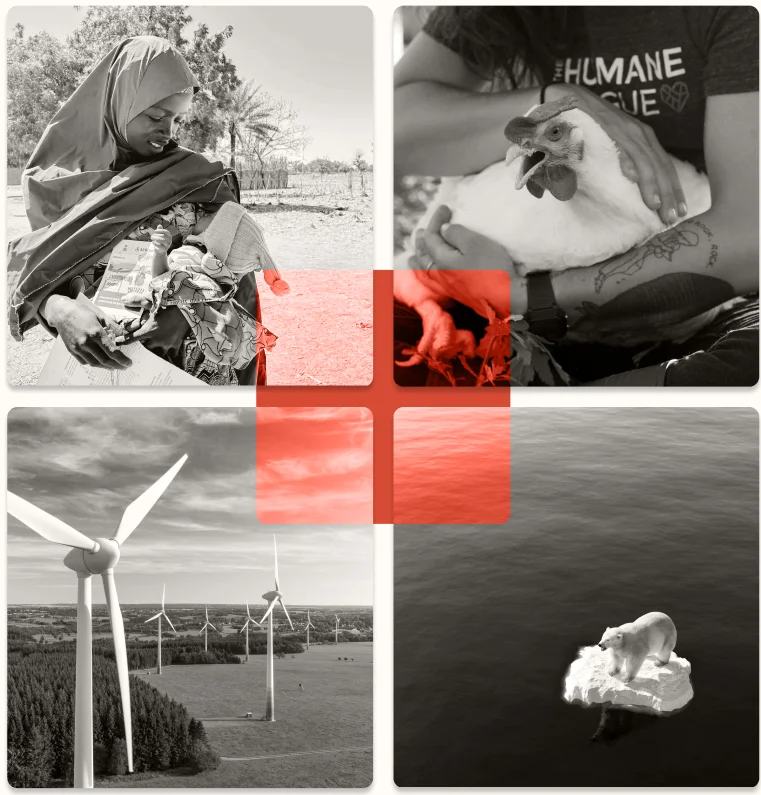
The cause areas we focus on address problems that affect many people, have concrete solutions and are in need of funding:
- Global health and poverty
- Animal Welfare
- Climate change and existential risks
In the Press




Our recommended charities
Improving global health and reducing poverty
Against Malaria Foundation
More than 1,100 children die every day from malaria, mainly in sub-Saharan Africa. Against Malaria Foundation distributes insecticide-treated mosquito nets to people at risk. To date, it has delivered 250 million nets.
Between 2004 and 2019, the use of mosquito nets prevented around 816 million cases of malaria and saved around 4.8 millions lives.
Between 2004 and 2019, the use of mosquito nets prevented around 816 million cases of malaria and saved around 4.8 millions lives.
Helen Keller International
Vitamin A deficiency causes blindness in 250,000 to 500,000 children, half of whom die within 12 months. Helen Keller Intl supports government programmes that provide high-dose vitamin A capsules to infants at risk.
Vitamin A supplementation has been shown to significantly reduce infant mortality by between 4% and 12%.
Vitamin A supplementation has been shown to significantly reduce infant mortality by between 4% and 12%.
New Incentives
Every year, 700,000 children under the age of five die from preventable diseases. New Incentives increases vaccination rates by offering small financial incentives to Nigerian families to take their children to clinics for vaccination.
Vaccination reduces child mortality from vaccine-preventable diseases by approximately 50%.
Vaccination reduces child mortality from vaccine-preventable diseases by approximately 50%.
Reducing animal suffering
The Humane League
More than 80% of animals in France are raised on factory farms. THL aims to end the abuse of farm animals by persuading companies to adopt higher animal welfare standards.
Over the past decade, THL has successfully secured commitments from more than 400 companies to cease battery egg production.
Over the past decade, THL has successfully secured commitments from more than 400 companies to cease battery egg production.
Good Food Institute
GFI aims to create a fairer, healthier food system, while reducing animal suffering and the ecological footprint of food production. They do this by promoting the development and marketing of alternatives to conventional meat, such as plant based meat and lab grown meat.
In 2024 GFI’s success included a $100 million partnership with the Bezos Earth Fund, halal recognition for cultivated meat in Singapore, and a new office in Japan. Ongoing efforts focus on public funding, national support, and overturning cultivated meat bans.
In 2024 GFI’s success included a $100 million partnership with the Bezos Earth Fund, halal recognition for cultivated meat in Singapore, and a new office in Japan. Ongoing efforts focus on public funding, national support, and overturning cultivated meat bans.
Mitigating climate change and existential risk reduction
Clean Air Task Force
CATF fights air pollution and climate change. It promotes clean energy solutions through scientific advocacy, policy reform and technological innovation.
They have been instrumental in helping to pass several key policy reforms in the past few years including the EU methane pledge and the 2022 Inflation Reduction Act.
They have been instrumental in helping to pass several key policy reforms in the past few years including the EU methane pledge and the 2022 Inflation Reduction Act.
Centre pour la Sécurité de l'IA
In 2025, AI are able to synthesise toxic molecules and interfere on the results of their own evaluation. CeSIA is a French non-profit research organisation that raises awareness of the risks arising from AI systems and advocates technically informed regulation.
In 2024, CeSIA raised awareness of the risks of AI among around one million French people and trained around one hundred people. In 2025, CeSIA contributed to the Code of Practice guiding the implementation of the European Union's AI Act.
In 2024, CeSIA raised awareness of the risks of AI among around one million French people and trained around one hundred people. In 2025, CeSIA contributed to the Code of Practice guiding the implementation of the European Union's AI Act.
Safeguarding the Future Fund
The Safeguarding the Future Fund addresses humanity’s greatest risks, including pandemics, nuclear war, advanced AI threats, and global conflicts, to protect current and future generations. By focusing on reducing existential threats, the fund offers an effective way to safeguard humanity's future and prevent the suffering of billions today.
Past recipients of this fund include the Carnegie Endowment for International Peace ( CEIP ) which was used to address the global risks arising from the Ukraine war and Blueprint Security to work on the prevention, mitigation and control of future pandemics.
Past recipients of this fund include the Carnegie Endowment for International Peace ( CEIP ) which was used to address the global risks arising from the Ukraine war and Blueprint Security to work on the prevention, mitigation and control of future pandemics.
More ways to make impact
Take the🔸10% Pledge
The 10% Pledge is a lifelong commitment to donate 10% of your income to effective charities. Join the 9,500 worldwide who have already signed the pledge.
Fundraise
Organise a fundraiser. Whether in your company, for a party, or for any other occasion, click here to start your own fundraising event.
Three reasons to donate with us
1.
One principle:
Guaranteed impact
Our priority is identifying opportunities where your donation can achieve the greatest impact. As new evidence emerges, we update our recommendations to reflect the latest findings
2.
Research focused
Identifying charities with a real impact can be time-consuming and difficult. We’ve collated thousands of hours of research from world leading charity evaluators, to help you have as much impact as possible with every euro you donate.
3.
Completely Independant
We operate independently, thanks to philanthropic grants. This allows 100% of your donation to go directly to the charities of your choice and ensures that our recommendations remain impartial.
TESTIMONIALS

Alex Cristia
Research Director - CNRS
.
"We all want to do good with our donations, but the world is a complex place. How do we identify and prioritise the charitable programmes that really make the world a better place? I appreciate the Mieux Donner approach, which takes into account measurable impacts and is transparent about uncertainties. "
"We all want to do good with our donations, but the world is a complex place. How do we identify and prioritise the charitable programmes that really make the world a better place? I appreciate the Mieux Donner approach, which takes into account measurable impacts and is transparent about uncertainties. "

Mohammed Moussa
CEO of TekTIME
.
"I offer technological services and although we can reduce our emissions as much as possible, I know I can make a bigger difference. By channelling part of my income to high-impact charities, my project takes on an even greater social dimension. To have an impact, my company gives to those who are in action."
"I offer technological services and although we can reduce our emissions as much as possible, I know I can make a bigger difference. By channelling part of my income to high-impact charities, my project takes on an even greater social dimension. To have an impact, my company gives to those who are in action."

Axelle Playoust-Braure
Science Journalist
.
"Since 2020, I have donated a significant proportion of my income to NGOs recognised for their effectiveness. The difference in impact between two associations can be immense. Mieux Donner is a valuable resource for informing yourself and making informed choices. "
"Since 2020, I have donated a significant proportion of my income to NGOs recognised for their effectiveness. The difference in impact between two associations can be immense. Mieux Donner is a valuable resource for informing yourself and making informed choices. "

Matthieu Ricard
Author and Buddhist Monk
.
"Effective giving is not about excluding empathy from our way of being, but once it has alerted us to the suffering endured by others, it's important to judge how best to eliminate or prevent that suffering."
"Effective giving is not about excluding empathy from our way of being, but once it has alerted us to the suffering endured by others, it's important to judge how best to eliminate or prevent that suffering."
FAQs
We recommend charities that
Focus on final outcomes:
Charities that prioritise the final outcome of their action and not indicators of impact. When talking about impact, it is essential to focus on the desired final outcome, such as improved opportunities and quality of life, rather than focusing on intermediate outcomes such as the number of books distributed.
Measure their impact
It’s surprising how few charities measure their impact. Our top recommended charities use scientific methods to evaluate the results of their actions, ensuring that their interventions produce the desired effects.
Are cost-effective
They save or improve the most lives per euro donated to them. Eg) our top recommended global health charities can save a life for as little as 3,000 euros, our top climate charities can avoid one ton of carbon emissions for just 1 euro and our top animal welfare charities can spare thousands of animals from factory farming for the same price of saving one animal in a refuge.
Are independently evaluated
All of our top charities are independently evaluated by world leading charity evaluators. See more information below.
We do NOT recommend charities based on their:
Location
A life is valuable whether it is based in France or the developing world.
Tax deductibility
Our top recommended charities are all tax deductible in Switzerland, but not in France. This is because French tax law dictates that a charity must operate from France in order to be tax deductible. We always prioritise the impact of a charity over its tax deductible status.
Overhead costs
Some of our charities such as Against Malaria Foundation have very low overhead costs, and some such as Clean Air Task Force – have much higher overhead costs. To explain why we don’t take overhead costs into account in our recommendations, imagine two charities:
- Charity A spends 10,000 euros a month on it’s operations and saves 1 life
- Charity B spends 20,000 euros a month on it’s operations and saves 6 lives
In the above examples Charity A saves 1 life for every 10,000 spent on it, whereas Charity B saves 1 life for every 3,300 euros spent on it. In this example – it’s clear to see that it’s not overhead costs that are important – but in fact the ratio of overhead costs to the desired impact. Research suggests that there is not much of a correlation at all between overhead and effectiveness.
Our recommendations are based on the research of independent experts
Finding the best aid organisations isn’t that easy. That’s why we work closely with experts who have been conducting extensive and in-depth research on the subject for many years. These experts are completely independent and work at the cutting edge of charity evaluation in their respective cause areas. They conduct rigorous tests on hundreds of charities to find out as precisely as possible how much good their programs achieve per euro spent. By comparing the cost effectiveness of so many charities, they are able to short list the most effective charities to donate to in order for your donations to have the biggest impact.
The charity evaluators whose research we primarily rely on are:
GLOBAL HEALTH AND DEVELOPMENT: GiveWell
GiveWell is the world’s leading research organisation that studies global health and development charities.
‘We search for the charities that save or improve lives the most per dollar. Our goal is to produce the world’s top research on where to give. Free, for everyone. We recommend a small number of charities that do an incredible amount of good’ (GiveWell)
GiveWell was founded in 2007 by Holden Karnofsky and Elie Hassenfeld, two former hedge fund employees. They wanted to do as much good as possible with their donations and found that there was little solid information available on how to do this. GiveWell invests more than 40,000 hours of research each year and has raised more than €1 billion for high-impact charities, saving an estimated 150,000 lives.
ANIMAL WELFARE: EA Animal Welfare Funds
The EA Animal Welfare Fund was rated as the top animal charity evaluator by GWWC’s ‘evaluating the evaluators project’ in 2024. They are therefore the primary charity evaluator we defer to in order to choose our top animal charities. We meet with them every few months to get up to date recommendations. They conduct thorough research into various animal welfare organisations to find those that help the most animals per dollar.
CLIMATE CHANGE: Giving Green
Giving Green is a nonprofit organisation that spends thousands of hours each year reviewing studies and climate charities to find the most cost effective interventions to combat climate change. From this research, they publish their top recommendations each year. Their team is made up of climate scientists, economists and impact evaluation experts with decades of experience working at the intersection of evidence-based policy and the environment. We meet regularly with Giving Green to discuss our climate recommendations and run climate workshops in collaboration with eachother.
Other evaluators
Although we primarily defer to GiveWell, Giving Green and EA Animal Welfare Fund, we also read the research of other top charity evaluators including LongView Philanthropy, Founders Pledge and Animal Charity Evaluators to ensure we are not overly-reliant on any one source of research. When choosing our top charities we prefer organisations whose effectiveness is corroborated by multiple independent evaluators.
Yes, the team at Mieux Donner offers free donation advice for both english and french speakers. You can book an appointment here.