

Helen Keller International
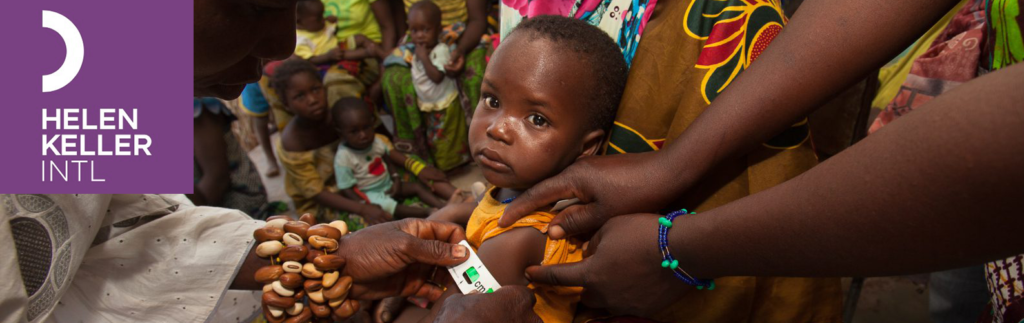
Distribution of vitamin A supplements to children under 5.
Last updated 1st November 2024
A Deadly Deffiency
According to the World Health Organisation, vitamin A deficiency causes blindness (total visual impairment) in 250,000 to 500,000 children every year [1].
- Half of those affected die within 12 months.
- This condition is common in low- and middle-income countries
- It can also lead to stunted growth and anaemia.
This deficiency can also increase vulnerability to infections and lead to death.
Helen Keller's fight against Vitamin A Defficiency
Vitamin A deficiency is extremely easy to prevent.
- A vitamin A capsule, distributed twice a year between the ages of 0 and 5, preserves eyesight and life.
- Data shows that distributions reduce total infant mortality in the countries concerned by between 4% and 12%.
- Each capsule costs €1
- Preventing these diseases also brings other benefits, such as increased income in later life, benefits to eyesight and avoided costs of treating the diseases [5].
Helen Keller Intl supports government programmes that provide high-dose vitamin A capsules to children at risk.
Helen Keller's impact
80 Million
capsules distributed
35 Million
supplemented children
in 2023
in 2023
€1
per capsule
Givewell is an evaluator which spends more than 50,000 hours of research examining hundreds of charities every year. Only four, including Helen Keller International, meet its high bar. The level of evidence of impact is considered very strong by GiveWell. GiveWell’s impact calculation is based primarily on a 2017 meta-analysis of 19 randomised controlled trials [4]. All of these trials show a significant impact of vitamin A supplementation on child mortality. The full GiveWell analysis report is available here [5].
‘Together, with our generous community of donors and partners, we provide the right support at the right time for 73 million children and family members around the world – helping them to grow and eat nutritious food, stave off malnutrition, build strong immune systems, access life-saving medical treatments, and prevent and treat blindness and vision loss.’ – Helen Keller International
After the distributions, Helen Keller checks its impact by conducting surveys among the target populations. GiveWell also stresses that the association’s transparency is satisfactory. GiveWell’s full report on Helen Keller is available here [3].
For €100, provide 50 children with vitamin A supplementation for a year, saving their eyesight and potentially their lives [2].
Tax deductibility: Maximise the impact of your generosity
Tax deductions in France are currently only available for donations to four of our recommended charities: Against Malaria Foundation, Good Food Institute, Helen Keller International, and Centre pour la Sécurité de l’IA
If you are taxable in France, you will benefit from a tax reduction of 66% of the amount of your donation up to the limit of the tax due or 20% of your taxable income.
In practice, this means that if you were planning to donate €100, you can triple this amount to reach a donation of €300 that you will declare, with a real cost of only €102 after tax reduction. This allows you to multiply the impact of your donation without increasing your planned expenditure.
You can read our full article on tax relief in France for more information.
We are able to offer tax deductibility for this association and all the organisations we recommend through our partners, Effektiv Spenden. If your tax residence is in Switzerland, please make your donations via this link, so that you can receive your tax receipt at the end of the tax year.
We work with partners around the world and can offer tax deductibility in many countries. Please contact us if you would like to make a donation from another country and we will discuss the tax options available to you. If you would like to donate and do not require a tax receipt, you can make a donation via Mieux Donner regardless of your country!
FAQs
Vitamin A deficiencycan cause death in several ways:
- It makes affected children more susceptible to infections from serious diseases. Infections were responsible for 43% of deaths in children under five in 2019.
- It affects the body’s production of the pigments needed for the retina to function properly.
HelenKeller International was founded by Helen Keller and George Kessler in 1915 to set up a fund to support those wounded in the First World War. The association has evolved considerably since then.
We recommend charities that
Focus on final outcomes:
Charities that prioritise the final outcome of their action and not indicators of impact. When talking about impact, it is essential to focus on the desired final outcome, such as improved opportunities and quality of life, rather than focusing on intermediate outcomes such as the number of books distributed.
Measure their impact
It’s surprising how few charities measure their impact. Our top recommended charities use scientific methods to evaluate the results of their actions, ensuring that their interventions produce the desired effects.
Are cost-effective
They save or improve the most lives per euro donated to them. Eg) our top recommended global health charities can save a life for as little as 3,000 euros, our top climate charities can avoid one ton of carbon emissions for just 1 euro and our top animal welfare charities can spare thousands of animals from factory farming for the same price of saving one animal in a refuge.
Are independently evaluated
All of our top charities are independently evaluated by world leading charity evaluators. See more information below.
We do NOT recommend charities based on their:
Location
A life is valuable whether it is based in France or the developing world.
Tax deductibility
Our top recommended charities are all tax deductible in Switzerland, but not in France. This is because French tax law dictates that a charity must operate from France in order to be tax deductible. We always prioritise the impact of a charity over its tax deductible status.
Overhead costs
Some of our charities such as Against Malaria Foundation have very low overhead costs, and some such as Clean Air Task Force – have much higher overhead costs. To explain why we don’t take overhead costs into account in our recommendations, imagine two charities:
- Charity A spends 10,000 euros a month on it’s operations and saves 1 life
- Charity B spends 20,000 euros a month on it’s operations and saves 6 lives
In the above examples Charity A saves 1 life for every 10,000 spent on it, whereas Charity B saves 1 life for every 3,300 euros spent on it. In this example – it’s clear to see that it’s not overhead costs that are important – but in fact the ratio of overhead costs to the desired impact. Research suggests that there is not much of a correlation at all between overhead and effectiveness.
Our recommendations are based on the research of independent experts
Finding the best aid organisations isn’t that easy. That’s why we work closely with experts who have been conducting extensive and in-depth research on the subject for many years. These experts are completely independent and work at the cutting edge of charity evaluation in their respective cause areas. They conduct rigorous tests on hundreds of charities to find out as precisely as possible how much good their programs achieve per euro spent. By comparing the cost effectiveness of so many charities, they are able to short list the most effective charities to donate to in order for your donations to have the biggest impact.
The charity evaluators whose research we primarily rely on are:
GLOBAL HEALTH AND DEVELOPMENT: GiveWell
GiveWell is the world’s leading research organisation that studies global health and development charities.
‘We search for the charities that save or improve lives the most per dollar. Our goal is to produce the world’s top research on where to give. Free, for everyone. We recommend a small number of charities that do an incredible amount of good’ (GiveWell)
GiveWell was founded in 2007 by Holden Karnofsky and Elie Hassenfeld, two former hedge fund employees. They wanted to do as much good as possible with their donations and found that there was little solid information available on how to do this. GiveWell invests more than 40,000 hours of research each year and has raised more than €1 billion for high-impact charities, saving an estimated 150,000 lives.
ANIMAL WELFARE: EA Animal Welfare Funds
The EA Animal Welfare Fund was rated as the top animal charity evaluator by GWWC’s ‘evaluating the evaluators project’ in 2024. They are therefore the primary charity evaluator we defer to in order to choose our top animal charities. We meet with them every few months to get up to date recommendations. They conduct thorough research into various animal welfare organisations to find those that help the most animals per dollar.
CLIMATE CHANGE: Giving Green
Giving Green is a nonprofit organisation that spends thousands of hours each year reviewing studies and climate charities to find the most cost effective interventions to combat climate change. From this research, they publish their top recommendations each year. Their team is made up of climate scientists, economists and impact evaluation experts with decades of experience working at the intersection of evidence-based policy and the environment. We meet regularly with Giving Green to discuss our climate recommendations and run climate workshops in collaboration with eachother.
Other evaluators
Although we primarily defer to GiveWell, Giving Green and EA Animal Welfare Fund, we also read the research of other top charity evaluators including LongView Philanthropy, Founders Pledge and Animal Charity Evaluators to ensure we are not overly-reliant on any one source of research. When choosing our top charities we prefer organisations whose effectiveness is corroborated by multiple independent evaluators.
We process donations free of charge, which means we do not keep any of your donation for ourselves. However, the payment methods credit card, PayPal and SEPA direct debit incur fees from the payment services we work with. These fees are deducted from your donation. The amount is calculated as follows for donations within France:
Transfer : Free of charge within the SEPA payment area
Transfer via Donorbox: 2.55% + 0.25 €
Credit card : 2.95% + 0.25 € (for European cards)
PayPal : 3,15 % + 0,25 €
For donations of > 1,000 euros, we recommend a free bank transfer. PayPal and credit cards are not recommended for large amounts due to the costs.
Fees would also be incurred for a direct donation to the respective organisations. We have already negotiated with all payment providers and received particularly favourable conditions for non-profit organisations. We have specially advantageous conversion fees compared to traditional bank.
We also finance ourselves through donations, but completely independently.
If you would like to discuss the best way to donate through us, please get in touch.
Donate to Helen Keller International
Your donation is paid directly to the organisation, and only transaction costs apply.
Mieux Donner does not charge any fees for its own operations.
If you would like a tax receipt in order to benefit from tax deduction in France, we will send your donation to Helen Keller International via Helen Keller Europe who may deduct up to 4% for their operating costs. This is currently the only option to donate to Helen Keller International’s vitamin A project and benefit from tax deduction in France.
1
Charity/fund
2
Donation amount
3
Payment details
4
Personal details
5
Confirm donation
[1] Vitamin A Deficiency (World Health Organisation) [Accessed 10/07/2024]
[2] Impact estimates for GiveWell’s top charities (GiveWell) [Accessed 10/07/2024] 2 is the amount estimated by GiveWell in 2022 for a child to receive vitamin A supplementation for one year. We use a conversion of 1 dollar to 1 euro to be conservative.
[3] Analysis of the impact of Helen Keller International (GiveWell) [Accessed 10/07/2024]
[4] Vitamin A supplementation for preventing morbidity and mortality in children from six months to five years of age, Cochrane Library, Imbad et al. 2017 [Accessed 29/10/2024]
[5] Analysis of impact of vitamin A supplementation (GiveWell) [Accessed 29/10/2024]
Other global health and development charities we recommend
Against Malaria Foundation
More than 1,100 children die every day from malaria, mainly in sub-Saharan Africa. Against Malaria Foundation distributes insecticide-treated mosquito nets to people at risk. To date, it has delivered 250 million nets.
Between 2004 and 2019, the use of mosquito nets prevented around 816 million cases of malaria and saved around 4.8 millions lives.
Between 2004 and 2019, the use of mosquito nets prevented around 816 million cases of malaria and saved around 4.8 millions lives.
New Incentives
Every year, 700,000 children under the age of five die from preventable diseases. New Incentives increases vaccination rates by offering small financial incentives to Nigerian families to take their children to clinics for vaccination.
Vaccination reduces child mortality from vaccine-preventable diseases by approximately 50%.
Vaccination reduces child mortality from vaccine-preventable diseases by approximately 50%.