
Mieux Donner

How to turn your climate anxiety into action

Thursday 10th October 2024, Reading time: 10 mins

Glaciers showing retreat due to climate change

It’s easy to feel overwhelmed by the rapid retreat of glaciers and the scale of climate change. I know the feeling well. I live in Chamonix and work as an international mountain leader. I spend my summers guiding hikes in the Alps and my winters guiding ski trips in Finland. In conversations with my groups, I realised that the majority of people care deeply about climate change, but the situation seems so vast and hopeless that it causes anxiety and paralysis. 


This led me to take action and found Mieux Donner alongside Romain Barbe, in order to educate people about the most effective actions they can take to not only reduce their own carbon footprint, but make a huge positive difference in the world.


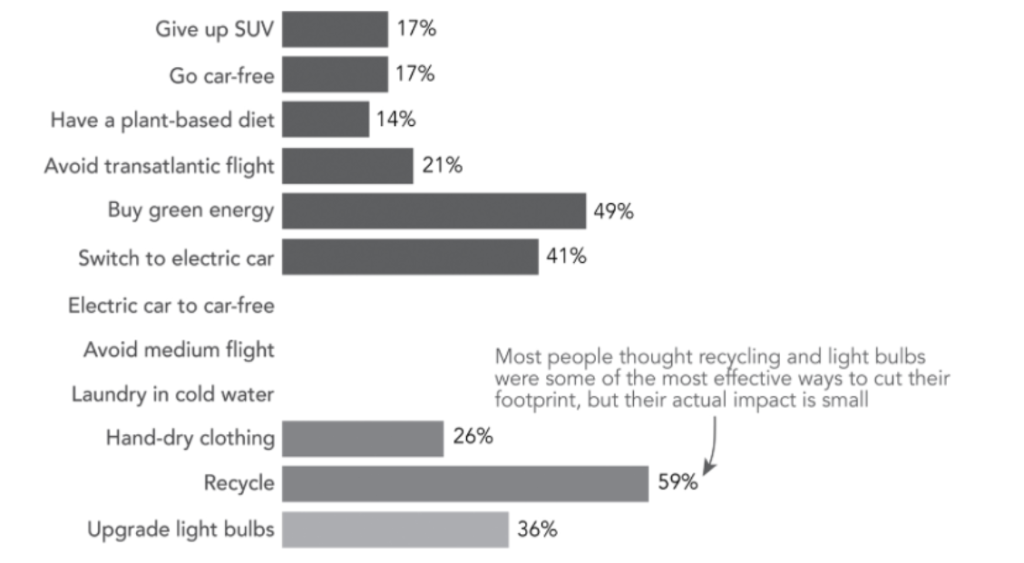
There are concrete, evidence based actions we can all take to reduce our carbon footprint, but the issue is there’s a lot of conflicting information online leading to a huge mismatch between what most people think is effective, and what’s actually effective:

What most people think is effective

Graph showing what people think is effective to combat climate change
(Source: Hannah Ritchie, Not the end of the world 2024)

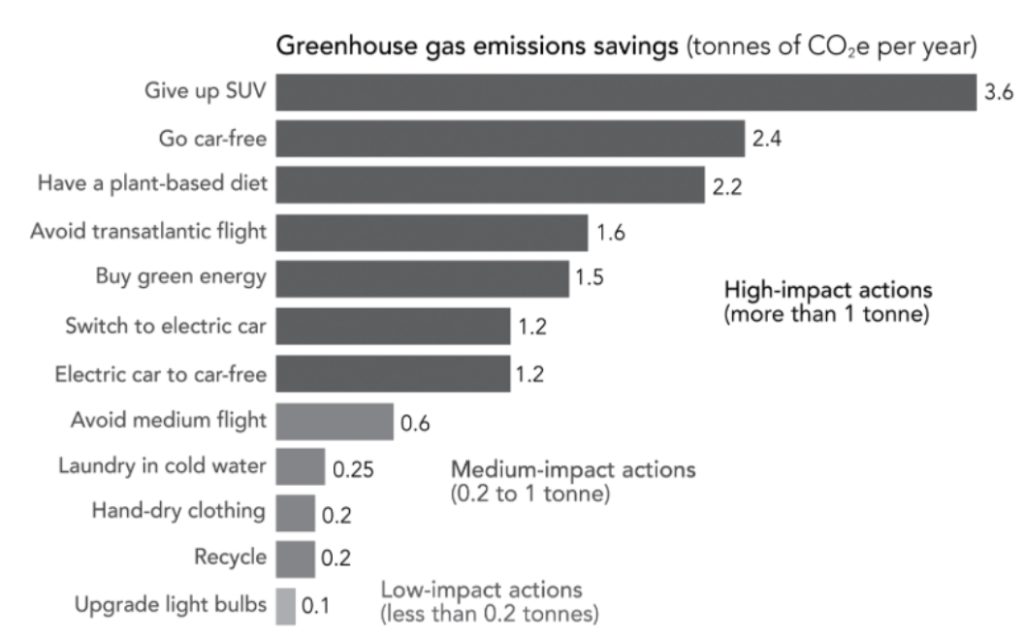
What is actually effective

What is actually effective to fight climate change
(Source: Hannah Ritchie, Not the end of the world 2024)

If you were to follow the top three most effective lifestyle choices and you gave up your car, switched to a plant based diet and didn’t take a transatlantic flight, you would save approximately 6.2 tons of carbon per year. All of these actions are great initiatives and set a positive example for a better future. 


But what if you could do even more?

Donations to effective charities are the biggest lever to address climate change

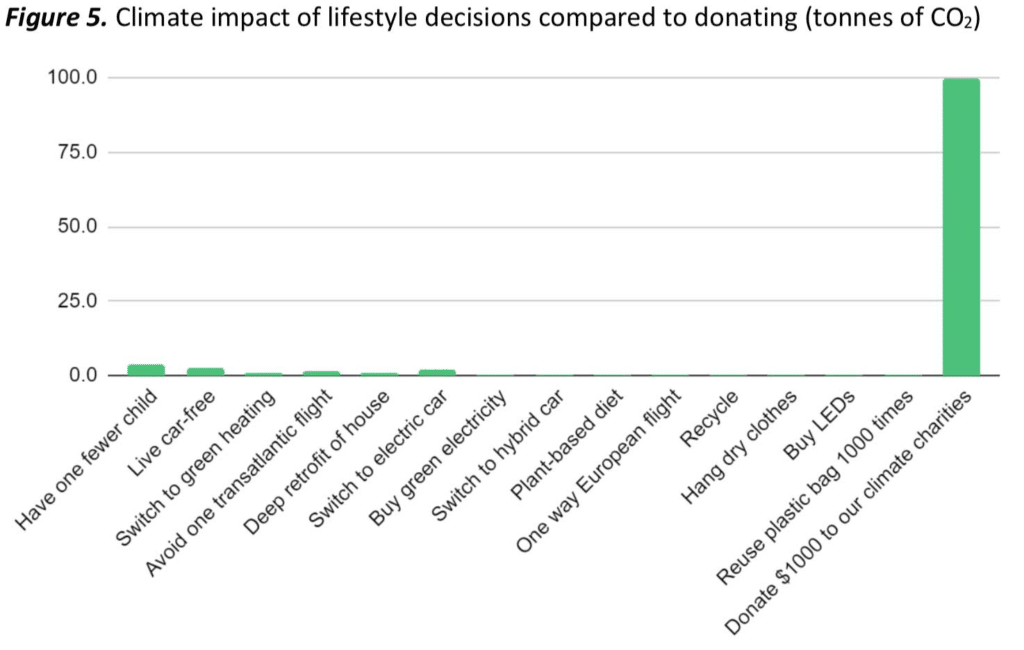
By far the biggest levers we have to enact systemic change are voting and donating to climate charities. Unfortunately, the majority of climate charities people donate to don’t live up to their claims. In fact, 90% of offsetting projects fail to meet their offsetting targets, and even 40% of UN carbon credits have been shown to be ineffective. 


In comparison, highly impactful climate charities enact policy change and technological innovation which can impact millions of people, or even entire continents.

Climate impact of lifestyle decisions compared to donating

Relative impact of lifestyle choices compared to donating to effective climate charities 

(Source: Founders Pledge – Climate and lifestyle report).

As an example, one of the most effective climate charities, The Clean Air Task Force worked closely with the European Commission to pass the landmark EU Methane Regulation last year. It’s estimated that regulations like this could achieve a huge 30% reduction in emissions from the oil and gas industry.

 

Another example of a highly effective charity is The Good Food Institute, who promote the development of plant based and lab grown meats. Alternative proteins are a particularly promising way of addressing climate change because livestock farming is responsible for around 20% of global greenhouse gas emissions.


In comparison to traditional carbon offsets which have little independent oversight, the most effective climate charities have been rigorously vetted by the world’s leading independent charity evaluators. Both Clean Air Task Force and the Good Food Institute for example have been independently evaluated by Giving Green to avoid 1 ton of carbon for every euro donated to them.

To put this into context, if you were to donate 170 euros a month to Clean Air Task Force or The Good Food Institute, your donation would mitigate more than 2000 tons of carbon in the atmosphere, equivalent to:

  • Growing 60,000 trees for a year [1]

  • Avoiding 1,500 transatlantic flights [2]

  • 500 people going car free for a year [3]

Ready to act?

[1] What is a tonne of CO2? [Accessed 10/10/2024].
One ton for 50 trees is an approximation that can vary depending on location, tree type, weather conditions, etc. According to some calculations, 15 to 83 trees are needed to capture an average of 1 tonne of CO2 per year. Trees grow faster in the tropics, so fewer trees are needed to store a tonne of CO2 than in the northern hemisphere. In our donation calculation, we have chosen an average of 50 trees per year to capture 1 tonne of CO2.


[2] Not the end of the world, Hannah Ritchie (2024)
Each transatlantic flight emits an average of 1.6 tonnes of CO2 equivalent.


[3] Not the end of the world, Hannah Ritchie (2024)
Going without a car for a year reduces CO2 equivalent emissions by 2.4 tonnes.

Profil de Jennifer Stretton, l'une des fondatrices de Mieux Donner.

Jennifer Stretton 

Jennifer is co-founder and co-director of Mieux Donner. You can contact her at jennifer@mieuxdonner.org or by writing on the contact form

You might also enjoy reading

Usines émettant des émissions de carbone par leurs cheminées.
Jennifer Stretton

Climate in an age of permacrisis – 5 principles for urgency in the face of climate complexity

This article was written by Armond Cohen, the Executive Director of one of our top climate non profits – Clean Air Task Force. The Clean Air Task Force is one of the most effective climate charities in the world. One of their most recent achievements is their work with the European Commission to pass the landmark EU Methane Regulation last year. It’s estimated that regulations like this could achieve a huge 30% reduction in emissions from the oil and gas industry.

Read More »