What is the cost of a human life?
Tuesday 8 October 2024, Reading time: 10 mins
Difficult choices
Human life is precious. It is natural to want to mobilise all our resources to save a life, even if it only prolongs a life by a week. But what happens when other people are also in danger, and our resources are not enough to help them all? As a society, we face practical limits that force us to make difficult decisions. In this context, one possible ethical position is to argue that we should maximise the number of lives saved with the budget that the country has set itself. If this criterion is chosen, then the rational way of proceeding is simple: the country must list the opportunities for interventions likely to save lives, then sort this list in order of increasing cost per life saved. Then it should fund the interventions in that order until its budget is exhausted.
Let’s take the example of a country that has to choose between the following three actions to save lives: allocating money to treat disease X (for example, appendicitis), redesigning a dangerous and busy road junction, or funding an annual heatwave plan. What interventions should this country fund?
A video on the subject by journalist (and comedian) David Castelo Lopez on France Inter.
To decide how to prioritise our funding, let’s look at each intervention in more detail:
Treating Disease X
Let’s say that the disease in question is fatal in 100% of untreated cases, but that a treatment with a 100% cure rate exists. We’ll assume that the cost of this treatment is €10k/patient and, to simplify the example, that people suffering from this disease cannot afford to pay for treatment themselves (in other words, the state is their only hope of survival).
In this case, we calculate that the cost of saving a life is €10k.
Redeveloping the dangerous road intersection
Let’s assume that there is an average of one fatality per year and that it is estimated that with redevelopment, this rate will be reduced to one fatality every ten years. Whether we redevelop or not, the infrastructure will last 30 years, but the additional cost of redevelopment will be €4m in total.
In this case, over the next 30 years, we statistically expect to see 3 deaths in the event of redevelopment and 30 deaths without redevelopment.
We could therefore save 27 lives for €4m, i.e. around €148k per life statistically saved.
Heatwave Plan
Finally, let’s assume that the heatwave plan costs €15m/year and saves an average of 200 lives each year.
In this case, the plan would statistically save one life for €75k.
Conclusion
Based on these results, the country should give priority to funding treatments for disease X, then the heatwave plan and finally, if it still has the budget, road improvements.
The value of a human life
We cannot repeat often enough that human life is precious. It should never be reduced to a simple monetary value. No figure can truly reflect the importance of each person’s unique existence; we are not talking here about interchangeable goods, but about human beings, each with an irreplaceable existence and uniqueness. However, in the arbitration context we described earlier, there comes a time when countries run out of budget. For example, if a country manages to fund the cure for all sufferers of disease X as well as the heatwave plan, but then no longer has enough money to fund the new road infrastructure, then we can say, in a way, that the value attributed by the country to a human life is between €75k and €148k. This value limit is what economists call the “value of a statistical life” [1].
Of course, the value of a statistical life associated with a country is not necessarily perfectly well defined, for at least three reasons:
On the one hand, the decisions taken by countries do not necessarily follow the procedure described above, and as a result their decisions are not always perfectly rational. As explained in the video above by David Castelo Lopez, some countries may be inclined to pay more to save a life in an aeroplane than to save a life in a car. In this case, the value placed on a statistical life depends on the interventions under consideration.
On the other hand, the moral criterion of “saving as many lives as possible” is not necessarily always considered to be the most relevant. For example, it can be assumed that the lives saved by the heatwave plan referred to above would mainly be the lives of elderly people, who have few potential years of life left. Conversely, the change in road infrastructure would save lives in a more balanced way across all age groups. Thus, taking the alternative moral criterion of “saving a maximum number of years of life”, it is possible that changing road infrastructure would be more advantageous than the heatwave plan. In this case, it would be meaningless to talk about the “value of a statistical life”, and we should instead think in terms of the “value of a statistical year of life”.
Finally, it should be emphasised that countries are forced to arbitrate between the money allocated to saving lives and the money allocated to researching the most effective ways of saving lives. The “list of interventions” mentioned above is therefore often incomplete and imprecise in practice. The result is that lives that could be saved for less than the value of a statistical life.
How much is life worth in France?
For the reasons given above, estimates of the ‘statistical life expectancy’ of countries should be treated with caution.
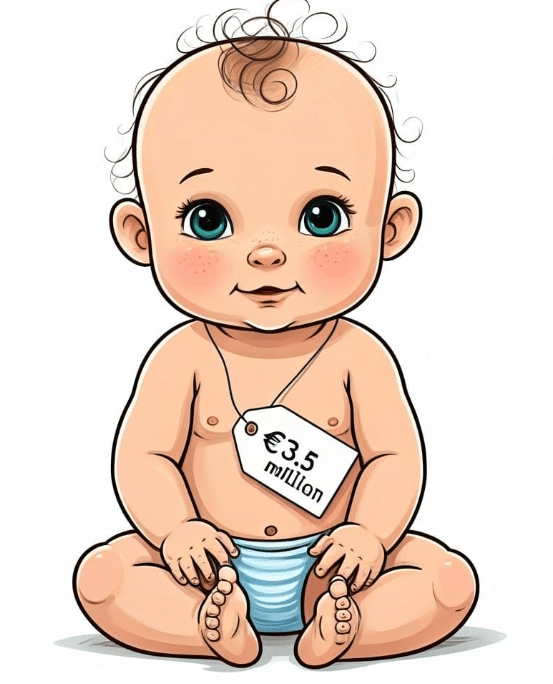
In France, however, the report of a working group dating from 2013 suggests using the figures of €3m for the value of a statistical life and €150k for the value of a year of life as a reference [2]. Assuming that these values have kept pace with inflation, they would now be more than €3.5m and €180k respectively [3].
Why it costs less to save a life in very low-income countries
As we have mentioned, the figure of ‘€3m per life saved’ does not imply that all cost-effective life-saving interventions have been carried out in France. It is likely that more affordable measures remain to be implemented. A couple of areas that seem cost effective are protecting the lives of those living on the streets or facing extreme food and energy insecurity.
Nevertheless, it’s fair to say that saving one more life in France (bearing in mind all the measures already put in place by the State) is relatively expensive.
Unfortunately, many countries are much worse off than France, both in terms of the “statistical value of life” and when comparing poverty rates. For some of these countries, there are identified ways of saving lives that are particularly inexpensive. Here are a few examples (for which we have applied the conversion 1$ = 1€):
In countries heavily affected by malaria, such as Uganda, Nigeria and the Democratic Republic of Congo, an insecticide treated mosquito net can be purchased and distributed for just €5 by donating to Against Malaria Foundation (AMF). This net protects two people from the disease for two years. The leading charity evaluator, GiveWell, estimates that it costs an average of €5,500 to save a life by donating to AMF [4], or just €1,870 after tax relief (if you are taxable in France). Most of the lives saved are those of children.
In countries such as Cameroon, Madagascar and Guinea, providing a child with vitamin A supplements for a year costs less than €2 [5]. GiveWell estimates that by donating to Helen Keller, you can save a life for as little as €5,000 [6] (or €1,700 after tax reduction in France).
In Nigeria, it costs around twenty euros to enrol a child in the New Incentives vaccination programme. GiveWell estimates that you can save a child’s life in this way by donating €3,000 to New Incentives [7].
If you would like to find out more about these three charities or make a donation to them, follow this link.
Conclusion
Analysing the cost of the different ways of saving human lives is an exercise that may seem cold and dehumanising, we can understand that. But when it allows more lives to be saved, more tragedies to be avoided, more grieving families to be saved, more children to suffer before they die, it is an exercise that we feel is necessary.
Most charities can have a positive impact on the world. However, you can help much more by targeting the charities with the lowest cost per life saved – in other words, those that are most effective in saving lives. As things stand, this means giving priority to helping children who have not been lucky enough to be born in a country as rich and protective as ours.
Romain Barbe
Romain is co-founder and co-director of Mieux Donner. You can contact him at romain@mieuxdonner.org or by writing on the contact form.