Making better decisions using counterfactual reasoning
Par Maximilien Jolivet et Romain Barbe, 23 Janvier 2025 – Temps de lecture : 10 min.
Do you remember, in Amélie (2001), the scene where, a few metres from Nino, Amélie stops? The moment lasts, suspended between all the possible versions of what happens next: the one where she dares to approach him, the one where she hesitates too long, the one where she turns back. These alternatives, which we can see as the sequence progresses, she imagines without any of them really happening.
You might think that the decisive moment is when you act. But very often it precedes action, in that brief oscillation between what is and what could have been. Counterfactual thinking is the way our minds replay our decisions before they even exist, like a second reality woven from assumptions and muted regrets. In this case, the counterfactual action was to find out if she was going to Nino.
Of course, if life were a Jean-Pierre Jeunet film, Yann Tiersen’s melody would be enough to guide us along the right path. But in reality, there’s no music to underline those moments when we’re on the brink of a different destiny, just that slight shiver of uncertainty that lingers, like an echo of the possible.
Adapted to real life, however, counterfactual reasoning is a useful tool that can help you make better investment decisions, for example. You’re hesitating between two stocks: one is safer but offers a moderate return, the other is riskier but potentially more profitable. By projecting yourself into each scenario – and asking yourself how you would react if either turned out to be a bad decision – you refine your analysis and reduce the risk of regret. This approach allows you to anticipate the consequences and adjust your strategy before you even take action.
Let’s start by defining the term a little more precisely.
What is counterfactual reasoning?
Counterfactual reasoning is originally a methodology used in history and theorised by philosophers including the French Raymond Aron, Henri Bergson and Pierre Livet. In his 1938 thesis, for example, Aron said: “In order to explain what has been, every historian asks what might have been. He highlights the value of taking an interest in an imaginary situation in order to better analyse a real situation. This method, applied today in social science, should enable us to question our choices exhaustively in order to improve the final decision.
To illustrate the use of counterfactuals in everyday life, let’s take the example of a simple decision: go for an afternoon hike. You could just as easily rest at home instead (a first counterfactual), or go swimming (a second counterfactual). However, the counterfactual can also be used to analyse a situation in which you are not necessarily an actor, for example, when candidate A is not elected, candidate B could be, which allows you to imagine a scenario and personally evaluate your actions in different scenarios.
This type of reasoning, which is often used unconsciously, comes into its own when it is used proactively to critically evaluate alternatives in different situations and make an optimal final decision.
Difference between counterfactual thinking and counterfactual reasoning :
Counterfactual thinking and counterfactual reasoning are two related but distinct concepts in cognitive science and philosophy.
Counterfactual thinking is a spontaneous cognitive process in which an individual imagines alternatives to past events, often in the form of hypothetical “what if” scenarios. This phenomenon is widely studied in psychology and neuroscience, as it plays a role in learning, decision-making and emotional regulation. For example, a person who fails an exam may think: “If I had studied harder, I would have passed.
Counterfactual reasoning, on the other hand, is a more deliberate and systematic approach. It involves the use of counterfactual thinking within a logical or methodological framework, often with the aim of analysing causality or optimising decisions. In the social sciences, it is frequently used in impact studies or randomised controlled trials, where a real situation is compared with a hypothetical alternative scenario. For example, an economist assessing the effectiveness of a public policy might ask: “What would have happened if this reform had not been implemented”, using formal data and models.
In short, counterfactual thinking is a natural and sometimes intuitive cognitive mechanism, whereas counterfactual reasoning is based on a structured and methodical analysis aimed at drawing logical or empirical conclusions.
Counterfactual reasoning and effective giving
Effective Giving is a set of ideas that has created a social movement since the late 2000s that aims to take an analytical approach to identifying the best ways to have a positive impact on the world through our giving.
To give you an example, let’s say you’re thinking of making a donation to an association and the first choice that comes to mind is your local animal shelter. It’s natural to want to support a cause that’s close to your heart. After all, when we know that doing something good – in this case, making a financial contribution to an organisation that’s important to us – can have a positive impact, it makes sense to do it.
But to have a better chance of maximising your impact, you shouldn’t stop there. Counterfactual reasoning reminds us that we shouldn’t just ask “Does this action do any good?”, but also “Does this action do more good than something else I could do?”.
This way of thinking is reflected in several fundamental aspects of effective giving, including :
Check the relevance of a programme before investing in it (PlayPumps)
Where possible, interventions should be rigorously evaluated by comparing the results between groups that benefit from the programme and control groups that do not. This makes it possible to explore the counterfactual: what would happen without the intervention? The example of PlayPumps illustrates the importance of this approach. Designed to provide drinking water to rural communities using merry-go-rounds/water pumps operated by children, the project looked promising on paper. However, it proved ineffective: the pumps required considerable effort, were often abandoned and cost much more than traditional alternatives. In the end, these pumps had a negative impact compared with traditional pumps. A more rigorous upstream evaluation would have highlighted these shortcomings before investing heavily in the programme. This case shows why it is essential to ensure that a programme has a real impact before rolling it out on a large scale.
Assessing the real impact (Scared Straight Away)
When evaluating the impact of an intervention, it is essential to compare it with a reference situation in order to determine whether it is really having a positive effect. This is what the researchers did with Scared Straight, a programme designed to deter young offenders from reoffending by exposing them to adult prisoners who shared their experience. Intuition suggested that this method was effective in instilling fear of the consequences. However, rigorous studies have shown that not only did the programme have no beneficial effect, but that it actually increased the risk of re-offending among the young participants (between 71% and 89% for young people who ‘benefited’ from the action, compared with an average of 70%) [1].
By comparing the results of young people who had taken part in the programme with those of a control group who had not, the researchers were able to establish that the intervention had a negative effect. This example illustrates the importance of basing oneself on solid comparisons before investing time and resources in an action that could, against all expectations, do more harm than good.
Compare different interventions to maximise impact
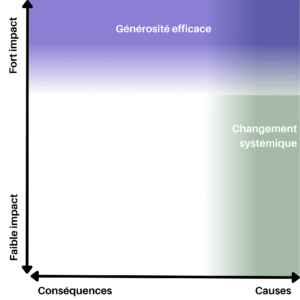
Comparing similar interventions enables us to assess whether an alternative – a counterfactual to the option initially considered – would have a more significant impact. Let’s take the example of animal protection: if you have €3,000 to donate, is it more effective to give it to a pet refuge or to an organisation that works against intensive animal farming? With that amount, a shelter could take care of just one animal for a year. In contrast, an equivalent donation could save the lives of 2,550 caged chickens through the work of The Humane League, or save 15,900 farm animals by supporting the Good Food Institute, which works for systemic change. The scale of this difference may seem surprising, but it illustrates the importance of comparing the real effects of different interventions before making a decision.
Taking into account neglectedness
The concepts of neglect help us to maximise our impact by concentrating on the actions that really need us. When a cause or association is already benefiting from substantial funding, it is useful to question the real impact of your additional donation. It may be that the most effective opportunities for improvement have already been exploited, leaving low-impact interventions to be funded. On the other hand, in under-funded areas or associations that still need funding for high-impact projects, your contribution can make all the difference.
Let’s imagine two towns: one with ten vaccination centres, and the other with just one. Going from ten to eleven centres has less impact than going from one to two, because the population’s needs are already well covered when there are ten centres.
At Mieux Donner, we draw on the counterfactual thinking of research organisations to contribute to effective generosity. Thanks to their rigorous analyses, which compare different charitable interventions taking into account criteria such as cost-effectiveness, transparency and the capacity of the cause supported to absorb donations, we help donors to really make a difference by identifying the charities that use resources in the most effective way possible.
This approach helps you to make a real difference by redirecting resources towards initiatives that produce measurable and significant results.
In practical terms, we guide you with impartial recommendations and assessments based on the best available data. Without taking any commission, we identify the most effective organisations directly for you, whether on the themes of global health, animal welfare or climate change, so that everyone can give in a meaningful and sustainable way.
Whether you’re just discovering counterfactual thinking or you’re already applying it to your decisions, I hope this article has helped you to grasp its full significance. By consciously incorporating this method into your thinking (for example, by using proven tools such as randomised controlled trials) rather than simply following your intuition, you’ll be able to maximise the effectiveness of your actions.
And what if you put this reasoning into practice today by supporting the most effective associations?
Romain Barbe
Romain is co-founder and co-director of Mieux Donner. You can contact him at romain@mieuxdonner.org or by using the contact form.