The three-basket method for better distributing your donations
You have already donated to a charity, given some of your time, or supported a cause that was close to your heart. It is a well-intentioned gesture.
But one question often arises: does this donation really make the difference I hope it will?
This is not just a personal doubt. It is a documented reality: the impact of a donation varies considerably depending on the cause, the organisation, the local context and the methods of intervention.
With the same amount of money, some actions can have a massive impact, while others will have a more limited or even marginal effect. This is not a question of intentions.
It is an objective observation: not all donations are equal in terms of their real impact on the people they help.
In some cases, one euro can significantly improve living conditions, prevent suffering or respond to a life-threatening emergency. In others, that same euro will have a much smaller impact.
This is why we talk about impact differences ranging from 1 to 10, 100, or even 1,000.
And it is this variation that makes it essential to choose where and how to give, if you want your generosity to have the greatest possible impact.
So what should we do with this information? Should we stop supporting causes close to our hearts? Should we put emotion aside and only give to causes with the “best impact”?
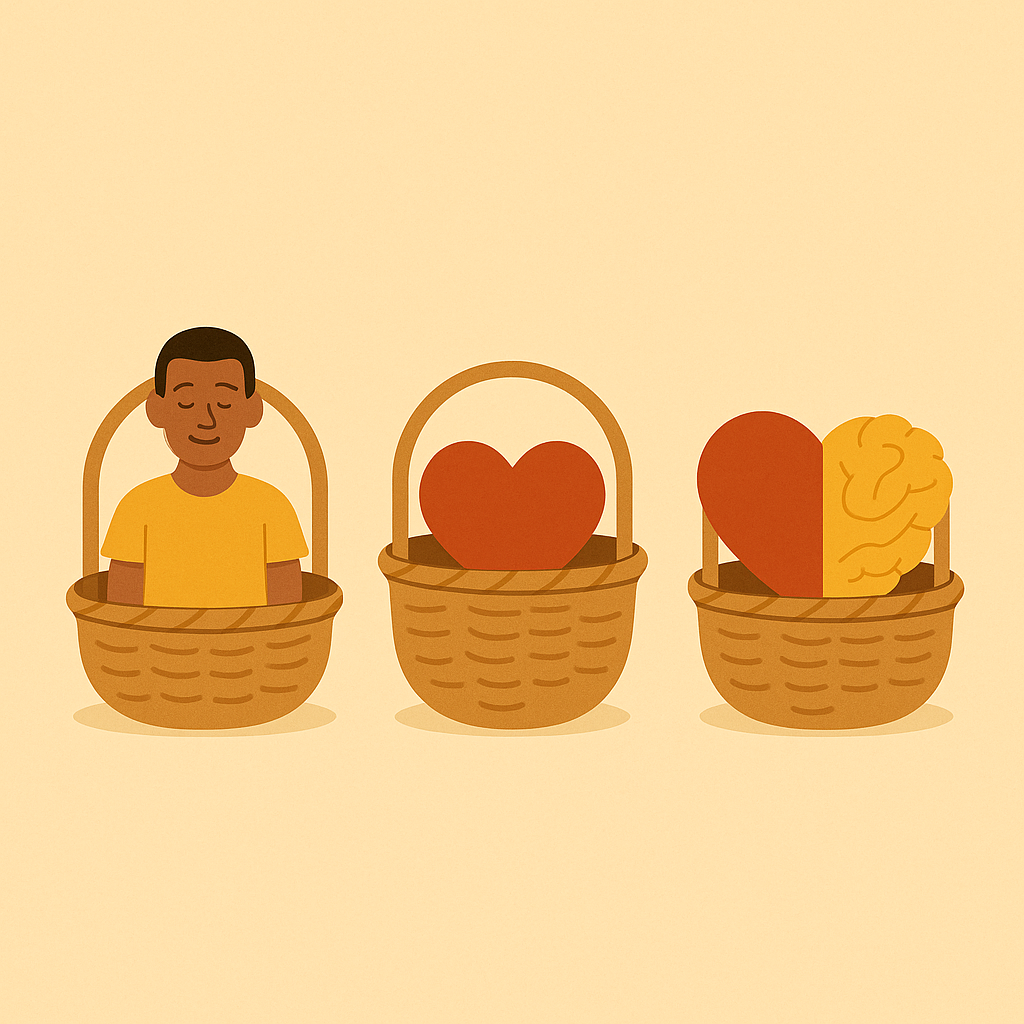
The answer is not to “choose” between emotion and effectiveness, but rather to combine the two. This is where a simple but powerful tool comes in: the three baskets model.
First, we will understand why effectiveness varies so much, then discover the three-basket model as a framework for reflection, and finally explore how to take concrete action according to this model.
This progression will help you move from the question (“Is my donation having an impact?”) to action (“How can I allocate my resources to combine heart and impact?”).
Why does effectiveness vary so much?
When we give, we do so with the intention of helping. But an important question needs to be asked: does this donation really make a significant difference?
The well-documented reality is that not all donations are equal in terms of their actual impact. Two identical donations can have very different results depending on the cause supported, the local context or the method used.
To understand this, we must adopt a counterfactual line of reasoning:
What else could have been achieved with the same resources?
In other words: what results were made possible by this donation that would not have been achieved without it?
This approach allows three essential criteria to be taken into account when assessing the potential impact of an action:
The scale of the problem: how many people are affected, and to what extent?
Potential for improvement: are there any effective, available solutions with a significant impact?
The neglected cause: is the cause underfunded, and therefore sensitive to every contribution?
These differences in impact are very real. Taking them into account does not mean denying one’s impulses. On the contrary, it means acting in full knowledge of the facts, with the desire to align one’s intentions with the effects produced.
Once again, the idea is not to pit “effective” causes against “heartfelt” causes. It is to realise that, in a world of immense and unequal needs, the way we allocate our resources makes a real difference.
And this is precisely where a simple yet powerful tool comes in: The three-basket model.
A framework that allows you to structure your generosity along three axes: yourself, your connections, and where your resources can have the greatest impact.
The three-basket concept: a compass for better distribution
Once we understand that not all donations have the same effect, another question naturally arises: How can I allocate my resources—money, time, energy—in a way that is fair, aligned, and useful?
The concept of the three baskets, proposed by Belgian researcher Stijn Bruers, offers a simple, accessible and, above all, non-judgmental framework. [1]
It allows us to combine intention, attachment and real impact.
🧺 Basket 1: yourself
Before helping others, it is essential to take care of yourself. This first basket, often overlooked in discussions about solidarity, reminds us that you have the right, and even the duty, to meet your own basic needs:
- housing, food, health, rest, financial security, leisure activities, etc.
This basket has no direct impact on the outside world, but it is the foundation of any lasting commitment. Taking care of yourself also means giving yourself the means to help others better afterwards.
But it also raises a personal and sometimes uncomfortable question:
When will I have ‘enough’ for myself?
There is no universal answer to this question. It depends on your situation, your constraints and your priorities.
But it opens up a space for reflection: once your basic needs are met, how much are you willing to devote to things that go beyond your personal needs?
🧺 Basket 2: the people and causes that are important to you
This basket corresponds to our personal attachments, our spontaneous impulses, our emotional loyalties.
For example, it includes:
- a donation to a local charity,
- support for a cause that is culturally or emotionally close to one’s heart,
- volunteering in one’s neighbourhood,
- an online fundraiser for a loved one.
This basket does not seek to compare impact. It aims for connection, closeness, and mutual recognition.
🧺 Basket 3: acting where it is most useful
It is often the least known basket… yet the most powerful in terms of overall impact.
It corresponds to the portion of your resources that you decide to allocate not based on your attachments, but based on where they can produce the most measurable effect.
It is often said kindly, almost timidly: do what you can, in good conscience, according to what moves you. But the third basket is not a grey area of goodwill. It is a concrete and demanding choice.
It is in this basket that your generosity becomes a real impact strategy, not just a reaction. You don’t have to put everything in it. But if you put nothing in it, you are leaving this very real potential untapped.
This is not cold calculation, but a form of expanded generosity: focused not only on what affects us, but also on what is possible, useful and effective.
This is what reliable data, rigorous assessments and tools such as Mieux Donner can help you achieve today.
How to fill your third basket?
Recognising the importance of the third basket is already a big step forward.
But practical questions quickly arise:
- How can we know which organisations have the most real impact?
- Should I give up on the causes that are important to me?
- What if I don’t have the time or expertise to compare?
Good news: filling your third basket does not require you to change everything or understand everything. You just need to learn a little… or get some help.
Step 1: choose your personal allocation
There is no perfect formula. But how you allocate your donations determines their impact.
Some people feel comfortable with a 50/50 balance between personal causes and global impact. Others choose to devote 20% to their emotional attachments… and 80% to high-impact actions. Still others go further, directing 100% of their donations to this third basket.
What matters is that it is a conscious choice.
Step 2: Rely on objective criteria
To ensure that the third basket delivers on its promises, you can rely on independent evaluators such as GiveWell, which rigorously analyses the results achieved by organisations. You can also use the tools offered by Mieux Donner.
Step 3: Take action, at your own pace
- Support a high-impact organisation on a regular basis: through a monthly or annual donation, even if modest
- Change your beneficiary when making a regular donation: by choosing a better-rated organisation working in the same field
- Talk about your choice with those around you: because spreading this mindset already contributes to a more informed and useful culture of giving
- Schedule an annual review of your donations: just as you would review a budget or a personal project
And of course, if you wish, we can assist you in identifying charities that match your criteria, your means and your convictions.
A word about volunteering
Some people ask themselves: What if I don’t have money to give, but I do have time?
It is a valuable resource, but it often falls into the second basket, as it is easier to choose local, emotional, and close commitments.
This is not a paradox, but a form of complementarity. And sometimes, encouraging your loved ones to direct their donations towards truly useful causes can have as much, if not more, impact than your own contribution.
And what about Mieux Donner in all this?
Mieux Donner is a conscious choice: the choice to devote oneself entirely to the third basket.
We do not claim to cover all types of donations or all causes. We are not a generalist platform. And this is not an oversight: it is a conviction.
Our role is to support people who want to take action where their impact can be greatest, based on solid data, rigorously selected associations and a clear decision-making framework.
In practical terms, this means:
- direct you to organisations whose effectiveness is documented and proven,
- help you consider how to allocate your donations in a way that suits you,
- provide you with simple tools to track and understand the impact of your generosity.
What don’t we do?
If you wish to support a local bookshop or a specific cause close to your heart, Mieux Donner will not intervene to recommend or evaluate. Not because these initiatives are pointless, but because they fall under a different type of commitment, a different “basket”, which requires different criteria and approaches.
Notre promesse est plus ciblée : vous aider à faire le plus de bien possible, avec ce que vous avez à donner.
What if we had a moral obligation to ‘help properly’?
The philosopher Theron Pummer defends a simple but demanding idea: if we choose to give, then we also have a moral responsibility to do so effectively. In other words, no one is obliged to give. But once we voluntarily commit to helping, it becomes legitimate to ask whether our choices are really doing the most good possible.
This reflection is based on a fundamental principle: the consequences of our choices matter.
Two generous actions can have very different effects. Ignoring these differences means risking missing out on what our resources can really achieve.
At Mieux Donner, we sometimes use a useful distinction: partial altruism, guided by proximity or emotion, and impartial altruism, oriented towards what helps the most, even at a distance or in a less visible way. This distinction does not come directly from Pummer, but it extends his moral logic.
The challenge is not to give up on our impulses. It is to complement them with a form of benevolent lucidity: acting with empathy, while taking into account what our gifts can really change.
In summary: helping more, conscientiously
Distributing resources is never a neutral act. And what we have seen throughout this article confirms this: not all donations have the same effect.
Some causes are urgent but already well supported. Others are vital… but not very visible, not very well funded, not very “emotional”.
In response to this, the three-basket model offers a simple compass:
- think of yourself (basket 1),
- act according to personal preferences (basket 2),
- and dedicate a portion to what helps the most (basket 3).
At Mieux Donner, we have chosen to focus on the latter area, as this is where we can make the biggest difference for others.
What now?
Take a moment to think about it:
- How are your donations or time allocated today?
If you wish to explore other ways of acting, consciously and with solid guidelines,
know that there are resources, tools and support available to help you move in this direction.
Nothing is mandatory. Just an invitation to think about what your donations can really change, and to take a step further, if you wish.