
Avoiding misleading marketing and making sure you truly make a difference


Romain Barbe
Founder of Mieux Donner
Reading time: 8 minutes
The idea of helping is often reduced to a catchy slogan in donation campaigns: “For just £2, you can save a life.” While this message is emotionally powerful, it deserves closer examination in order to understand the deeper issues it raises.
In reality, the cost of saving a life cannot be reduced to a simple figure, nor is it as straightforward to calculate as it may seem. This kind of simplification, often used for marketing purposes, can be misleading and may obscure the complex challenges involved in assessing the effectiveness of humanitarian interventions.
The misleading marketing of the ‘cost of saving a life’
When we are told that a small donation, such as €2, can save a life, it is worth asking what this statement really means. Such claims are often based on simplified calculations that do not fully account for the scientific and economic complexities involved.
For example, €2 may correspond to the average cost of a treatment for one person. However, this does not imply that each beneficiary would otherwise have died without the intervention. In practice, the impact of a €2 donation is probabilistic rather than deterministic: most beneficiaries are not in an immediate life-threatening situation, and a single donation does not map neatly onto a single life saved.
Take, for example, treatments for diseases such as malaria or malnutrition. While a £2 donation may help fund the distribution of treatments or nutritional supplements, this does not mean that the person receiving them was on the verge of death.
In many cases, such support reduces the risk of severe illness or complications and improves overall health outcomes, but it does not necessarily prevent imminent death. This is better described as risk reduction rather than strictly life-saving.
Furthermore, some charities calculate their figures in a particularly favourable way by failing to account for all associated costs. For example, they may omit indirect operating costs, the expenses of partner organisations, or even the public and private funding that supports the programme.
The figures presented on our website are based on realistic estimates of the full cost of an intervention and include all necessary expenses: administrative costs, upstream communication, monitoring and impact evaluation, costs related to local partners, and the public resources that support these actions.
In other words, it is not only the direct cost of treatment that must be considered, but the full range of costs associated with delivering the intervention.
The figures presented on the Mieux Donner website are based on realistic estimates of the full cost of an additional intervention and include all necessary expenses: administrative costs, upstream communication, monitoring and impact evaluation, costs related to local partners, and the public resources that support these actions.
In other words, it is not only the direct cost of treatment that must be considered, but the full range of costs associated with delivering the intervention. Your additional donations make the intervention possible.
From slogan to impact
‘Save a life’ is not the only marketing slogan to be cautious about; there are many others: ‘Provide access to drinking water for a household for life for €5’ or ‘Teach 12 children to read with a donation of €50’…
The problem is that these figures do not necessarily reflect the actual results of the actions undertaken. The real question to ask is: how many additional people gained access to water thanks to the intervention, compared to what would have happened otherwise?
In many cases, it is as if I were giving my little cousin a €10 book and claiming that for €10, a child can learn to read. It is true that the book cost €10, and it is very likely that my cousin will learn to read. But presenting it this way is misleading, because without my book, he would almost certainly have learned to read anyway.
This example may seem simplistic, even slightly absurd, but much of the sector relies on similar reasoning when presenting impact figures.
Charities do not always present their impact in this way with the intention of deceiving people; they may sincerely believe in these figures because they are unfamiliar with more rigorous methods of measuring impact. However, it must also be acknowledged that some charities do not always have strong incentives to prioritise accuracy. And unfortunately, too many charities focus primarily on raising as much money as possible rather than on helping as many people as possible.
People's estimates, a distorted view
We spoke with Dutch researcher Paul Smeets. In a forthcoming publication entitled “When Does Charity Effectiveness Matter to Donors? The Role of Ratings and Expectations about Cost-Effectiveness,” he examines individuals’ expectations regarding the cost of saving a life. By asking people how much they believe it costs to save a life, he found that responses often cluster around €250 — a figure far removed from most rigorous estimates.
According to him, this misperception stems in part from advertisements broadcast on the radio or featured on certain charity websites, which highlight very low figures and can leave a misleading impression of the true cost of saving a life.
A point of reference: the cost of living in developed countries
A more relevant point of reference is to consider the estimated value of a human life in OECD countries such as France. We have detailed the concept of the “statistical value of a human life,” including how it is estimated and its limitations, in another article. In France, for example, a 2013 working group report recommends using €3 million as the reference value of a statistical life.
A scientific measure of the cost of the impact
The best estimates of the cost of saving a life are based on rigorous scientific methods, particularly those drawn from public health and economic research.
Rather than putting forward a simplistic figure, this research draws on multiple sources of evidence: results observed in the field, the quality of the available studies, and the real-world impact of interventions when additional funding is provided.
In concrete terms, researchers seek to answer questions such as:
Does the intervention actually work?
Can the results observed be generalised to other contexts?
What happens if we invest one additional euro today?
These estimates rely on robust data and deliberately conservative assumptions. Even so, uncertainty remains: measuring impact in the real world is never an exact science. The objective is therefore not to produce a perfect figure, but a reliable and transparent estimate that can be used to compare different actions and direct donations toward those most likely to save lives.
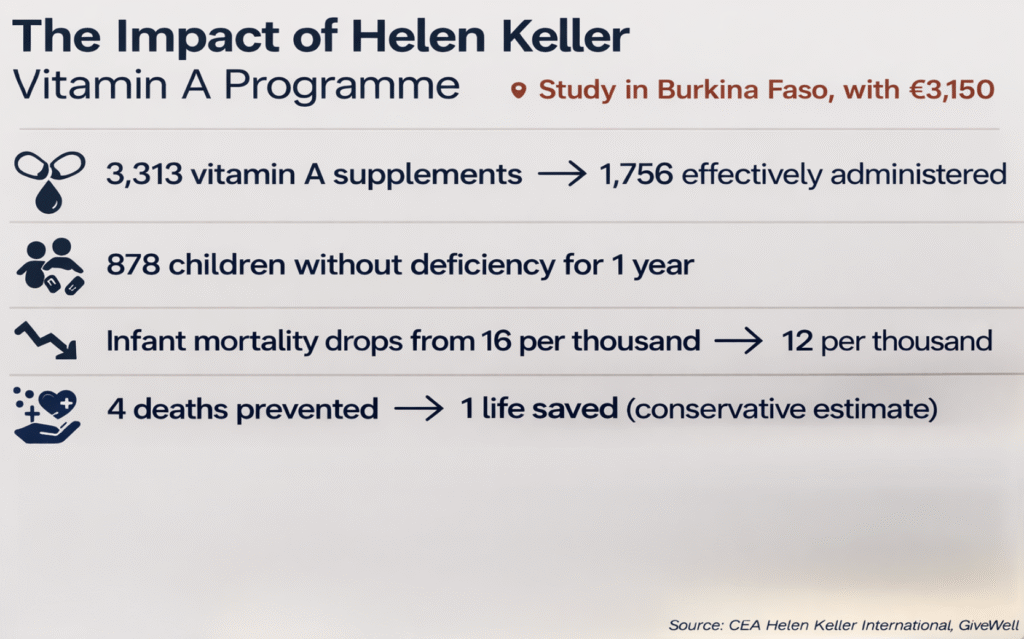
A concrete example: vitamin A supplementation
Let us take the example of the intervention for the distribution of vitamin A supplements in Burkina Faso. At a cost of approximately €3,150, one intervention makes it possible to distribute 3,313 vitamin A supplements, each of which protects one person for six months. On this basis, 1,756 of these supplements will actually be used by children, helping to improve their health by preventing deficiencies. According to the most recent studies, the observable effect is a reduction in infant mortality from 16 per 1,000 to 12 per 1,000, preventing four deaths.
The best evaluations take into account both the internal and external validity of studies, as these criteria often limit the replication of results.
Internal validity refers to the rigour with which a study measures the effect of an intervention in the specific context in which it was conducted. For example, excluding certain types of populations may lead to an overestimation of the results.
External validity, by contrast, assesses whether the results can be generalised to other contexts or populations. The effectiveness of an intervention depends heavily on the local environment in which it is implemented, and results may vary from one region to another.
This may also be linked to diminishing marginal utility, meaning that the impact of an intervention can decrease as it is expanded into areas where needs are less urgent or less severe.
For this intervention, GiveWell adjusted the results based on these two criteria and estimates that the observed impact could plausibly be up to four times lower than what was measured in the initial studies. This leads to the more conservative estimate of one life saved rather than four deaths averted.
It is therefore essential to ensure that the methodologies used are rigorous and that studies are transparent — especially when comparing results produced by different organisations. The way in which results are obtained can significantly influence the conclusions drawn from them (in our case, by a factor of four). For this reason, it is preferable to avoid simplistic comparisons of headline figures without first examining their scientific validity.
Saving lives is not the only relevant measure of impact. For example, when a thousand mosquito nets are distributed or 1,000 children are protected from vitamin A deficiency, the effects go far beyond preventing death. These interventions reduce disease and suffering, enable children to attend school more regularly, allow parents to work more consistently, help households avoid medical expenses, and reduce the risk that other children come close to dying. In short, such interventions both save lives and prevent a wide range of additional harms.
As an evaluator, GiveWell does not limit its analysis to counting lives saved. Its approach relies on a multi-criteria assessment that considers several dimensions of impact, including improvements in quality of life, reductions in suffering, and indirect benefits for communities. This framework provides a broader understanding of overall impact, going beyond a narrow focus on mortality alone.
Helping beyond marketing
The effectiveness of a charity is measured by its ability to achieve concrete results relative to its cost. The most effective charities can have an impact that is more than 100 times greater than others, meaning that the same donation can help many more people.
Rather than being influenced by marketing messages that may rely on questionable assumptions or oversimplified claims, you can choose to give based on the recommendations of independent evaluators. This approach increases the likelihood that your donation will genuinely make a difference and contribute to saving or improving as many lives as possible.
Tags : English Article