
Strategy & Impact
Giving for Systemic Change: Definition and Guide to Impact
Systemic change is one of the most ambitious goals a donor can pursue: not merely alleviating immediate suffering, but tackling the mechanisms that produce it. It is a legitimate aspiration, and historical examples show it can be realised — from the abolition of slavery to access to contraception, from clean-air regulation to civil rights.
But the concept of systemic change raises serious questions. What exactly is systemic change? How does it differ from acting directly on the consequences of a problem? And above all: how can a donor know whether an organisation that claims this ambition has the tools to deliver on it?
At Mieux Donner, we have studied these questions drawing on academic literature, research from leading independent evaluators, and analysis of documented examples of large-scale change. This guide is the result of that work.
Our conviction: the spectrum of "treating consequences / addressing causes" is not a spectrum of effectiveness. What matters is the rigour with which an intervention is chosen and evaluated. And there are concrete tools for doing so.
What is systemic change?
A concept without a settled definition
If you ask ten foundation directors what "systemic change" means precisely, you will get ten different answers. This ambiguity is not accidental: the concept draws on many disciplines — systems thinking, sociology of social movements, development economics — and has no recognised institutional definition.1
What can be said is that a minimal consensus exists around one central idea: systemic change aims to modify the mechanisms that produce a problem, not merely its visible manifestations. Acting on causes rather than consequences. The researcher Donella Meadows formalised this intuition by distinguishing different levels of intervention in a system: changing its parameters (a rate, a threshold), changing its rules (a regulation, a law), modifying its feedback loops (evaluation or accountability mechanisms), or transforming the underlying paradigms (the beliefs and norms that give it legitimacy). The higher the intervention in this hierarchy, the deeper the potential impact — and the harder the causal attribution. This intuitive distinction is useful as a starting point, but insufficient on its own to guide funding decisions.
On multi-year and unrestricted funding
A common argument in philanthropic circles holds that systemic change requires multi-year, unrestricted funding, granted without any expectation of short-term results. This approach points to real problems: overly earmarked grants can distort an organisation's strategy, and operating costs are a necessary condition for impact.2
But multi-year funding is a modality, not a selection criterion. Even on long-term projects, it is healthy for funders and organisations to ask regularly: are we on the right trajectory? Is the emerging evidence pointing towards the expected success? Funding can be stopped if new data show that a different intervention would be more effective. That is not a failure. It is a requirement of rigour.
What the great historical movements teach us
History offers striking examples of real, documented systemic changes. The abolition of slavery, women's suffrage, tobacco regulation, the eradication of smallpox. Rutger Bregman, in Moral Ambition (2025), analyses these transformations: they were driven by small groups of determined people who combined rigour in choosing their targets, pragmatism in their methods, and persistence over the long term.
These movements also benefited, at key moments, from substantial private resources. The British abolitionists were supported by Quakers and convinced merchants, long before the state legislated. The women's suffrage movement relied on networks of private donors for its campaigns, newspapers and lawyers. The contraceptive pill and early vaccine research advanced more quickly thanks to private foundations, before states took over. Bregman draws a clear-eyed lesson from this: it would be healthier to live in a world where states tackled these challenges head-on with adequate public resources. While we wait for that world, the resources available today can help make it possible.
The consequences/causes spectrum — and why it says nothing about effectiveness
Direct action can generate massive systemic effects
Take the example most often cited as the archetype of direct aid: the distribution of insecticide-treated bed nets to combat malaria. The Against Malaria Foundation distributes bed nets to people at risk in sub-Saharan Africa. It is hard to imagine anything more concrete, more direct. And yet.
Between 2004 and 2019, bed nets helped prevent around 816 million cases of malaria and contributed to saving approximately 4.8 million lives.3 At that scale, the effects cease to be purely individual. Regions whose working-age population is no longer decimated by disease show documented productivity gains over ten to twenty years.3b Children who no longer fall ill stay in school longer. A simple medical intervention, repeated at scale in a sufficiently neglected area, can permanently transform the trajectory of an entire region. Moreover, distributing bed nets widely enough brings us closer to a world in which malaria could be eradicated — which would itself constitute one of the greatest systemic changes in public health history.
This intervention's position on the consequences/causes spectrum did not determine its actual scale. What determined it was its scale, its rigour, and the neglected nature of the problem it targeted.
The false dilemma between direct aid and structural transformation
The "direct aid versus systemic change" debate is one of the most persistent in philanthropic circles. It often pits those who fund measurable short-term interventions against those who want to address root causes. This opposition is understandable. It is also largely unproductive.
The most effective organisations documented to date operate at very different points on this spectrum. GiveWell recommends direct global health interventions because their evidence base is exceptionally strong. Founders Pledge recommends climate advocacy organisations because their analysis of the cost-to-policy-leverage ratio is compelling. The question is not where an organisation sits on this spectrum. The question is: does it have solid evidence that its actions are contributing to real change, and how does it know?
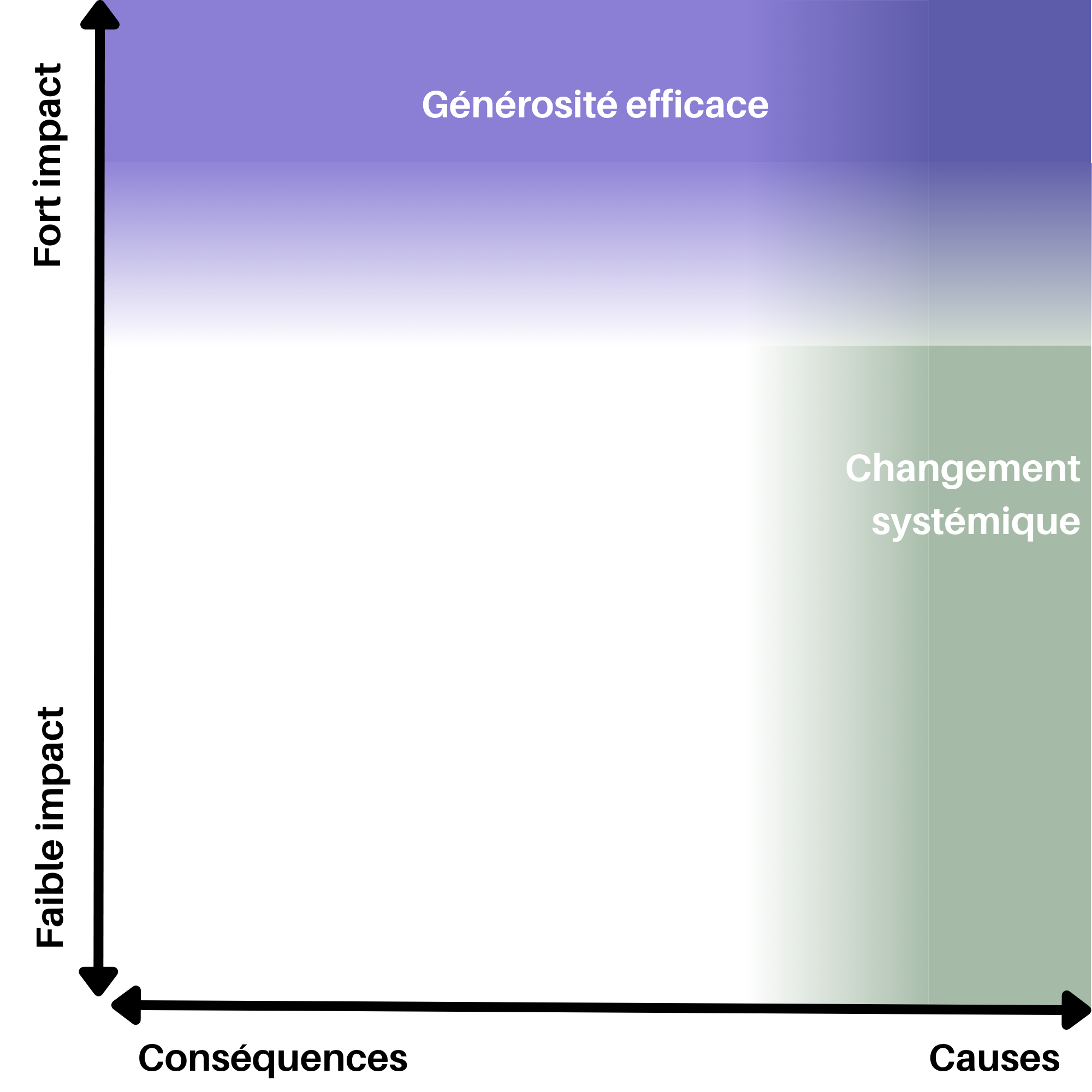
Effective giving and systemic change: two overlapping areas
The best impact opportunities sit at the top of the chart. The two areas overlap: some interventions belong simultaneously to effective giving and to systemic change.
Where do you sit on this chart?
The three-basket method distinguishes between resources devoted to yourself and those close to you, causes that matter to you personally, and interventions that can make the greatest possible difference. The allocation is yours to decide — but we invite you not to leave the third basket empty.
If you choose to concentrate part of your giving on maximum impact, you can absolutely specialise in more systemic approaches. But whatever your position on the spectrum, the same finding applies: very few organisations in France use the rigorous prioritisation methods that identify high-impact interventions. Most actors drawn to systemic change do not apply — and often are not aware of — these principles. Directing resources towards a systemic organisation that does not apply them is rarely the most effective use of your generosity.
How to prioritise when you cannot measure everything
The three criteria: scale, tractability, neglectedness
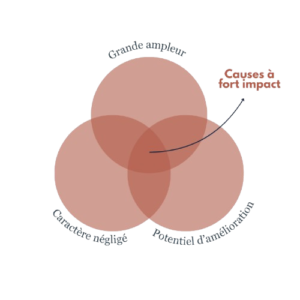
When faced with very different interventions, how do you choose? The most rigorous independent evaluators — GiveWell, Founders Pledge, Coefficient Giving — converge around three criteria that Mieux Donner uses in its own selection process.4
- Scale: does the problem affect a large number of people, and how deeply?
- Tractability: what proportion of the problem can be effectively solved with the knowledge and levers available today? Assessing this criterion means identifying real points of leverage, not just intentions.
- Neglectedness: how much funding is already devoted to this problem? A heavily funded problem offers little room for a marginal contribution. An important but neglected problem can be transformed by modest funding that arrives at the right moment.
Robust evidence without a randomised trial
Rigorously evaluating a systemic intervention does not necessarily require a randomised controlled trial. This method is the gold standard for testing medical interventions or resource transfers, but it cannot be applied to most advocacy work or efforts to transform social norms. You cannot randomise the passage of a law.
What you can do is build a rigorous argument from converging evidence. To evaluate advocacy in favour of a tobacco tax, for example, you can combine historical data on the effect of taxes on consumption, available economic models, epidemiological studies on tobacco-related diseases, and an estimate of the probability of success given the political context. The result is not certainty. It is a reasoned estimate that enables you to compare options and choose with discernment. Imprecision is not the impossibility of comparison.
A reference example: advocacy on lead paint
In 2020, a small organisation incubated with an initial grant of $60,000 began advocating for lead paint regulations in high-burden countries: the Lead Exposure Elimination Project (LEEP).8 Its choice resulted directly from the three criteria.
On scale: lead exposure kills around 1.5 million people per year — more than tuberculosis.9 On neglectedness: fewer than $15 million in philanthropic funding is dedicated to it annually, for a problem representing approximately 1% of the global disease burden.7 On tractability: 61% of countries have no regulation on lead paint, and governments have proved receptive to locally produced data from LEEP.
The results are documented: in Malawi, the market share of lead-containing paints fell from 67% to 24% between 2021 and 2023. The preliminary estimate of cost per DALY averted is $12, which compares favourably with benchmark global health interventions. This is systemic change — a national regulation permanently amended — underpinned by a rigorous prioritisation process and measurable milestones. LEEP now operates in several countries simultaneously: it is the scale-up of the proof of concept that makes the change genuinely systemic at a global level.
Three further high-impact examples affecting the system
Social norms and contraception: Family Empowerment Media
Family Empowerment Media (FEM) broadcasts radio programmes in Nigeria to correct misconceptions about modern contraception. Its work targets causes: the lack of information and the stigma that hinders access to methods that are already available. A randomised trial conducted in Burkina Faso by J-PAL and IPA (Glennerster et al., 2022) on a similar model showed a 20% increase in the use of modern contraceptives, and 14% more women believing they should control the number of children they have.10 That last figure measures a change in social norm, not merely individual behaviour.
Regulatory advocacy: Clean Air Task Force
Clean Air Task Force contributed to the adoption of the first major methane-emissions regulation in the European Union, as well as to the US Inflation Reduction Act in 2022.11 That regulation alone has the potential to reduce global methane emissions from the oil and gas sector by more than 30%, representing 7% of all human emissions. This type of intervention changes the conditions in which thousands of companies operate, without having to reach each one individually.
Capacity building: School for Moral Ambition
The School for Moral Ambition illustrates how the same criteria can be applied to highly systemic ambitions. To define its areas of action, the organisation drew up a list of more than 30 neglected global problems, conducted approximately 1,000 hours of research, and interviewed more than 50 experts.12 Three priorities emerged: the protein transition, the fight against the tobacco industry (8 million deaths per year), and tax equity for the ultra-wealthy. The Tax Fairness Fellowship places professionals for seven months within tax justice organisations in six countries. This programme does not yet have the track record to be assessed on outcomes. What is assessable is the method that produced it.
The objection of root causes
"Until we change the system at its foundations…"
A sincere objection recurs frequently in philanthropic circles: "Distributing bed nets, funding climate advocacy — all well and good, but until we tackle global economic structures, power dynamics, or the growth model, we are only managing the symptoms of a fundamentally broken system."
This objection points to a genuine limitation of certain philanthropic approaches that satisfy themselves with visible short-term impact without ever interrogating the mechanisms that produce the problems they treat. It deserves to be taken seriously.
Why this argument can lead to inaction
The problem with the root-causes argument is that it has no bottom. Every cause has its own cause. Global economic inequalities have historical roots in colonisation. Colonisation has roots in political and military structures. Those structures have roots in cultural and institutional dynamics. One can go back indefinitely.
Pushed to its logical conclusion, this argument leads to paralysis: no intervention is worth pursuing until the global system has been transformed. And since that transformation is a distant and uncertain horizon, nothing gets done. Children die from preventable diseases in the meantime.
There is also a serious epistemic problem. Whether a given economic system is the primary cause of global poverty is a complex empirical question, one that available data do not resolve simply. That is not a reason to stop asking it. It is a reason not to make it a prerequisite for all action.
Pursuing the utopia and acting now
Rutger Bregman articulates in Moral Ambition (2025) a stance that holds together the most radical ambition and the most rigorous action: it would indeed be healthier to live in a world where states tackled poverty, child mortality, and climate change head-on, and where the ultra-wealthy paid their fair share of taxes. That world is worth pursuing. In the meantime, the resources available today can help make it possible — as the abolitionists and the suffragettes did before us.
"He never gives in to that passive patience which serves as an excuse for inaction. He recognises that social change will not come overnight, but he acts nonetheless as if that change were immediately possible." Martin Luther King, "Transformed Nonconformist"13
For a donor, this translates concretely: it is entirely coherent to fund both direct interventions with demonstrated impact and advocacy organisations whose methods are rigorous. This is not a compromise. It is a consistent strategy, provided both types of funding rest on the same standards of rigour.
How to evaluate a project that claims systemic change
What a serious organisation must be able to explain
When faced with an organisation claiming systemic ambition, here are the concrete questions to ask. The most rigorous organisations welcome them.
- Is the problem clearly defined and delimited? A serious organisation knows precisely which problem it is trying to solve, for whom, and within what scope. A vague answer such as "transforming the food system" without specifying the lever or the target is a warning sign.
- Is the theory of change supported at every link? A theory of change is not a decorative diagram. It is a line of reasoning in which every step rests on converging evidence: historical data, comparable studies in similar contexts, expert opinion, intermediate results measured in the field.14
- Is the problem neglected? A heavily funded problem leaves little room for a differentiated contribution. An important but neglected problem can be transformed by modest funding that arrives at the right moment.
- Does the organisation measure its progress against intermediate milestones? Systemic change takes time, but progress can be tracked. An advocacy organisation can measure how the positions of targeted decision-makers are evolving, legislative advances secured, and new coalitions built.
- Is the organisation honest about its uncertainties? The best organisations publish their assumptions, their mistakes, and their revisions. This transparency is not a weakness — it is the hallmark of a learning organisation.
Warning signs
- Confusing ambition with method. Wanting to change a system is an aspiration. Having a credible method for doing so is something else. An organisation that describes in precise terms the world it wants to build, but remains vague about the concrete mechanisms through which it expects to contribute, has confused the two.
- A causal chain that is too long without intermediate milestones. The more steps a theory of change strings together before reaching the intended impact, the harder it is to verify that each link holds. This requires particular attention to the points of fragility and how the organisation monitors them.
- The absence of a counterfactual. An organisation that attributes to its own actions alone a change that would probably have happened anyway is overstating its contribution. Rigorous organisations explicitly consider the question: what would have happened without us?
| Criterion | Rigorous project | Rhetorical project |
|---|---|---|
| Problem definition | Precise, delimited | Broad, diffuse |
| Theory of change | Explicit, supported at every link | Present on the surface, without evidence |
| Neglectedness | Analysed and documented | Not addressed, or claimed without analysis |
| Intermediate milestones | Defined and tracked | Absent or very general |
| Honesty about uncertainty | Public and acknowledged | Minimised or absent |
| Counterfactual | Considered and estimated | Assumed without analysis |
The donor's role in the system
Funding systemic change is not simply a matter of selecting the right organisations. A donor can also play other roles in the ecosystem: producing or funding missing data that make an advocacy case credible, building coalitions between actors who would not otherwise speak to one another, or signalling to other funders that a neglected topic deserves attention. These roles are distinct and complementary.
They do not, however, exempt the donor from the rigour of prioritisation. Funding knowledge production on a topic is also a choice to fund that topic rather than another. The questions of scale, neglectedness, and tractability apply to each of these roles — not only to the choice of which organisation to support.
What this means for your giving
Systemic change is not a superior category of funding to direct aid. It is an ambition that, like any philanthropic ambition, deserves to be evaluated with rigour. Organisations that answer seriously the questions posed in this guide — whatever their position on the consequences/causes spectrum — are the ones that deserve support.
The right question to ask is not "does this organisation pursue systemic change?" but "does this organisation have solid reasons to believe its actions are contributing to real change, and how does it know?" That question applies equally to a charity distributing bed nets and to an international tax advocacy organisation.
What the documented examples in this article have in common — whether Against Malaria Foundation, LEEP, Family Empowerment Media, or Clean Air Task Force — is an identical approach: a clearly delimited problem, evidence on the levers of action, attention to the neglectedness of the cause, and measurable milestones to track progress. It is this approach that Mieux Donner seeks to identify in its charity recommendations.
To go further on impact evaluation, we recommend our article on cost-effectiveness analysis and its nuances, as well as our three-basket method for structuring a coherent giving strategy.
Looking to fund high-impact organisations?
Mieux Donner selects charities whose interventions — whether direct or systemic — rest on robust evidence and a rigorous prioritisation process.
Discover our recommended charities →Sources
- Gautier, A. and Spanu, M., "Vers une philanthropie de changement systémique en France", Tribune Fonda no. 257, 2023. Ashoka x Fondation de France, quantitative survey, June 2021. ↩
- Fondation de France, "Pas de philanthropie sans confiance", 2024. Ashoka x McKinsey, "Embracing Complexity: Towards a Shared Understanding of Funding System Change", 2020. ↩
- Against Malaria Foundation / GiveWell, 2004–2019 data, cited at mieuxdonner.org/against-malaria-foundation-en. ↩
- Bleakley, H., "Disease and Development: Evidence from Hookworm Eradication in the American South", Quarterly Journal of Economics, 2007. See also: Barofsky, J. et al., "Malaria eradication and economic outcomes in sub-Saharan Africa", NBER Working Paper, 2015. ↩
- Berger, A., "Exploring Cause Prioritization in the Journal of Economic Perspectives", Journal of Economic Perspectives, vol. 38, no. 2, Spring 2024, pp. 63–82. Available at coefficientgiving.org. ↩
- WHO / UNICEF, malaria data 2023. Cited at mieuxdonner.org.
- Giving What We Can / LEEP, 2025: givingwhatwecan.org/charities/leep.
- Berger, A., op. cit., figure 2 (comparison of disease burden / philanthropic funding by cause).
- LEEP, "Introducing LEEP: Lead Exposure Elimination Project", EA Forum, October 2020: forum.effectivealtruism.org. ↩
- LEEP, "Seven things that surprised us in our first year working in policy", EA Forum, May 2021. Open Philanthropy / EA Forum, "Announcing the Lead Exposure Action Fund", September 2024. ↩
- Glennerster, R., Murray, J. and Pouliquen, V., "The Media or the Message? Experimental Evidence on Mass Media and Modern Contraception Uptake in Burkina Faso", J-PAL / IPA, 2022. Preprint available at cepr.org. ↩
- Clean Air Task Force / Mieux Donner: mieuxdonner.org/donate. Founders Pledge, Climate Change Fund impact report, 2022. ↩
- School for Moral Ambition, institutional website, 2024–2025: moralambition.org. ↩
- King, M.L., "Transformed Nonconformist", in A Gift of Love: Sermons from "Strength to Love" and Other Preachings, Boston, Beacon Press, 2012, p. 18. Cited in Bregman, R., Moral Ambition, 2025. ↩
- Charity Entrepreneurship, "Nailing the basics: Theories of change", EA Forum, July 2023: forum.effectivealtruism.org. ↩