
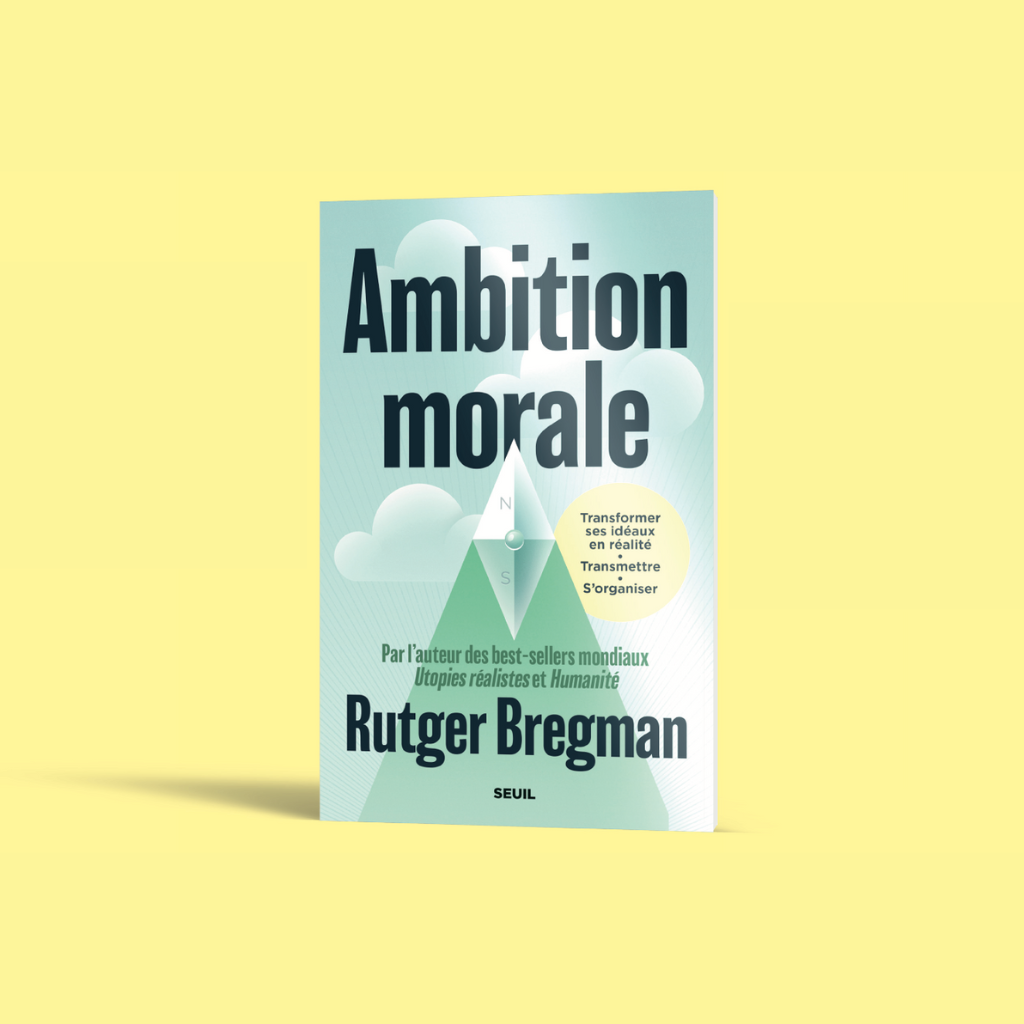
Summary of Rutger Bregman's Moral Ambition: What we remember to make a difference

Ombline Planes
Head of Communications
Reading time: 7 minutes
We are living in a time of multiple crises: climate emergency, growing inequalities, wars, loss of bearings. Everywhere, the news reminds us that the challenges are immense and that solutions can no longer be merely symbolic. Faced with this reality, it is tempting to withdraw into oneself, to seek refuge in personal development, material comforts or small daily gestures that ease the conscience. But is this enough to transform the world?
Rutger Bregman, Dutch journalist and essayist, answers bluntly: no. In his new book Moral Ambition, he offers a fresh perspective: rehabilitate ambition, but not just any ambition. He strongly criticises ambition that is focused on oneself, one’s career or prestige. What he advocates is moral ambition: putting one’s energy, talent and resources at the service of the most important causes and the most effective actions.
That’s what made us want to read this book, and that’s also why we want to tell you about it. Because Moral Ambition isn’t just something to read on your own. It’s a resource to share, discuss and debate. It’s a text that deserves to be circulated, because it opens up essential conversations about what it really means to ‘do good’.
Summary of Rutger Bregman's book Ambition Morale
The central thesis: acting effectively, not just "well"
Bregman’s thesis is clear: it is not with fine abstract principles or by following a mainstream path that real change is achieved. Those who truly transform society are not pure moralists, attached to their personal consistency, nor are they traditional careerists, who lock themselves into predetermined trajectories. They are those who know how to combine three qualities:
- Seek out the most important causes and the most effective methods, with the rigour of an entrepreneur who knows how to analyse, measure and iterate.
- Maintain the moral compass of an idealist, capable of aiming high, rejecting cynicism and maintaining ethical clarity.
- Act with the determination of an activist, who is not discouraged by the scale of the challenges and accepts risk, discomfort and, at times, misunderstanding.
It is this combination of rigour, creativity and ambition that Bregman calls moral ambition. And he sees it as the key to restoring meaning to our individual lives and strength to our collective commitments.
The waste of talent: a striking observation
Right from the first chapter, Bregman hits hard: “No, you are not fine the way you are.” Contrary to the reassuring rhetoric of personal development, he denounces the massive waste of talent in our modern societies.
He quotes anthropologist David Graeber and his theory of bullshit jobs: jobs that contribute almost nothing to society. He describes prestigious but hollow careers, tasks that serve no purpose other than to fill Excel spreadsheets, produce reports that no one reads, or coordinate teams that do not need coordination. On the other hand, essential professions such as nursing, teaching, refuse collection and research are underpaid and undervalued, even though they produce immense social benefits.
Bregman does not stop at pointless jobs: he also criticises superficial activism, which aims more to ease the conscience than to solve problems. Signing an online petition, sharing an activist post or boycotting a product on an ad hoc basis is not what brings about structural change in the world.
To clarify his point, he proposes a career matrix, crossing the axis of personal ambition with that of social utility. Careers with low impact or low ambition lead to a dead end. Only those that combine real impact and clear ambition truly transform the world.
At Mieux Donner, this diagnosis resonates. Because we share Bregman’s concern: in a world where so much talent is wasted in careers with little social utility, how can we redirect this energy towards what really matters? This is precisely what we seek to shed light on: what actions, what associations, what career choices allow us to maximise the impact of our limited resources?
In practical terms, this means helping everyone distinguish between what appears useful and what actually is useful. A one-off donation, a prestigious career or a symbolic commitment may seem rewarding, but they do not always have an impact on the most serious problems. Our role is to provide guidance, analysis and recommendations based on data, so that time, talent and money can be directed where they can save the most lives or reduce the most suffering.
In this sense, Bregman’s diagnosis feeds into our mission: to remind people that good intentions alone are not enough. The challenge is to choose clearly and rigorously where our impact will be greatest.
Giving meaning back to your career: moral ambition as your compass
A working life represents around 80,000 hours. As Bregman points out, this is a rare and precious resource. How should we use it? Certainly not by simply following the beaten track or seeking only personal fulfilment. But by devoting this time to what matters most.
He illustrates this with the example of Thomas Clarkson and the British abolitionists. Seeing the horror of slavery, they could have contented themselves with indignant speeches or abstract moral principles. But they chose an effective strategy: to focus their efforts first on abolishing the slave trade. An achievable goal, a structured campaign, gradual victories and, ultimately, a historic turning point.
Bregman presents the history of abolitionists not only as a moral struggle, but also as an example of effective pragmatism. Aim for a specific target, make it a clear priority, and achieve an initial victory that paves the way for others. However, there is room for nuance here: the history of abolition cannot be explained solely by this strategy. Slave revolts, economic developments, and diplomatic interests were also decisive factors. This simplification serves Bregman’s purpose, but deserves to be supplemented.
At Mieux Donner, this narrative resonates particularly strongly. Because it is exactly the logic we defend with our ITN criteria (Importance, Neglect, Tractability). In a world saturated with causes and emergencies, not everything can be addressed at once. We must target what is crucial, neglected, and solvable by realistic means. Abolitionists applied this logic ahead of their time, and that is what made them effective.
That is why we do not simply call on people to “follow their calling” or “listen to their heart”. We help everyone make data-driven decisions: where to invest their 80,000 hours of working life, how to turn their skills into a lever for impact, and how to avoid the trap of prestigious but socially hollow careers.
In 2024, we were incubated by Charity Entrepreneurship. As Romain, our co-founder, says:
It was a kind of Hogwarts for benefactors. From the outside, it seems surprising, almost unreal. But when you're there, it just seems right and moral: the most natural way to learn how to change the world.
Romain Barbe
This incubator allowed us to discover stories that had a profound impact on us. The story of the Against Malaria Foundation (AMF), undoubtedly the best charity in the world in terms of impact/cost ratio, moved us with its rigour and efficiency. We also learned how Wall Street bankers became the founders of GiveWell, now the world’s leading charity evaluator. They didn’t just “give”: they sought out the best ways to do so. This methodological rigour sparked a revolution in philanthropy, and it is on this basis that we now base our recommendations in the areas of health and poverty alleviation.
At Mieux Donner, we believe that giving can become an act of profound consistency.
That is why we invite those who wish to do so to commit to giving 10% of their income to high-impact charities.
This may seem like a modest gesture, but collectively it can transform millions of lives.
Moral ambition, as Bregman describes it, then becomes a compass. It invites us to reject waste and seek consistency between our ideals and our concrete choices. And that is precisely the mission of Mieux Donner: to support those who want their careers, like their donations, to be aligned with a demand for efficiency and real impact.
What the book contributes to the contemporary debate
Moral Ambition is not a self-help manual. It is not a book that promises you greater peace of mind or improved productivity. It is a call to collective responsibility. A book that tells us that simply wanting to “do good” is not enough. We must aim higher, with rigour, method and a long-term vision.
The strength of the book lies in two complementary dimensions:
- An accessible, narrative style: Bregman does not get lost in academic abstractions. He brings his ideas to life through stories, whether about historical figures such as Clarkson or contemporary examples of researchers and activists. He interweaves anecdotes, data and personal accounts to show that moral ambition is not a theory, but a living practice.
- A bold and uncomfortable message: Bregman does not seek to reassure us. He demands more. More clarity about the causes we choose, more rigour in how we measure impact, more courage to abandon what flatters our intuitions but does not really change the world. This is what makes this book a disturbing but salutary read.
What is particularly interesting for us at Mieux Donner is Bregman’s ability to explain technical concepts that structure our daily work in layman’s terms: prioritising causes, impact assessment, optimal allocation of scarce resources. When he describes why certain careers or donations change lives more radically than others, he translates the approaches we use, such as ITN criteria or GiveWell evaluations, into clear language.
In this sense, Moral Ambition contributes to the contemporary debate by making these ideas accessible to a much wider audience. Where impact experts talk about ‘tractability’ or ‘negligence’, Bregman tells a story that speaks to everyone: that of our choices, big and small, and their disproportionate power depending on how they are oriented. It is a valuable mediation that raises the level of public discussion and allows everyone to ask themselves the right questions: “Where can I have the most impact, and how can I devote my energy to it?”
Why we at Mieux Donner recommend it
This book embodies the tensions, vision and methods that underpin our daily work at Mieux Donner.
The book resonates particularly with two pillars of our approach:
- Recommendations from associations, based on reliable assessments (GiveWell, AMF), which help to target high-impact causes.
- The ITN criteria (Importance, Negligence, Tractability), which structure our strategic prioritisation choices: just as Bregman encourages us to aim for trafficking rather than total slavery, we seek to identify the most effective actions.
Moral ambition also helps us overcome false moral comforts: believing that an anonymous gesture is enough, or that ‘giving locally’ is always better, is often an illusion. This book reminds us that when it comes to impact, difficult choices are sometimes the most effective.
Finally, it puts our wealth, time, talent and money back into perspective: they are scarce resources that must be invested wisely. It is precisely this requirement that we promote through advocacy, tools and partnerships that we develop on a daily basis.
Limitations and critical remarks
You also need to read Bregman with a critical mind.
His tone is sometimes provocative or divisive. But this also has a virtue: it awakens, challenges and breaks through apathy.
His historical and economic accounts are often based on individual stories or those of small groups, rather than on an overview as an academic work would do. When he recounts the abolition of slavery as a victory due mainly to the pragmatism of abolitionists, he glosses over other decisive forces (without necessarily specifying the real influence they had): the slave revolts that disrupted the colonial system, the economic pressures linked to the industrial revolution, and the diplomatic issues that also served the interests of the British Empire.
Similarly, when he talks about bullshit jobs, he makes a stark contrast between “useful” and “useless” jobs. The reality is often more nuanced, with positive or negative externalities that are difficult to measure.
But these simplifications serve a clear purpose: to make the message readable and inspiring. And in this respect, they contribute to the book’s educational power. Rather than losing his readers in the complexity of the debates, Bregman chooses to make an impression. The details may be debatable, but it is difficult to deny the usefulness of this intellectual shock.
A book that elevates the debate
Ultimately, Moral Ambition is a book that changes the way we think about action. It reminds us that good is not achieved solely through good intentions, but through rigour, courage and method. It puts ambition back at the heart of morality, not as a flaw, but as a necessity.
We strongly encourage you to read it. But beyond reading it, we hope you will talk about it with others, recommend it, and discuss it. Because a book reaches its full potential when it circulates and fuels collective conversations.
And that is precisely our mission at Mieux Donner: to help everyone transform their moral ambition into real impact.
Buy the book:
Fnac, Amazon, Cultura, La Librairie , Gibert, la procure, Decitre, Rakuten
Tags : English Article