
Climate change

Where to give for the climate in 2026: Giving Green's new recommendations
Giving Green is the leading evaluator of climate and biodiversity work. This independent research team spends the year working out where a climate donation does the most good, then publishes what it finds, along with its method and its uncertainties. Its own funding is kept separate from the charities it assesses, and we build our climate recommendations on its work.
Giving Green announced $40.5 million in grants at the end of October 2026. Half of it goes to low- and middle-income countries, up from 15 per cent last year. The team published its first three sector reports, which weigh every strategy in a sector against the others. And a new dashboard sets out its ratings for 34 climate strategies.
What Giving Green announced at the end of October
$48.1M
distributed over 2026
52
grants in this round alone
50%
to emerging economies, up from 15% in 2025
On 29 October 2026 the Giving Green Fund announced $48.1 million distributed over the year, $40.5 million of it in this round alone, spread across 52 grants to charities and research institutes[1]Giving Green (2026). Top Climate Nonprofits & Giving Strategies for 2026 and Beyond.. This is the largest round since the fund launched five years ago. At the same point last year the announcement covered $26 million and 29 grants[2]Giving Green (2025). Giving Green Announces $26 Million for High-Impact Climate Solutions..
These grants cover five of the six sectors Giving Green has prioritised: electricity, food and land use, industry, carbon dioxide removal, and climate risk management. The sixth, transport, was assessed in 2025 and will be looked at again in 2027. A report on the electricity sector is due the same year[1]Giving Green (2026). Top Climate Nonprofits & Giving Strategies for 2026 and Beyond..
We have set out elsewhere how we select the charities we recommend.
Emerging economies now take half of Giving Green's support
The sharpest change is in where the money goes. Half of this round's grants go to low- and middle-income countries, up from 15 per cent last year[1]Giving Green (2026). Top Climate Nonprofits & Giving Strategies for 2026 and Beyond..
Two figures carry the argument. In 2024 those countries produced 64 per cent of annual global greenhouse gas emissions, around 34 of the world's 53.2 billion tonnes of CO2 equivalent, land-use change excluded. Philanthropic foundations spend 2 cents per tonne emitted there, compared with 19 cents in the United States and 14 cents in the European Union[3]Giving Green (2026). Accelerating Climate Change Mitigation in Low- and Middle-Income Countries.. The gap runs from seven to ten times.
A second argument rests on historical responsibility. According to Giving Green, high-income countries have emitted roughly 1.8 trillion tonnes of CO2 equivalent since 1850, about half the world total, while holding 17 per cent of today's population[3]Giving Green (2026). Accelerating Climate Change Mitigation in Low- and Middle-Income Countries.. Those countries developed on fossil energy that was cheap and plentiful. Emerging economies need the same access to energy, and their demand is climbing fast. Helping them meet it without locking in coal and gas for forty years is necessary.
To sort them, the team ranked countries on three criteria: current and projected emissions, how feasible philanthropic work is on the ground, and the gap between the funding that exists and what is needed. India and Indonesia come first, and each has a strategy report of its own this year. China, Mexico and South Africa follow, then Brazil, Malaysia, Pakistan and Thailand[3]Giving Green (2026). Accelerating Climate Change Mitigation in Low- and Middle-Income Countries..
One example: Bangladesh's brick kilns
In Bangladesh, informal brick kilns burn coal in hand-built furnaces. A team led by Nina Brooks tested a training programme that changes how the bricks are stacked and how the fire is fed, with no equipment to buy. Science published the result in 2025: emissions of CO2 and fine particulates fell by 20 per cent compared with the control group[4]Brooks, N. et al. (2025). Reducing emissions and air pollution from informal brick kilns. Science., and 74 per cent of the operators trained were still using the practices in the second year[5]J-PAL. Training brick manufacturers to reduce emissions in Bangladesh (case study).. Operators spend less on coal and get better bricks out of it, so they have every reason to carry on.
Charity Entrepreneurship, the incubator that hunts for the most effective interventions in the world and the one Mieux Donner itself came through, put this intervention to its February 2026 cohort. On its estimate, a charity training 500 kilns a year would avoid around 232,000 tonnes of CO2 equivalent annually[6]Ambitious Impact (2025). Introducing our newest charity recommendations..
Why money goes further in these countries
Labour and advocacy cost less there, and much of the infrastructure has yet to be built. A kiln, a power station or an electricity grid lasts for decades. Acting before the decision is taken costs far less than correcting it afterwards.
The first three sector reports
Until this year Giving Green published its reports strategy by strategy. The team has now added a level above that. A sector report weighs the strategies within one sector against each other and explains which ones it keeps. Three sectors are covered.
Food, agriculture and land use
This sector accounts for 22 to 38 per cent of global emissions, 12 to 20 billion tonnes a year, and it received 8.5 per cent of foundations' mitigation spending in 2024. Livestock makes up 57 per cent of the sector's emissions for 18 per cent of the calories the world eats[7]Giving Green (2026). Food, Agriculture, and Land: Sector Report..
Giving Green's first priority here is scaling alternative proteins. Replacing half of all animal products would avoid between 3 and 8 billion tonnes a year, according to the studies it reviews[8]Giving Green (2026). Scaling Alternative Proteins: Strategy Report.. The field takes less than 1 per cent of climate philanthropy today[1]Giving Green (2026). Top Climate Nonprofits & Giving Strategies for 2026 and Beyond., and private funding has dropped by more than 80 per cent from its 2021 peak[7]Giving Green (2026). Food, Agriculture, and Land: Sector Report.. A second strategy covers cutting the methane that ruminants produce as they digest, which the report treats as cover in case alternative proteins fail to scale fast enough.
Industry
Industry accounts for roughly 31 per cent of global emissions and takes 2.8 per cent of foundations' mitigation funding[9]Giving Green (2026). Industry: Sector Report.. Steel and cement together come to about 14 per cent of global emissions[1]Giving Green (2026). Top Climate Nonprofits & Giving Strategies for 2026 and Beyond..
The obstacle is what clean processes cost on top. The premium runs from 12 to 145 per cent for steel and from 75 to 150 per cent for cement[9]Giving Green (2026). Industry: Sector Report.. Those numbers land hard, but they thin out in the finished product: low-carbon cement adds 1 to 2 per cent to the cost of a house and 2 to 5 per cent to a road[10]Giving Green (2026). Decarbonizing Cement and Concrete: Strategy Report.. Green steel in production today comes to about 60,000 tonnes a year, or 0.003 per cent of the world market for conventional steel[9]Giving Green (2026). Industry: Sector Report..
Climate risk management
This report does not work in shares of emissions. It looks at the damage a high-warming world would do, which rises faster than the temperature does. Giving Green keeps one priority here: funding governance and research on solar radiation modification, the techniques that would cool the planet by reflecting part of the sunlight away[11]Giving Green (2026). Climate Risk Management: Sector Report..
Giving Green takes no position on deployment and does not fund the technical research itself. Its argument is that whatever gets decided one day, the decision should rest on rules and on knowledge. Neither exists today. Philanthropy has put in $102 million, 38 per cent of all funding in the field between 2005 and 2025, and low- and middle-income countries received 3 per cent of that[11]Giving Green (2026). Climate Risk Management: Sector Report..
| Sector | Share of global emissions | Share of foundations' climate philanthropy (2024) | First-priority strategy |
|---|---|---|---|
| Food, agriculture and land use | 22 to 38% | 8.5% | Scaling alternative proteins |
| Industry | around 31% | 2.8% | Decarbonising steel, cement and concrete |
| Climate risk management | not applicable | not quantified | Governance and research on solar radiation |
Read these with care: the reports name no charity. They exist to decide where the fund and the recommended list will put their resources. Giving Green also flags that several of its industrial funding figures come from a funders' consortium whose data cannot be checked independently.
The most effective climate charities are the same ones
Five charities are on the 2026 list: Clean Air Task Force, Project InnerSpace, Opportunity Green, the Good Food Institute and Future Cleantech Architects. They are the same five as last year[1]Giving Green (2026). Top Climate Nonprofits & Giving Strategies for 2026 and Beyond..
Not every charity is reassessed each year. Giving Green has brought in a cohort system: a charity is assessed, then recommended for the two years that follow. Clean Air Task Force, Project InnerSpace and Opportunity Green make up the 2026-2027 cohort. The Good Food Institute and Future Cleantech Architects were reviewed again this year and confirmed for the 2027-2028 cohort[1]Giving Green (2026). Top Climate Nonprofits & Giving Strategies for 2026 and Beyond..
That follows from the profile Giving Green is looking for. To join the list, a charity has to absorb several million dollars a year and hold a strategy over several years. In 2025 the amounts ran from $1.6 million for Opportunity Green to $4 million for Clean Air Task Force and the Good Food Institute, most of it spread over two years[2]Giving Green (2025). Giving Green Announces $26 Million for High-Impact Climate Solutions..
The recommended list
Five charities, several million dollars each, over two years. It carries the long commitments.
The Giving Green Fund
52 organisations funded this year, often for a few hundred thousand dollars, with a fresh assessment every quarter. It follows what is moving, and the subjects that are still young.
A schematic built from invented values. It illustrates the difference in profile between the two options, not a measured performance.
Climate Strategy Dashboard: seeing the reasoning
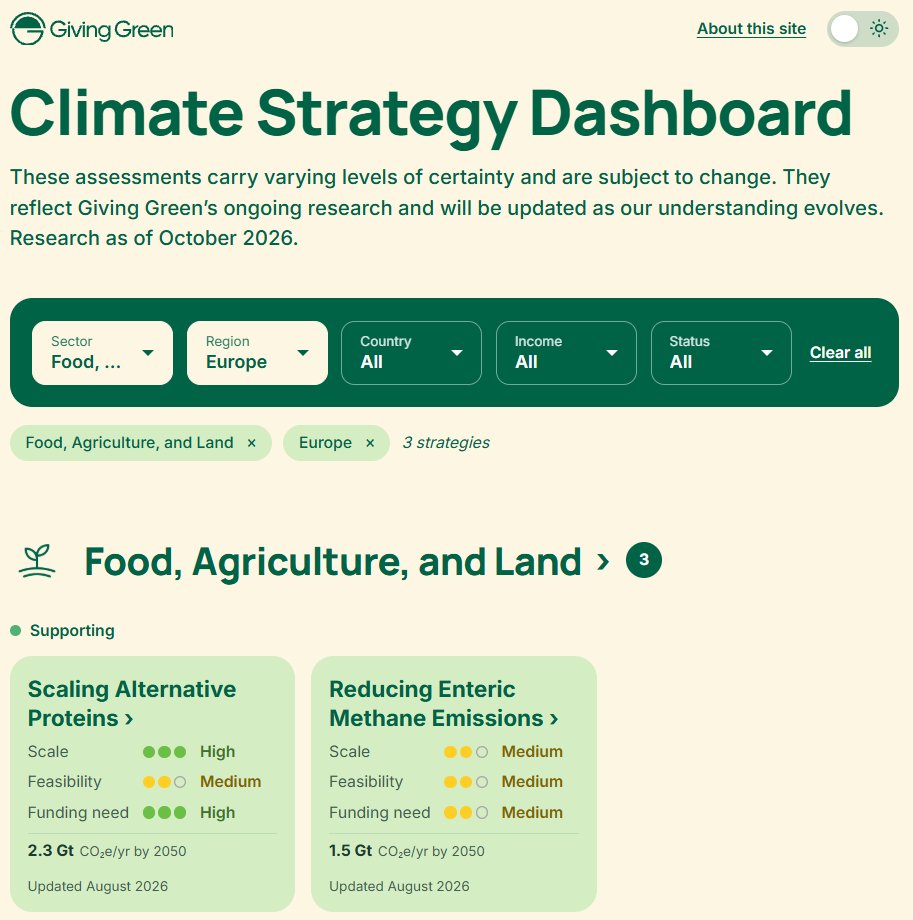
Giving Green has put an interactive dashboard online. It brings together 34 climate strategies, filterable by sector, region, country, income level and status[12]Giving Green (2026). Climate Strategy Dashboard..
The dashboard filtered on one sector and one region. Each card carries its three ratings and its mitigation potential to 2050. Source: Giving Green, Climate Strategy Dashboard.
Each strategy has its own card, with three ratings: the scale of the problem, how feasible philanthropic action is, and the need for funding. Each one runs from low to high. The card also gives the mitigation potential at 2030, 2050 and 2100, the philanthropic funding on record, the main funders, the state of public and private support, and the list of sub-strategies. Some cards carry the cost-effectiveness analyses already published and the charities recommended on that subject.
You can see what a recommendation rests on, and you can see what Giving Green does not know. The warning at the top of the page is explicit: these assessments carry varying levels of certainty and will be revised[12]Giving Green (2026). Climate Strategy Dashboard..
Giving to effective climate charities
For a climate donation, where the money lands now counts as much as the cause it funds. On the research available today, giving in India or Indonesia is the best-argued choice.
We are in regular contact with the Giving Green teams, so we can put the strongest climate opportunities of the moment in front of you while you keep the French tax reduction, which a direct donation to these charities does not give.
If you are weighing several options, or preparing a large donation, we also offer personalised advice, free of charge. And if you are still wondering whether carbon offsetting can do this job, we have covered that question in detail.
Giving for the climate from France
Support the climate charities Giving Green recommends, with a French tax receipt.
See our recommended charitiesTo work through the strategies one by one, Giving Green's dashboard is online.
Frequently asked questions
What is Giving Green?
An independent American research team that assesses where a climate donation does the most good. It publishes its recommendations, its method, its ratings and its uncertainties every year. Its funding is kept separate from the charities it assesses, and it takes nothing out of the donations.
What is the difference between the recommended charities and the Giving Green Fund?
The recommended list holds five charities funded over several years for substantial amounts. The fund backed 52 organisations in 2026, often for a few hundred thousand dollars each, and it reassesses every quarter. It takes the newer bets and the subjects that are still young.
Why is Giving Green funding emerging economies more heavily in 2026?
Those countries produce 64 per cent of annual global emissions, and foundations spend 2 cents per tonne emitted there compared with 19 cents in the United States. The funding gap runs from seven to ten times. India and Indonesia are the team's two geographic priorities this year.
Can I give to these charities from France and deduct my donation?
A direct donation to these charities, which are based outside France, carries no right to the French tax reduction. Giving through Mieux Donner supports the same organisations and keeps the deduction. You can also book a session of personalised advice, free of charge.
Sources
- 1 Giving Green (2026). Top Climate Nonprofits & Giving Strategies for 2026 and Beyond. givinggreen.earth
- 2 Giving Green (2025). Giving Green Announces $26 Million for High-Impact Climate Solutions, 2025-2026 Top Climate Nonprofits, and New Grantees. givinggreen.earth
- 3 Giving Green (2026). Accelerating Climate Change Mitigation in Low- and Middle-Income Countries. givinggreen.earth
- 4 Brooks, N., Biswas, D., Maithel, S. et al. (2025). Reducing emissions and air pollution from informal brick kilns: Evidence from Bangladesh. Science. Read the study
- 5 J-PAL. Training brick manufacturers to reduce emissions in Bangladesh. povertyactionlab.org
- 6 Ambitious Impact (2025). Introducing our newest charity recommendations. forum.effectivealtruism.org
- 7 Giving Green (2026). Food, Agriculture, and Land: Sector Report. givinggreen.earth
- 8 Giving Green (2026). Scaling Alternative Proteins: Strategy Report. givinggreen.earth
- 9 Giving Green (2026). Industry: Sector Report. givinggreen.earth
- 10 Giving Green (2026). Decarbonizing Cement and Concrete: Strategy Report. givinggreen.earth
- 11 Giving Green (2026). Climate Risk Management: Sector Report. givinggreen.earth
- 12 Giving Green (2026). Climate Strategy Dashboard. Accessed 4 November 2026. givinggreen.earth