How We Calculate the Impact of Carbon Reduction
At Mieux Donner, we often share that donating €1 to Clean Air Task Force (CATF) or €3 to the Good Food Institute (GFI) can help avoid one tonne of CO₂ emissions. These figures can seem surprising—if not implausible—especially for those familiar with the carbon offsetting sector, where cost estimates per tonne are often much higher. In this article, we explain how these numbers are calculated, their limitations, and why they still represent some of the most promising opportunities for individuals who want to support climate solutions based on evidence.
This article will focus on CATF as a case study, though a similar analysis can be conducted for GFI or any other climate charities we may recommend in the future.
How we come up with the figure of one ton per dollar/euro for CATF
It isn’t simple to calculate exact numbers for tons of carbon avoided, particularly for policy interventions. The climate charity evaluators that we partner with, Giving Green, no longer publicly give estimates of the amount of euros per ton of carbon avoided due to inherent uncertainty in these estimations. However, Giving Green aims for their top climate charity recommendations to hit the benchmark of 1 ton of carbon per dollar spent. They still recommend CATF as their top climate charity and you can read more about why in their deep dive report [1].
While Giving Green is a research organisation, Mieux Donner is a fundraising organisation and we need to balance presenting uncertainty with giving a sense of certainty through benchmarks so people are motivated to donate and have an idea of relative impact. Therefore, on our website you’ll see that we present the impact of our top recommended climate charities in terms of tons of carbon avoided per euro and we give a source for the data so that people can read into it for themselves.
And while it’s incredibly difficult to put an exact number on this, the best available research gives us confidence that the tons of carbon avoided per dollar that we give is conservative, and not an overestimation. We always try to err on the side of caution and use a more pessimistic estimation in our impact calculations as we would never want to mislead someone about the impact of their donation.
Here’s our reasoning for the estimation:
Estimates can be based on past results — which are usually more accurate, but may not fully reflect future developments — or on projections of future outcomes, which are inherently more speculative. Ideally, and assuming no major shifts in strategy, policy, or technology, both approaches should produce figures of the same order of magnitude.
In our case, the conservative estimates for both past impact and projected future impact are similar, while the optimistic projections for future impact are even higher than past results.
- Giving Green has recommended CATF as one of their top recommendations again for 2025 and their benchmark for top charities is around 1 ton per USD.
- Founders Pledge is one of the leading climate charity evaluators and they did extensive evaluation on CATF. They came up with the value of CO2e for $0.10-$1. See page 116 onward of this report for full assumptions [2] and why we believe 1 dollar per ton is conservative and hence acceptable to promote as a figure.
This is taken from page 119 of the report: ‘While this estimate will clearly be wrong, the assumptions are chosen such that it is likely that this estimate is too conservative — it could easily be the case that the actual cost-effectiveness is 10x or 100x of that estimate, while it seems significantly less likely that the estimate is too optimistic. Of course, not every project of CATF is as impactful as their work on 45Q [3], we should not take the conservative estimate of this work as the conservative guess of their work in general. Rather, it makes sense to assume that the average project is 10x less cost-effective than this project, resulting in a cost of USD 1/tCO2e as a conservative guess.’
- Although The Founders Pledge report is from November 2021 – CATF have been instrumental in large policy successes since then, demonstrating a continuity of impact including the EU methane regulation [4] and the Inflation Reduction Act [5]. This leads us to believe the estimation is the same, and perhaps even better considering the scale of these two policies.
The estimation of one ton per dollar is shared by our colleagues, Effektiv Spenden [6], the most successful and well regarded effective giving initiative in mainland Europe.
How can we measure the impact that a charity has on policy change?
Policy change is one of the most powerful ways to reduce carbon emissions. Unlike individual lifestyle choices, policy shapes the systems in which millions of people live — meaning everyday decisions and activities automatically result in lower emissions.
For example, the EU Methane Pledge, passed in 2024, is expected to cut emissions equivalent to Germany’s entire annual output — every single year.
One of the reasons Clean Air Task Force (CATF) is considered one of the most effective climate charities is its key role in driving major policy changes like this, including:
- 2024: Helped establish EU methane regulations on imported fossil fuels which will reduce the equivalent emissions of Germany every single year.
- 2022: Advised on clean energy tax credits in the U.S. Inflation Reduction Act.
- 2021: Played a key role in the Global Methane Pledge, securing commitments from 100+ countries to reduce methane emissions by 30% by 2030.
- 2020: Secured $125 billion in U.S. federal funding for climate technologies.
- 1996: Led efforts to cut coal-fired power plant emissions in the U.S. by 70%.
Of course, CATF wasn’t the only organization involved in getting these policies passed. So how can we determine how much credit they deserve for each individual policy win? Here’s an example that illustrates the research process used by charity evaluators like our partners at Giving Green.
Example
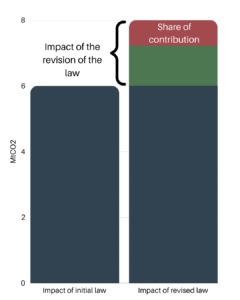
Let’s imagine a fictional scenario in a theoretical country—let’s call it “Ecotania”—which plans a new ecological investment of €1 billion. The initial version of the proposed law was expected to result in the avoidance of 6 million tonnes of CO₂ (MtCO₂). That gives a cost-effectiveness of around €166 per tonne of CO₂ avoided.
Several actors—NGOs, think tanks, political parties—tried to influence how the money would be spent. One organisation, CATF, focused on a particularly effective but underrepresented solution: renewing aging gas infrastructure to limit methane leaks. They chose this strategy not only because it was highly cost-effective, but also because no other actor was pushing for it.
CATF’s team of five full-time experts worked on this issue. They published technical reports, met with government agencies, and lobbied key decision-makers. As a result of this advocacy, the final law was revised. A portion of the budget was redirected to pipe renewal.
Now, the same €1 billion investment will result in the avoidance of 8 MtCO₂ instead of 6—improving cost-effectiveness to €125 per tonne. This 2 MtCO₂ difference is the impact of the law revision, which is not solely due to CATF.
The work of a targeted team influenced how a billion-euro policy was implemented and led to substantially greater climate impact—this is the kind of catalytic leverage that policy-focused climate charities can have.
Is the impact counted twice?
The same impact can be claimed by many different people or groups, and that’s often fair. For example, if a new law in Ecotania cuts 8 million tons of CO2, the government might claim the full 8Mt, while an organisation like CATF might claim 0.7Mt for its role in making the law happen — and both would be right. A political party that pushed for the law might also deserve credit. So might the voters who elected them, the companies that carried out the projects, the banks that funded them, and the researchers who invented the technology.
At the same time, if two organisations worked closely together on one change, it wouldn’t be fair for both to claim 100% of the impact. In cases like this, the impact is shared. The point is: the real world is messy. Impact can only be counted meaningfully by asking, “Compared to what would have happened otherwise, what difference did this action make?”
Why not just pay 40bn and sort out climate change?
‘If it’s true that CATF is able to reduce 1 ton of carbon per euro, and we produce 40 billion tons of carbon each year – why not just pay 40 billion and sort out climate change?’
The extrapolation doesn’t apply to an infinite scale, but it holds true for CATF’s funding gap (the amount of funding required to continue and expand operations), detailed in page 17 of Giving Green’s deep dive report [7]. This funding will be important in particular in funding their promising super hot rock geothermal program (needs 12.5m over three years) and expanding into Africa and the Middle East.
While diminishing marginal returns do exist, there are also opportunities to leverage different actions. Giving Green continues to rank CATF as the top charity (out of hundreds they know) because, at present, every donation is expected to have the highest impact.
We are focused on marginal thinking – asking where the next euro should go, and then the next, and so on. After CATF reaches their $10 million funding gap, we would likely redirect focus and remove them from our recommendations. Until then, additional donations are crucial for effectively addressing climate change.
Interestingly, even if we could extrapolate the euros per ton to solve climate change (which we definitely can’t in this example), there are lots of examples that show that, even when this is the case, we aren’t always very rational in how we distribute our spending.
For example when it comes to spending on international development, Rory Stewart, former UK Member of Parliament and president of GiveDirectly points out that “we spend almost twice as much annually on international development as it would take to lift everyone in the world out of extreme poverty.”. Providing direct cash transfers to people living in extreme poverty is highly scalable. Yet, even when solutions exist, they often require individuals and organisations willing to seize and implement them effectively.
Lifestyle changes vs donations
We often show this graph about the impact of individual action:
If you were to follow the top three most effective lifestyle choices and you gave up your car, switched to a plant based diet and didn’t take a transatlantic flight, you would save approximately 6.2 tons of carbon per year. All of these actions are great initiatives and set a positive example for a better future. However, we need to couple lifestyle change with systemic change if we are to make a difference that matches the scale of the climate crisis. By far the biggest levers we have to enact systemic change are voting, promoting ideas and donating to climate charities.
We definitely need both lifestyle changes and systemic change to meet our climate goals. The study by founders pledge shown in the graph above isn’t meant to discard the importance of lifestyle changes but rather to show how those of us with the financial means can do huge amounts of good if we direct our financial resources appropriately.
Donate to allow systemic change
In conclusion, while precise measurements of carbon savings can be difficult to achieve, the evidence behind climate policy interventions like those promoted by CATF shows how targeted investments can drive meaningful change. By supporting high-impact climate charities, we can ensure that our donations contribute to the most effective solutions available today. Supporting these organisations is an investment in a sustainable future.