
If you already know the answer, then:

Founder and Director
Reading time: 5 minutes
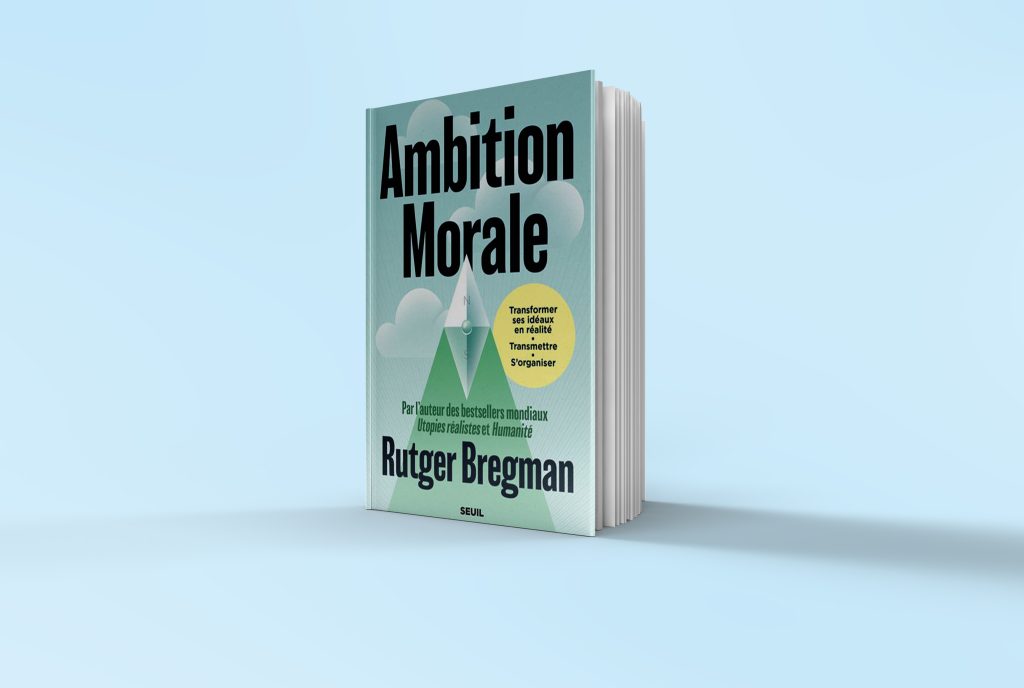
What I liked most about Rutger Bregman’s book, Moral Ambition, is its boldness. At a time when morality is often watered down, softened, made “acceptable” so as not to offend, he does exactly the opposite: he challenges, shakes things up, provokes… and it feels good!
We have become so accustomed to sparing others that we end up sparing our own convictions. We say: “Do what you can, that’s good enough,” “Small gestures count,” “It’s not your job to carry the world on your shoulders.” But sometimes we need to be reminded that yes, we can do more. And that we should!
Bregman does so bluntly. He writes: “No, you are not fine the way you are.” He challenges: “What are you doing? Wake up! Take action!” And he debunks the myth of the “noble loser”, that moral hero who acts with sincerity… but without impact. It may sting, but it’s very true.
And honestly? I found it really inspiring. Not guilt-inducing. Not moralising. Just… powerful. Because his words hit home. And because he dares to say that the world doesn’t need more good intentions, but more results.
It reminds me of all those organisations I see out there, with commendable approaches and essential causes, but which fail to use their resources strategically to help as much as possible. If they did, they could, frankly, have 100 times more impact.
So, for those who might find inspiration in them, I have compiled my ten favourite quotes from the book here. Even if you don’t read the book, they are worth checking out: they are calls to rethink our relationship with morality, action and impact.
1. “We hold all kinds of viewpoints on all kinds of matters, but we generally do little with our viewpoints.” (Chapter 4, p. 68)
2. “It’s not what you think is right that counts, but what you’re prepared to do about it.”(Chapter 4, p. 69)
3. “There are two forms of ‘knowing.’ You can know something and then do something about it. Or you can know something and look away, afraid to face the consequences of what you know to be true.” (Chapter 2, p. 31)
4. “You can’t be afraid to come across as weird if you want to make a difference. Every milestone of civilization was first seen as the crazy idea of some subculture or another, from the Pythagorean theorem to the conviction that slavery is depraved.” (Chapter 3, p. 49)
5. “The fear of being different runs deep in human nature. We may tell earnest tales of our personal convictions, but what we actually do is mostly a matter of mimicry. The longing to belong is like a magnet, interfering with our inner compass.” (Chapter 2, p. 25)
6. “The only person we can’t use in this fight [to change the world] is the fool who thinks good intentions are enough. Someone whose clear-eyed convictions put them squarely on the right side of history, but who achieves little in the here and now. Let’s call this figure the Noble Loser” – (Chapter 4, p. 65)
7. “Many people are more preoccupied with the kind of work they do than with the impact that work has. As long as it feels good.” (Chapter 1, p. 12)
8. “The trouble with idealists who lack ambition is they tend to prize awareness more than action. Words and intentions take precedence over deeds and consequences, and what something’s really like often gets eclipsed by what it feels like.” (Chapter 1, p. 14)
9. “In some circles, you’d think the highest good is not to have any impact at all. A good life is then primarily defined by what you don’t do. Don’t fly. Don’t eat meat. Don’t have kids…the aim is to have the smallest footprint possible, with your little vegetable garden and your tiny house. Best-case scenario? Your impact on the planet is so negligible, you could just as well not have existed. Don’t get me wrong – it’s a fine idea to align even your smallest deeds with your biggest values. But surely a good life consists of more than what you don’t do? One would hope that on your deathbed, you can chalk up your life’s work to more than simply all the harm you didn’t cause?” (Chapter 1, p. 13)
10. “There are libraries full of books about the question of what distinguishes the doers from the non-doers, the builders from the non-builders, and the heroes from the rest. But what if moral ambition isn’t a personal quality or attribute, but rather a frame of mind? And what if that mindset is contagious– something everyone can catch?” – (Chapter 2, p. 37)
Before founding Mieux Donner, I was an engineer. I enjoyed solving problems, seeking optimisation, and building efficient systems. But at one point, a simple question called everything into question: what if I put these skills to work on truly important issues?
It was this question that made me change direction. It led me to take an interest in effective giving, and then to join the Charity Entrepreneurship programme, an international incubation programme for high-impact associations. There, I discovered an ecosystem of people who take one idea very seriously: using resources (money, time, energy) rationally to amplify their impact on the world and do good.
It sounds abstract when you put it like that, but I can assure you, it’s very concrete.
Rather than donating to the closest or best-known charity, we start by asking ourselves:
– Where are the most urgent needs?
– Which organisations are actually saving or improving the most lives?
– How can we ensure that what we are doing is really working?
It is not always intuitive. Nor is it always comfortable. But it is truly inspiring.
Personally, I have decided to commit to donating at least 10% of my income to charities that have been carefully selected for their impact. It’s a way of ensuring that my values don’t go untapped, of transforming my resources into real change.
Above all, it is a response to that feeling many of us share: that of being overwhelmed by the scale of the world’s problems. Faced with these situations, feelings of powerlessness are common. So we look the other way. But in reality, we have more power than we think.
Rutger Bregman talks about moral ambition. He says that what we lack is not the will to help, but clear and concrete ways to take action. I agree. That is exactly what our effective giving approach offers: a structure and guidelines to align your values with your actions.
So if you too want to take action without giving up everything, without becoming a full-time activist, without radically changing your life… there are ways. Some people choose to change careers. Others get involved through impact giving. And it can even be both, as I have chosen to do.
And sometimes, all it takes is for someone to suggest it to you.
So here’s my suggestion:
What if you made giving a strategic, ambitious and joyful practice?
What if you joined the thousands of people who have chosen to use their resources to make a real difference?