The List of Effective Non-Profits to Help Those in Need
21 Janvier 2025, temps de lecture : 6 min.
Based on rigorous assessments, some non-governmental organisations stand out for their ability to fund high-impact projects to help people in difficulty:
List of high-impact associations helping people in difficulty :
Against Malaria Foundation: This non-profit was set up to combat malaria. Each donation of €5 protects one or two people for 2-3 years.
New Incentives: This association works to increase child vaccination rates.
Malaria Consortium, malaria prevention programme: This association fights malaria through preventive treatments.
Deworm the World by Evidence Action: This programme aims to eliminate intestinal worms, parasites responsible for many illnesses among children in the poorest countries. Despite much debate about the effectiveness of this approach, the potential impact remains high.
GiveDirectly, an anti-poverty programme: This organisation offers to transfer money directly to the most disadvantaged. Numerous studies have been carried out on their impact, and they follow a reliable process for selecting recipients.
Malaria Consortium and others are not available via Mieux Donner, but are nevertheless remarkably effective. Our selection is based on the criteria set out in our methodology.
Helping people in difficult situations: humanitarian associations combat social exclusion
In a context where isolation and armed conflict are exacerbating inequalities, more and more homeless people and people with difficulties are facing daily challenges. Accessing and maintaining housing is becoming increasingly complex, while natural disasters are exacerbating precariousness. Faced with these challenges, the associations are working as a key player to help people in need.
This mission to put an end to exclusion is not limited to one-off aid. For nearly 40 years, these charitable organisations have been building sustainable solutions throughout France and abroad. Known for their work with vulnerable communities, they make an effective contribution to the fight against poverty.
The different types of aid: a comparison between France and other countries
In the richest countries, reintegration; in the poorest countries, health.
In France, the associations work alongside the CCAS (Caisse Centrale d’Activités Sociales), distributing meals and managing local facilities for collective accommodation. Through outreach work and more than 70 day centres, these organisations help people who are being reintegrated into society to find a place to live and regain their independence. Victims of natural disasters and the destitute also receive essential support.
The Armée du Salut and Médecins du Monde are examples of organisations that provide support towards reintegration, while the Fondation Abbé Pierre has long been working for the right to housing. They are tackling problems where progress is difficult, with many players already working to resolve them.
In poor countries, most interventions are aimed at environmental and humanitarian disasters, while those that last longer are aimed at providing sustained health services, as well as the means for food or economic autonomy. Some specific issues, such as vitamin A malnutrition or malaria, are extremely neglected. Even a small contribution can make a huge difference.
Choose an association to support
Assessment criteria
To maximise the impact of your support, consider these three essential criteria:
- The scale of the problem: What is the scale of the problem the association is trying to solve?
- Potential for improvement: Are there effective, proven solutions?
- Neglected: Does the problem already receive sufficient attention and resources?
In addition, at Mieux Donner, we use evaluators such as GiveWell or Founder’s Pledge to prioritise the most cost-effective interventions.
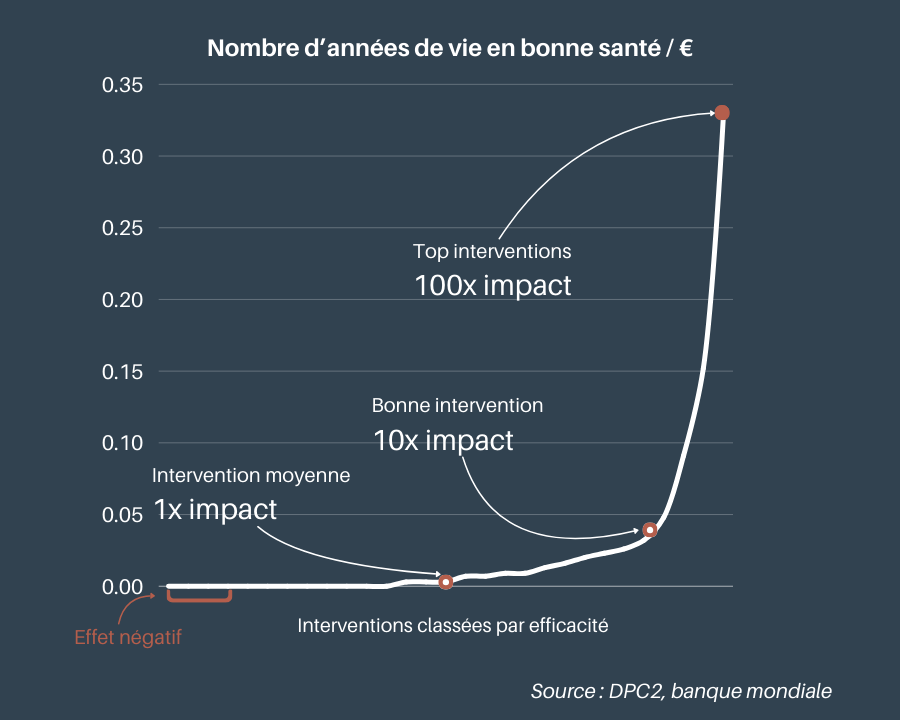
In fact, if we organise the interventions from the least to the most effective, we obtain the curve below:
Here we can see that the cost-effectiveness of the most effective interventions is much higher than that of the least effective.
Transparency and efficiency
We may sometimes think that the most important thing is to help, and that it doesn’t matter what kind of help we give. However, not all charity projects share the same rigour. The case of PlayPump, for example, is notorious. This association proposed to install water pumps in the form of a turnstile. The idea was that children would have fun and pump water at the same time. The reality is that the turnstiles were difficult to use, and turned into informal and unsuitable water pumps.
To avoid this type of pitfall, give preference to associations that :
- Publish detailed reports on their activities and finances
- Have their impact assessed by independent bodies
- Demonstrate excellent cost-effectiveness
Help and support services, different forms of support :
Immediate help
En France, cela consiste en des distributions alimentaires et de l’aide matérielle pour les besoins urgents. Dans les pays les plus pauvres, il s’agit de matériel médical distribué à grande échelle : par exemple, la distribution de moustiquaires imprégnées par Against Malaria Foundation permet de prévenir efficacement le paludisme. Helen Keller International assure la supplémentation en vitamine A. Notons aussi que GiveDirectly propose des transferts monétaires directs qui ont un impact immédiat et prouvé sur la vie des bénéficiaires.
Sustainable solutions
In France, this can involve taking in children and recreating social links through home visits. In the hardest-hit countries, for example, New Incentives encourages child vaccination through financial incentives, creating lasting protection. GiveDirectly is also experimenting with ten-year universal income programmes that look promising. [1]
Social inclusion
Many programmes are aimed at isolated people in the countries of the North. This is an approach that is still neglected in the interventions put in place in the countries of the South, but there are some innovative approaches such as StrongMinds, a programme that combats depression in Africa through culturally adapted group therapy, which has been proven to be effective.
How can I get involved in humanitarian action?
Support non-profit organisations by becoming a volunteer
If you’re having trouble finding out how to help, platforms such as TousBenevoles or jeveuxaider.org make it easy to get involved. The Les implantations website helps you find opportunities for action near you. Among the associations listed, Against Malaria Foundation is accepting volunteers in France.
Donations to charitable organisations
Financial donations are still the most effective way of supporting these associations. By giving to highly effective organisations, you maximise the impact of every euro donated. You can make a donation directly via our donation form on MieuxDonner.org.
Charitable partnerships
Companies can leverage their social impact through strategic partnerships. Whether through CSR programmes, skills sponsorship or fundraising events, these collaborations can create lasting change on a large scale.
Conclusion
In 2025, helping people in difficulty remains a major challenge. Humanitarian organisations play an essential role in enabling people to go on holiday, access healthcare and regain their dignity.
By concentrating our efforts where they have the greatest impact, we can make a difference. Don’t hesitate to support our recommended charities. Although it may seem daunting, sharing your commitment on social networks can have a profound impact by helping to establish giving and volunteering as social norms.
Ressources