Assessing the climate impact of donations: between modelling and uncertainty
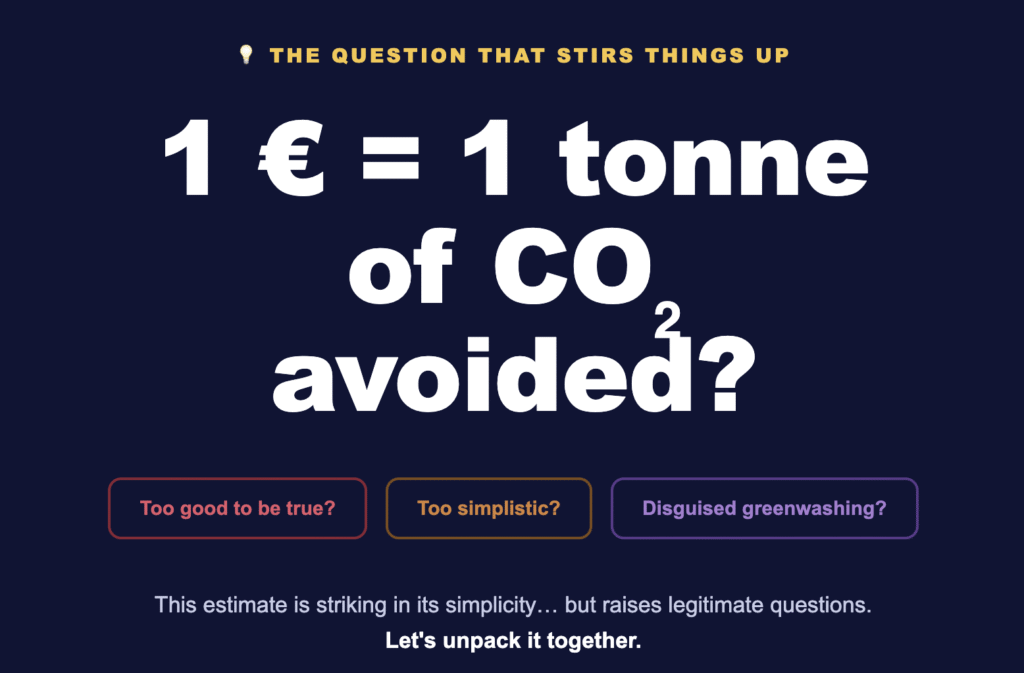
At Mieux Donner, we sometimes use a calculation that is strikingly simple: “€1 = 1 tonne of CO₂ avoided.”
This figure certainly catches the eye. It highlights, in a concise way, the considerable potential of well-targeted donations. But it also raises legitimate questions:
- Too good to be true?
- Too simplistic?
- A new form of greenwashing disguised as generosity?
We hear these criticisms, and sometimes we agree with them. That is precisely why we wanted to write this article: to clarify what this estimate actually means.
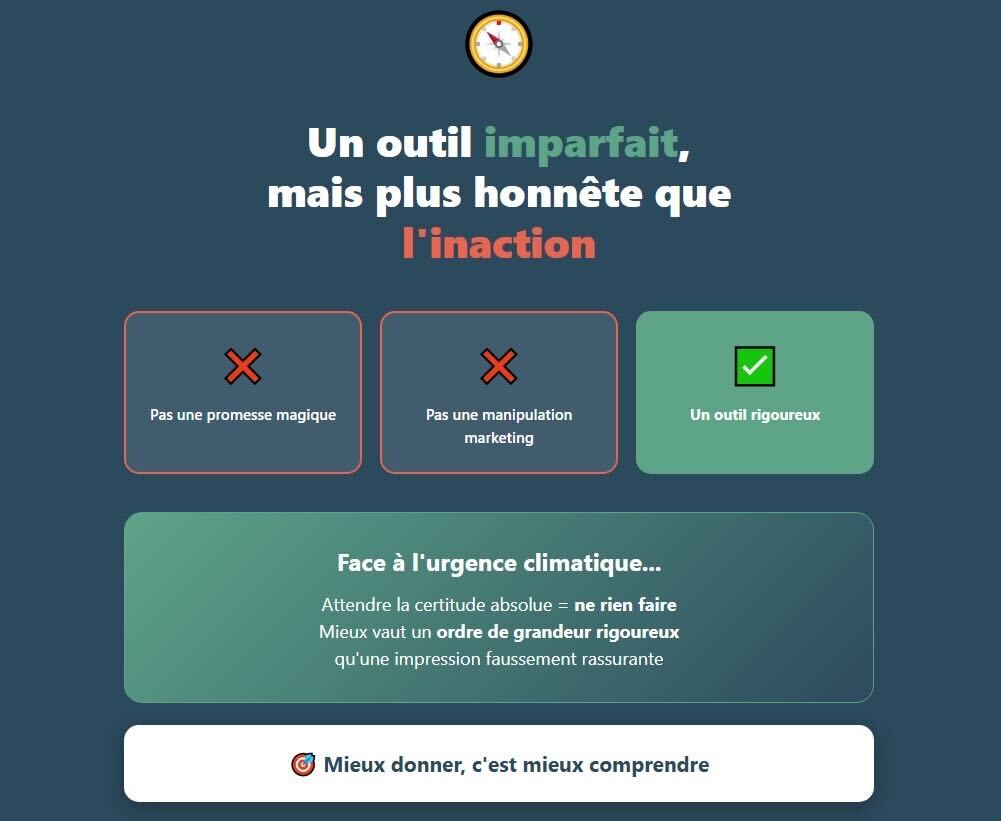
This is neither a magic promise nor a marketing ploy.
It is a useful and reliable tool, provided one understands both its limitations and its strengths.
Where does this figure of €1 per tonne of CO₂ come from?
This estimate is in fact based on rigorous analysis, underpinned by research and data. Before criticising it or accepting it unquestioningly, it is important to understand where it comes from, how it is constructed, and what it actually allows us to compare.
Modelling based on rigorous research
The figure “€1 = 1 tonne” is based on research by the organisation Giving Green, which has modelled the impact of initiatives carried out by organisations such as the Clean Air Task Force (CATF). Unlike visible operational projects, these NGOs work through indirect but powerful channels: political advocacy, regulatory lobbying, support for low-carbon research and development, etc.
The impact of these measures is more difficult to quantify directly, but when their indirect effects are analysed in contexts of underfunding, it appears that, on average, every euro invested can prevent around one tonne of CO₂ emissions.
This is therefore a modelled average, based on conservative scenarios, and not a certified measure or a carbon market price.
Comparing very different shares: a tricky task
To better understand what this figure does (and does not) tell us, we need to look at the key tool behind this estimate: cost-effectiveness analysis.
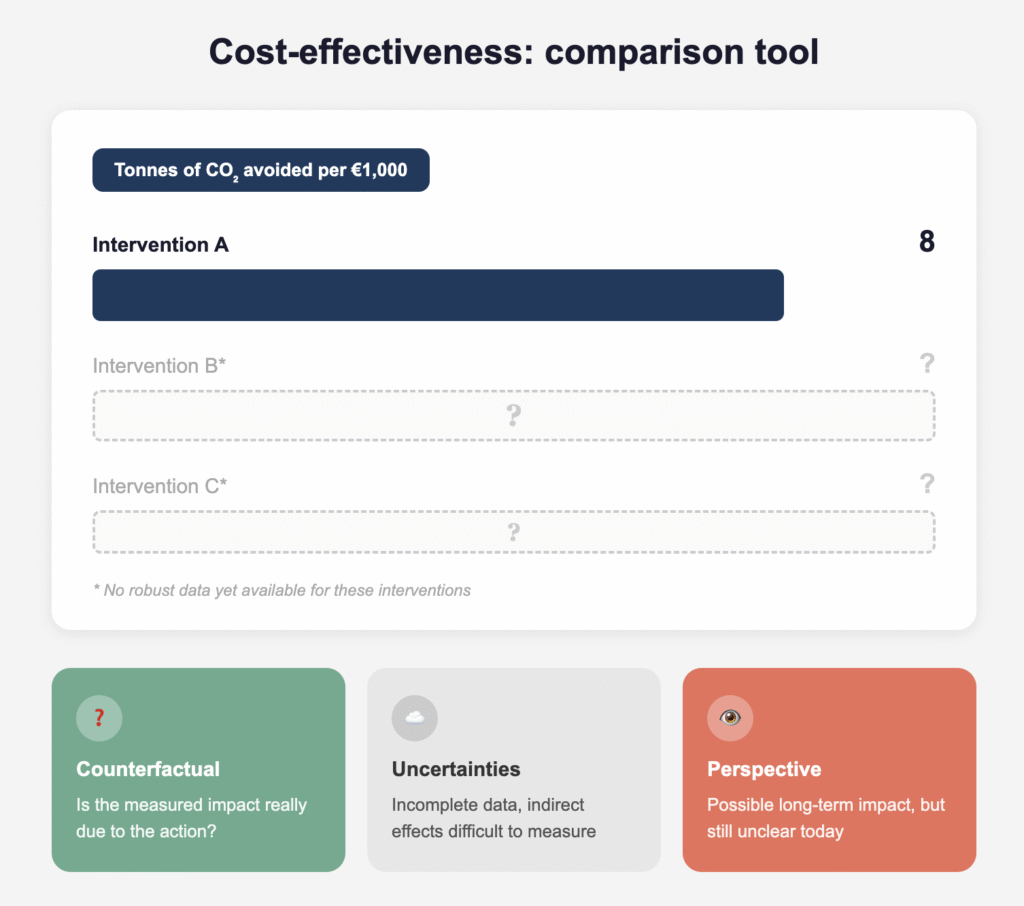
This type of analysis aims to answer a question that appears simple on the face of it: “How many tonnes of CO₂ can be avoided for every €1,000 invested?”
But behind this simplicity lies a wide variety of methods, assumptions… and perspectives.
It shows that the impact can vary significantly depending on the interventions (A, B, C).
Indeed, the results of these analyses can vary significantly depending on the methods used to estimate the impact. Several factors influence these differences in estimates: the baseline scenario (what would happen without this action?), the assumptions made, the level of uncertainty accepted, the way in which indirect effects are assessed, as well as the difficulty in quantifying certain indirect effects, such as the influence of advocacy on the adoption of public policy, or support for research into the development of an entire sector.
In other words, not all “tonnes avoided” are equal depending on the methods used, and that is to be expected.
A change in perspective alters the conclusions
Another crucial factor is the perspective from which the impact is assessed.
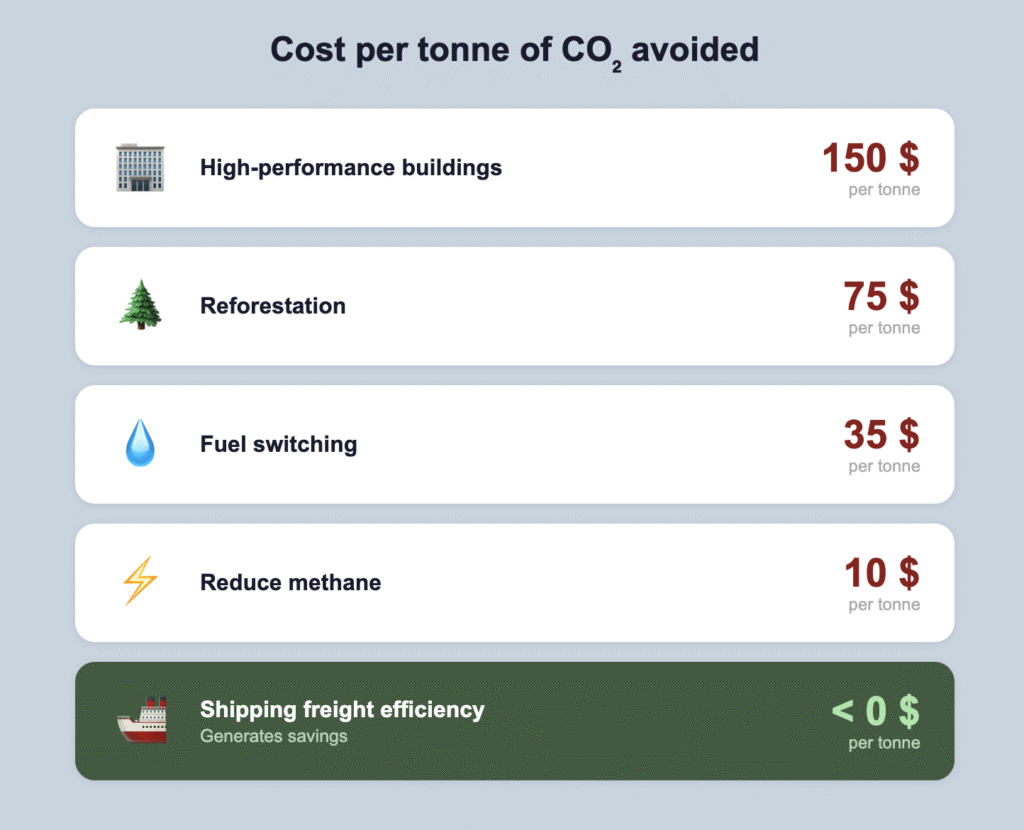
Here, we estimate the cost per tonne of emissions avoided for different strategies, from an ‘investor’s’ perspective (public or private).
Result:
- Building an energy-efficient building costs around $150 per tonne saved,
- Whilst optimising sea freight can generate savings whilst reducing emissions (even when borrowing costs are taken into account).
These analyses are useful for guiding large-scale investments, but they do not reflect the marginal impact of a philanthropic donation, particularly in areas where every additional euro can trigger or accelerate systemic change.
Encouraging an investor to adopt a new approach, or funding a strategic initiative that attracts further investment, does not have the same effect as direct action
Measured impact vs. modelled impact
Finally, it is important to distinguish between two approaches that are often confused:
- Carbon accounting measures actual emissions reductions achieved, in accordance with established standards.
- Cost-effectiveness analyses, on the other hand, model a potential impact based either on past results (generally more reliable, but sometimes outdated) or on future projections (more speculative, but useful for forecasting). When the two align, as is the case in our conservative models, this reinforces the robustness of the estimates.
Cost-effectiveness analyses are neither guarantees nor predictions.
But they are powerful tools for making rational decisions in the face of uncertainty.
What this figure tells us (and what it does not)
Now that we understand where the estimate of “€1 = 1 tonne of CO₂ avoided” comes from and how it is calculated, one key question remains: what is its real purpose?
Like any tool designed to simplify things, it has its strengths… and its limitations. The key is not to take it at face value, but to know how to use it effectively.
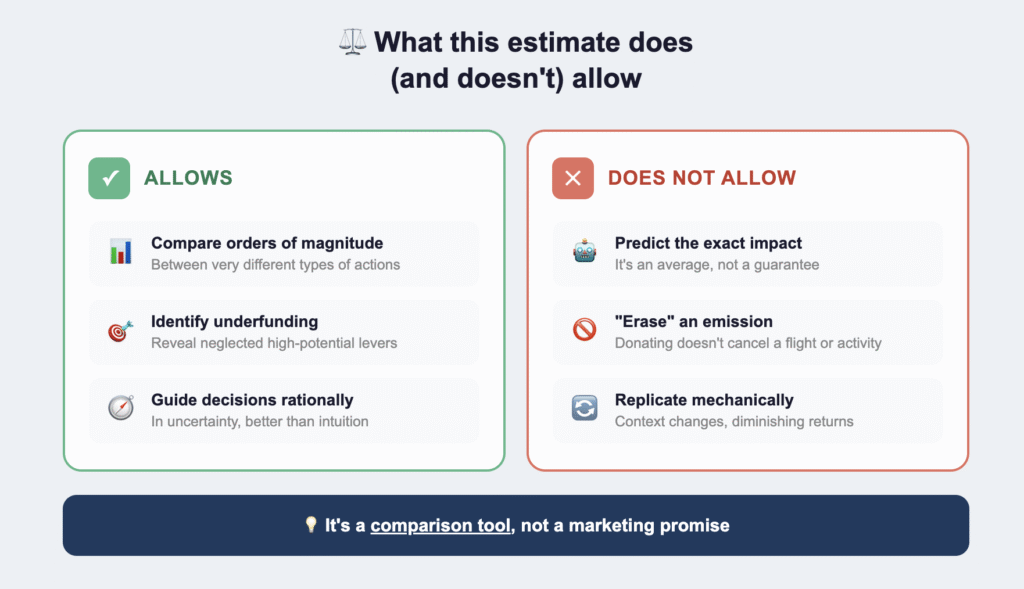
What this estimate enables
1. Compare orders of magnitude between different types of action
This is undoubtedly its most useful application: comparing very different strategies. How does €1,000 invested in political advocacy measure up against €1,000 spent on planting trees? Or on improving an industrial process? Such an assessment helps to highlight differences in effectiveness that are often overlooked, yet are essential for guiding funding decisions.
2. Making a complex reality understandable
Donors, whether individuals or businesses, want to take action on climate change, but often find themselves overwhelmed by the sheer number of initiatives. This figure helps to illustrate the potential of a well-targeted donation, without oversimplifying the issue.
3. Highlight the underfunding of high-impact initiatives
Certain initiatives (such as lobbying for energy standards and supporting regulatory innovation) are severely underfunded, despite their potentially significant impact. This assessment highlights these levers and calls for this imbalance to be rectified.
What this estimate does not allow for
1. Predicting the exact impact of a donation
The figure is a modelled average, not a promise. It offers no individual guarantee as to the impact of a single euro at a given point in time.
2. “Deleting” a live broadcast
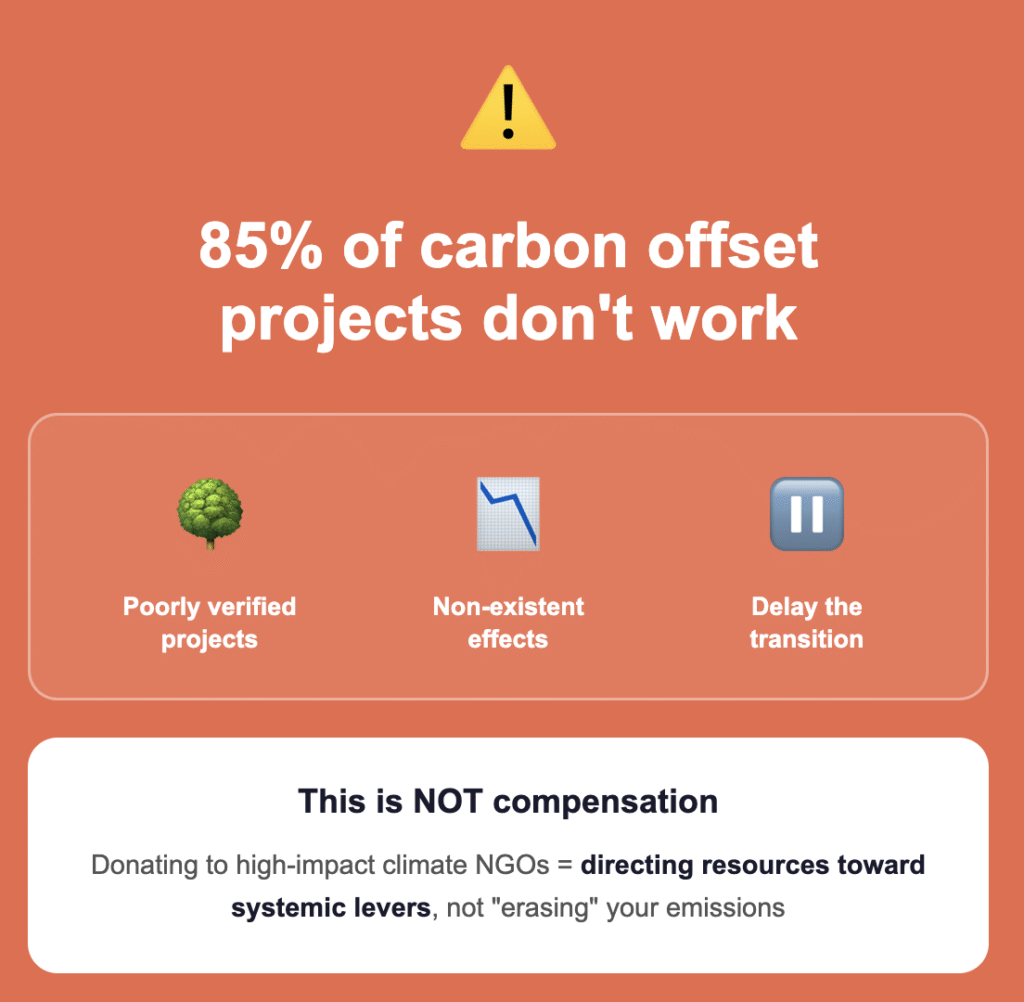
Donating to a climate cause does not cancel out a transatlantic flight, the production of concrete or a tonne of methane emitted elsewhere. This figure does not offset anything; it directs resources towards effective solutions.
3. Mechanically replicating a past impact
Even the most effective interventions can suffer from diminishing returns. Past success is not always replicable, especially if the context (political, technological, economic) changes.
Why this isn’t carbon offsetting
This confusion often arises: if donating helps (on average) to prevent emissions, does that not, in a way, amount to ‘offsetting’ the emissions we generate elsewhere?
Giving does not erase. Giving enables action.
We do not promise carbon neutrality through a donation.
We do not claim that there is a direct link between a specific programme and a charitable initiative.
We do not offer any carbon credits, whether symbolic or financial.
The estimate of “€1 = 1 tonne” is not intended to gloss over theft, an activity or a way of life, but to strategically direct available resources towards the most promising initiatives.
A lever, not an excuse
This figure is not “compensation”, but a means of amplifying impact.
It enables donors – individuals, businesses and foundations – to support systemic initiatives that are often overlooked, yet are crucial to transforming our infrastructure, our laws and our technologies.
An unflinching critique of the compensation market
At Mieux Donner, we are far from neutral on this issue.
We actively criticise the carbon offset market as it currently operates.
For behind these tempting promises lies a far more fragile reality: poorly vetted projects, non-existent benefits, and even adverse effects that are holding back the transition.
Can this estimate really be applied across the board?
(No, and here’s why it’s still useful)
No. And that is precisely why it remains useful.
A valid criticism of the estimate that “€1 = 1 tonne of CO₂ avoided” is that it cannot be applied universally, at all times, to every cause. And this is true: the results obtained by certain organisations, such as the Clean Air Task Force, cannot be replicated exactly.
Their impact has often been linked to a specific context, a particular political window of opportunity, or a highly targeted capacity for action. It would be misleading to assume that these results will remain valid indefinitely. Even the most effective interventions may face diminishing returns as the low-hanging fruit is exhausted.
But that doesn’t make the estimate obsolete. Quite the contrary.
Above all, it reveals one thing: there is a massive gap between the funding that certain initiatives would require and the resources they currently receive. This ‘funding gap’ affects, in particular, initiatives with high potential for impact, as they are often less visible or less ‘marketable’.
As long as this funding gap persists, every euro donated can increase the likelihood of a significant and lasting impact. This is because the marginal effect of a donation, in a system that is far from saturated, can be considerable.
This is where estimation comes into its own. Not as a guarantee, but as a rational guide. In an uncertain world, it helps direct resources towards areas where they can make a real difference. Not by promising a precise return, but by providing an understanding of the scale involved.
Rather than a certainty, it offers an approach. A rigorous, humble and transparent way of asking oneself:
“Where can my money really make the biggest difference?”
An imperfect approach, but a more honest one than doing nothing
We must be realistic: all impact figures are imperfect. They are based on assumptions, uncertainties and models. No single indicator can capture the complexity of the real world.
But in the face of the climate emergency, waiting for absolute certainty amounts to doing nothing. And between a vague hunch and a rigorous estimate, our choice is clear: a well-founded estimate is better than a falsely reassuring impression.
Our aim is not to twist the figures to simplify the world. It is to make the impact of donations clear, understandable and useful, even when it is complex, indirect or uncertain.
We are confident that people, whether acting as individuals or within an organisation, can grasp the nuances, provided they are spoken to with honesty, rigour and high standards.
Our guiding principle isn’t comfort. It isn’t storytelling. It’s real impact.
And although it is impossible to predict exactly what impact a particular euro will have, research does provide useful benchmarks to help guide informed decisions. Here are a few:
Donating €1 to a high-impact climate NGO could prevent around 1 tonne of CO₂e. (Source: Giving Green)
This donation would be ten times more effective than purchasing high-quality carbon credits.
And around 50 times more effective than funding tree planting (Source: IPCC, 2022)
Finally, a donation of €1 could have the same environmental impact as avoiding a transatlantic flight. (Source: Atmosfair)
These figures are not promises. They are indicative figures designed to help everyone direct their resources towards what can really make a difference, in a world where every euro can have a far greater impact than we might think.
Giving better also means understanding better
The estimate that “€1 = 1 tonne of CO₂ avoided” is neither a magic wand nor a scam.
It is a tool: imperfect, but powerful—provided it is used with caution, transparency and rigour.
More and more people are taking a serious interest in the real impact of their donations. It’s no longer enough simply to ‘do good’; people are looking to do better.
And that is precisely the point of our approach: to make the impact visible, understandable and actionable, without oversimplifying it or treating it as sacrosanct.
And what are you doing to boost your climate impact?