Effective altruism: how Mieux Donner brings GiveWell and Giving What We Can to France
Every euro you give is a chance to help save a life, ease suffering or make a lasting difference to the future. But with so many causes and only limited resources, how do you choose the actions that will do the most good?
The effective altruism movement grew out of this question. It offers a rigorous approach to finding the best ways to help others. Popularised by thinkers such as Peter Singer (“Famine, Affluence, and Morality”, 1972), Toby Ord and William MacAskill, it rests on two core principles:
- A genuine wish to help: believing that every life counts, and that we can put part of our resources (money, skills, time) towards making the world better.
- Scientific rigour: relying on the best available evidence to guide our choices, and favouring proof (randomised trials, meta-analyses) over intuition.
Mieux Donner builds on these principles, translating and adapting research from GiveWell, Giving What We Can and other evaluators to point you towards the most effective, transparent and evidence-backed interventions.
Effective altruism in practice
Effective altruism rests on a few key principles:
- A willingness to help: everyone can contribute, according to their means and priorities (giving, volunteering, career choices and so on).
- Critical thinking and scientific rigour: solid evidence (randomised trials, meta-analyses, independent evaluations) takes priority over intuition or emotion alone.
- Flexibility and openness: priorities are revisited in light of new evidence, rather than locked into a single cause.
- Transparency and integrity: effective organisations publish their results, limitations and evaluations in an accessible way.
- Collaboration: impact grows when people share what they learn.
-
Mieux Donner builds on these principles, translating and adapting research from external evaluators such as GiveWell to point you towards the most effective, transparent and evidence-backed interventions.
Taking action from France
Wondering how to turn these principles into action?
Here are four ways to get started:
- Think about your career: the 80,000 Hours career quiz helps you identify jobs with a high social impact, and the career guide from Altruisme Efficace France is particularly worth reading. Public health, research, reducing risks from AI and public policy are among the most promising fields.
- Give effectively: through Mieux Donner, you can support rigorously evaluated charities while benefiting from a suitable tax framework. Some organisations qualify for tax relief through European partnerships such as Transnational Giving Europe.
- Spread the word: write an article, give a talk, share a podcast… Altruisme Efficace France offers resources and events to help anyone share these ideas with others. Romain, the founder of Mieux Donner, is also happy to talk with you or come and speak about these topics.
- Volunteer: your skills (analysis, communication, web development and more) can help us do more.
Why does this approach matter so much today?
We live in an era of huge, interconnected challenges:
- Extreme poverty: according to Our World in Data, 817 million people were living in extreme poverty in 2024, around 10% of the world’s population, on less than US$3 a day (2021 PPP).
- Malaria: in 2023, there were around 263 million cases of malaria and 597,000 deaths, 95% of them in sub-Saharan Africa.
- Climate change: global warming already stands at an average of +1.1°C above pre-industrial levels, and 2024 set a record of +1.55°C. Without drastic cuts in emissions, the critical +1.5°C threshold could be crossed by 2030.
- Existential risks: pandemics, unregulated biotechnology and AI going wrong could threaten humanity’s long-term stability.
Effective altruism offers a structured way to get the most out of every action:
- Impartiality: a life is worth the same in Niger as in Paris, or in a generation not yet born.
- Rigorous evaluation: interventions are compared by cost-effectiveness (lives saved, suffering prevented, tonnes of CO₂ cut) or using prioritisation methods.
- Constant updating: recommendations change as new research and data come out.
Key players in effective altruism
- GiveWell: an independent evaluator founded in 2007, focused on global health and poverty interventions. It publishes in-depth analyses of programmes such as bednets, vitamin A supplementation and malaria prevention medicines. GiveWell specifically recommends that donors living in France give through us.
- Giving What We Can (GWWC): launched in 2009 by Toby Ord and William MacAskill, GWWC promotes a voluntary pledge to give at least 10% of your income to high-impact causes. Mieux Donner was incubated through its programme and works closely with GWWC to promote the pledge in France.
- 80,000 Hours: an organisation set up in 2011 to help people move into careers with a high social impact, offering practical resources (guides, a quiz, coaching).
- Altruisme Efficace France: an association that translates and shares the movement’s resources for French-speaking audiences. It runs meet-ups, local groups, webinars and educational publications.
More recently, Power for Democracies has been applying prioritisation principles inspired by effective altruism to questions of democracy.
Our role: making effective altruism accessible to people in France
At Mieux Donner, we’re proud to be part of the effective giving movement, which Giving What We Can and other international organisations helped get started. Our mission is simple: to help everyone in France give better, with clarity, rigour and impact.
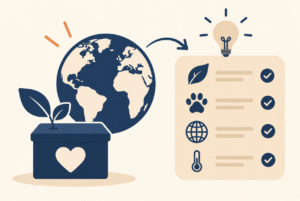
To do this, we look at causes that affect many lives, where every donation can fund solutions with real potential for change. We assess each cause on its scale, its tractability and how neglected it is.
- Scale: we focus on problems that are major in size or severity (for example malaria, malnutrition and climate change).
- Tractability: we favour solutions that have already shown significant results, are often low-cost and are ready to scale up.
- Neglectedness: we direct donations towards causes that are still underfunded, where each euro can make a real difference.
We then select the charities with the greatest impact per euro donated, drawing on analysis from independent evaluators such as GiveWell and Giving Green.
We make this research accessible to donors in France through:
- clear profiles of each recommended cause, intervention and organisation
- a transparent methodology
The 10% Pledge: a practical commitment
We’re also the French partner for the 10% Pledge, an initiative led by Giving What We Can. The idea is simple: make a voluntary commitment to give at least 10% of your income to high-impact charities.
It isn’t a contract or an imposed rule. It’s a personal, considered choice, and a practical way to bring your actions in line with your values. More than 10,000 people around the world have already taken the Pledge, committing over a billion dollars in total to highly effective causes.
In practice, our role at Mieux Donner is to:
- raise awareness of the Pledge in France, with clear explanations;
- support people who want to take it, with tools, advice and real-life examples;
- make the Pledge easy to keep, by making it simple to give to evaluated charities directly from France.
Taking the 10% Pledge is a way to make a difference: simple, structured and genuinely useful.
Impact in numbers: health, climate and animal welfare
Bednet distribution | Around €5 per net | Covers around two people for roughly two years. Between 2004 and 2019, bednets helped avert more than 816 million malaria cases and save 4.8 million lives. |
Vitamin A supplementation (Helen Keller Intl) | €2 per child per year | Significantly reduces child mortality, an effect confirmed by many high-quality studies. |
Promoting plant-based alternatives (GFI) | 50 € | Spares an estimated 265 animals from factory farming. |
This table shows a simple truth: a few well-directed euros can reduce deaths, prevent suffering and help build a more sustainable future.
Every donation can have an outsized effect, as long as it goes to the right interventions. That’s exactly why we exist: to help you turn your generosity into real, measurable and lasting impact.
Give better, starting today
Giving thoughtfully turns your generosity into a powerful way to save lives and protect our shared future. Mieux Donner lets you support rigorously selected charities from France, with a suitable tax framework and personal guidance.
Every euro given with care turns into practical help for the people who need it most.