Generous, definition: what makes a generous person?
13 février 2025, temps de lecture : 7 min.
Introduction: What makes a generous person?
Generosity is an essential human quality that can take many forms. According to the Larousse, it involves giving and benevolence, while Le Robert defines a generous person as someone who gives without expecting anything in return.
Historically associated with nobility, generosity today encompasses universal human values such as compassion and altruism. But what makes a person truly generous is still debated. Depending on one’s philosophical stance, there are several ways in which a person can be considered generous: based on the consequences of their actions, their actions, or their character.
How do you recognise a generous person?
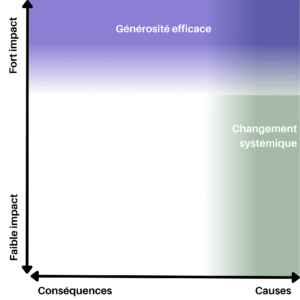
By the consequences of your actions: effective generosity
Effective generosity means giving your resources where they make the biggest difference. Take the example of someone who gives €500 to a charity such as PlayPumps: the aim is to build turnstiles that serve as water pumps in villages in poor countries such as Malawi. A classic view of generosity would assume that this action is proof of generosity in itself, as long as it is done selflessly.
However, it turns out that PlayPump had the opposite effect to that intended: the turnstiles were too hard to push to have fun, and in the end the children deserted them, leaving the village women to push the turnstiles, a task that is more difficult than using a water pump and humiliating.
Conversely, €500 donated to an organisation like Hellen Keller International can protect nearly 250 children for a year from Vitamin A deficiency, which can lead to eye disease and death. In fact, the money spent to save a life has up to a hundred times more impact in the best associations, which is why it’s best to check whether your donation is having a real impact. Effective generosity asks the following questions: on what basis do you claim that your action is really improving the world? Could you have used the same resources to help more people in a different way?
By the motivation behind your actions: the three-basket rule
The Dutch philosopher Stijn Bruers suggests that our actions can fall into three baskets: those done for ourselves, those done to help our loved ones or our country, and those done to help the rest of the world. From this point of view, we can identify that a person is generous “for one of the baskets” (for example, their loved ones, but not the rest of the world), which is different from being generous “for all the baskets”.
The 10% pledge is a very good example of the third ‘basket’ in action: it is a public pledge to donate 10% of one’s income to high-impact charities until retirement. The aim is to help as much as possible, but leave the remaining 90% to be divided between baskets for yourself and those close to you.
By your character: virtue ethics
The final way in which people are identified as generous is through their character. Many ancient philosophers, such as Aristotle, suggested that, in order to distinguish good from evil, we had to carefully observe a person’s character, habits and tendencies.
In psychology, situationism explains our behaviour not as a function of defined character traits, but as a function of the situation in which we find ourselves. Studies have shown that people’s willingness to give help or money can differ depending on very simple details, such as whether they have just found a coin on the floor or not, or whether they are criticised for being late.
There are a number of ways to fight these biases: join a community that promotes generosity, find out about your donations, or build up a habit of giving, for example by taking the Test Pledge.
What can we give?
Generosity isn’t just about money:
Time and skills: Offering your skills can also be a way of making an impact. This can be done by volunteering for impact organisations, by launching an impact organisation, or by focusing your career on high-impact issues.
Simple things: Even if a skill is widely shared or is not your job, you can give it to others: attention, support, advice, feedback on someone’s work.
Symbols: Some cultures will have gestures that are typically identified as an expression of generosity, whether it’s bringing something with you to dinner in a country like France, or holding the door in many others. But these habits are not always aligned with the three types of generosity mentioned above, so it may be worth sharing your acts of generosity to make them a social norm.
Characteristics of a Generous Person
Different characteristics can be observed in people who donate frequently:
1. Empathy and emotional intelligence
Generous people are attentive to the needs of others and know how to offer help without being asked. They are very sensitive to the emotions of others and seek to alleviate their difficulties.
2. Altruism
Helping others is a key characteristic of generous people, who give without seeking recognition or reward. Acting without expecting anything also has benefits in terms of creating strong friendships and solidarity. This is the attitude behind expressions like “giving without counting the cost”.
3. Psychological well-being
Generosity can bring personal satisfaction and fulfilment, and increases happiness by creating a virtuous circle. Generous acts are associated with hormones such as oxytocin, which are also involved in positive social relationships and make people feel good. This is the phenomenon behind the expression “giving for pleasure”. Having said that, it’s important to distinguish between the pleasure of giving and the good actually done by the gift – there are two different ‘baskets’ here, as introduced above.
Generosity in Action: Its Impact
Generosity contributes to a more caring society by strengthening trust and cooperation between individuals. A simple gesture can trigger a domino effect of benevolence: for example, holding a door, helping a stranger or offering your time to a cause all contribute to collective well-being by inspiring those who follow. This is all the more true when it comes to giving standards: giving is less scary when you know that others are doing it!
Developing your Generous Spirit
You may still feel far from being an example of generosity. But it’s very important not to blame yourself: motivation is much stronger than guilt. Here are a few actions that can help you cultivate your generosity without pressure.
Get informed: There are many resources available to help you understand how to direct your donations to have the greatest impact. To find out more, you can download our guide to giving.
Start gradually : You don’t have to give a huge sum from the outset.
Surround yourself well: The Test Pledge and the 10% Pledge give you access to a motivated and energetic community.
Practise gratitude: Gratitude fosters generosity by encouraging sharing.
Overcoming the fear of lacking: Rethinking abundance and believing that giving does not mean losing is essential. The principles of economics and sociology teach us that the world is not a fixed cake whose parts are divided between the people who live in it: it’s a big collective garden where certain actions can make the garden grow.
Daily habits: Complimenting, helping and actively listening are all ways of integrating generosity into our daily lives.
Conclusion: Generosity, a lifelong journey
Generosity not only enriches society, but also fosters personal growth and happiness. Small, regular gestures have a significant cumulative impact. Ultimately, generosity leaves a lasting legacy and inspires others to follow suit.