

The happiest countries and findings from the World Happiness Report 2026
Finland, Iceland, Denmark lead the 2026 ranking. Full list of 147 countries, key findings on social media and wellbeing, and how your donations create happiness.

In France, €100 out of your own pocket can fund €294 of donations to charities that save lives. The reason is simply the 66% tax reduction, which most donors don't take advantage of.

At Mieux Donner, we believe two things can radically transform the impact of your generosity: choosing a rigorously selected charity, and making smart use of the French tax system. This article combines the two.
It's tax return season (April to June 2026). This is exactly the right time to understand how the system works, work out what your donation really costs you, and act.
When you donate to a charity recognised as being in the public interest, the French state gives part of it back to you as a reduction in your income tax. The most common rate is 66% of the amount donated, up to 20% of your taxable income.
In practice: you give €100 and your tax bill falls by €66. Your donation has cost you €34 net.
To take advantage of it, all you need to do is:
Most donors think like this: "I want to give €100, so I'll give €100." That's a logical mistake.
The right way to think about it: how much can I afford to spend, net? Then work out the gross donation from that real budget.
| Your real cost (net) | Donation made | Tax reduction |
|---|---|---|
| €34 | €100 | €66 |
| €100 | €294 | €194 |
| €200 | €588 | €388 |
| €500 | €1,470 | €970 |
In other words, if you can afford to spend €100 net, you can give €294 to an effective charity. That's almost three times the impact for the same financial effort.
The tax reduction increases the size of your donation. But it's the charity you choose that determines what that money actually achieves.
That's why at Mieux Donner, we never separate the two questions: how much to give, and who to give it to.
Many charities qualify for tax relief in France, although some highly effective international organisations still fall outside the system. Here are the four we recommend, which combine proven effectiveness with eligibility for the 66% reduction from France.
Malaria still kills more than a thousand children a day, mainly in sub-Saharan Africa. AMF funds the distribution of insecticide-treated bednets at around $6 each, and each net protects a household for two to three years. Since it was founded, AMF has distributed more than 340 million nets.
GiveWell puts the average cost per life saved at around $5,500 for its 2022–2024 distributions, making it one of the most cost-effective interventions in the world. In 2024, GiveWell directed $150 million to AMF, its largest allocation to any charity.
Every year, vitamin A deficiency causes blindness in 250,000 to 500,000 children, and half of them die within 12 months. Helen Keller International supports government programmes that give high-dose vitamin A capsules to at-risk infants.
The 2022 Cochrane systematic review, covering 19 randomised trials and more than 1.2 million children, found a 12% reduction in all-cause mortality, with high-certainty evidence. It is one of the cheapest and best-documented interventions in global health.
More than 80% of farmed animals in France are raised in factory farms. According to a study published in Nature Food, animal-based foods produce twice the greenhouse gas emissions of plant-based foods. GFI speeds up the development of alternatives to meat: plant-based proteins, cultivated meat and fermentation.
Its advocacy helped secure $523 million in public funding for alternative protein research in 2023. An analysis cited in GFI's 2024 report ranks the shift to alternative proteins as the second most powerful climate lever, with a potential of 6.1 GtCO₂ a year. Giving Green estimates GFI's cost-effectiveness at around €3 per tonne of CO₂ avoided, compared with often more than €50 elsewhere in the climate sector.
The 2025 International AI Safety Report documents worrying capabilities already present in today's systems: helping to synthesise toxic molecules and pathogens, AI systems interfering with the results of their own evaluations, and autonomous replication. Figures such as Geoffrey Hinton and Yoshua Bengio, two of the most cited AI researchers in the world, are publicly warning about these risks.
CeSIA (the French Centre for AI Safety) is France's first independent research organisation working on these issues. In 2024, it raised awareness of these issues among around a million people in France. In 2025, it is contributing to the Codes of Practice guiding how the EU AI Act is implemented. Its estimated effectiveness: a €200 donation reaches 720 people with its awareness work.
The 2026 tax return covers your 2025 income and donations. Returns are filed between April and June, depending on your département.
If you've never used this system before, here's the simplest way to go about it:
Tax relief
Everything you need to know about tax relief on charitable donations
How it works, which charities are eligible, and worked examples to triple the impact of your donations.
See the main page →Our team offers free, personalised advice to help you build a giving strategy that suits your situation and your values.
Book a free appointment → Finland, Iceland, Denmark lead the 2026 ranking. Full list of 147 countries, key findings on social media and wellbeing, and how your donations create happiness.

Human life is precious. It is natural to want to mobilise all our resources to save a life, even if it only prolongs a life by a week. But what happens when other people are also in danger, and our resources are not enough to help them all? As a society, we face practical limits that force us to make difficult decisions.


It’s easy to feel discouraged by the dramatic retreat of glaciers in the Alps and the scale of climate change can easily leave us feeling powerless. This article will equip you with the knowledge to take meaningful climate action, in both your personal life and through your charitable donations.
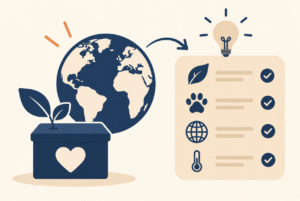
Giving Green has published its 2026 climate recommendations. Half the fund’s grants now go to low- and middle-income countries, three new sector reports rank the strategies, and the five recommended charities stay the same.

At least 7,900 excess deaths. Ninety-four thousand people cut off from mains water. Two to three million birds dead in days. What the year cost France, and what it changes about where you give.
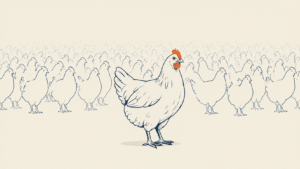
More than 230 million land animals are slaughtered every day, nine in ten of them chickens. The 2024 figures by species, including fish and France.