
Rutger explains:

Communications Project Manager
Reading time: 3 minutes
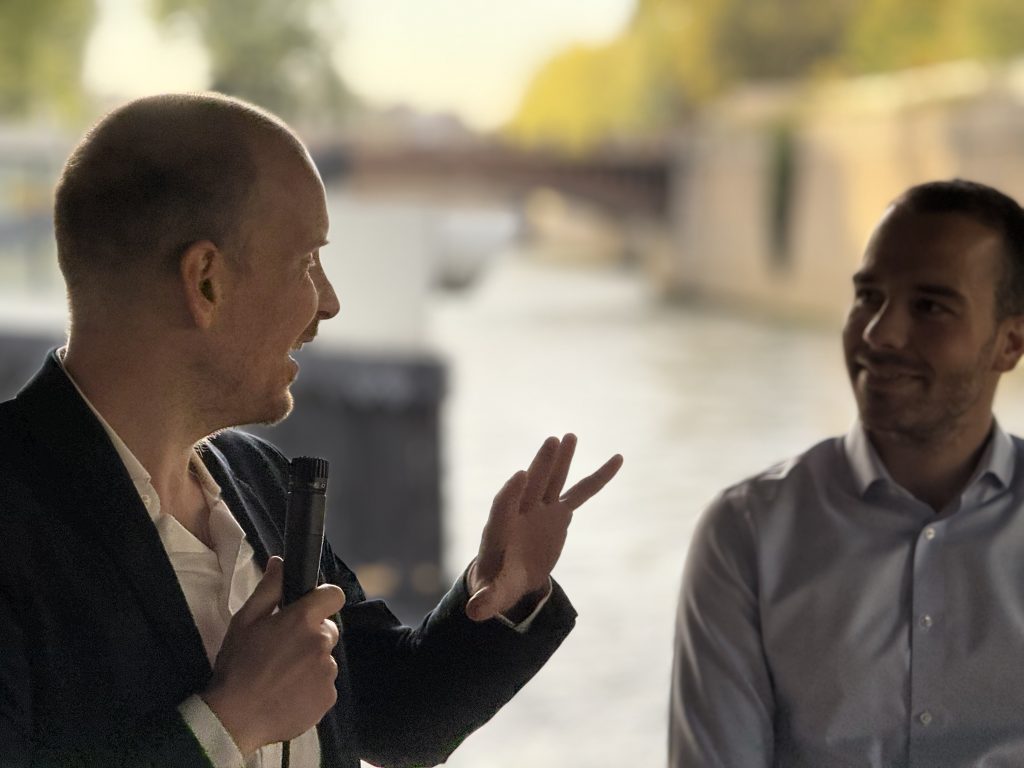
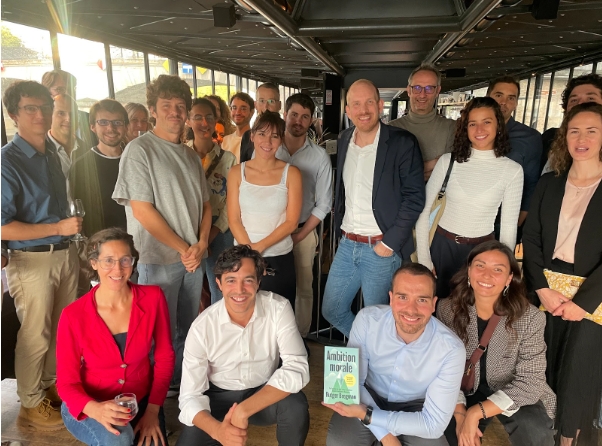
Some encounters are like collective lightbulb moments. The one that took place in Paris with Rutger Bregman, on the occasion of the French release of his book Ambition morale, was one such moment.
The Dutch writer came to Paris on 11 September to ask us a disturbing but essential question: what if we used our talents for something other than our careers?
The event organised by Mieux Donner was not just another conference. It was an invitation to fundamentally rethink what it means to succeed in life in these times of multiple crises.
👉 If you haven’t read Moral Ambition yet, check out our full summary:
Right from the outset, Bregman hits hard. He cites a large-scale international survey conducted in 47 countries, showing that nearly a quarter of the workforce doubts the social value of their work.
"That's an astonishing figure. It's more than five times the current unemployment rate."
This figure highlights a huge waste of talent. Brilliant graduates, perfect CVs, promising careers… but behind all that, a void of meaning. Bregman then talks about the famous “Bermuda triangle of talent”: consulting, corporate law, finance. Rutger adds:
"This gaping black hole sucks in so many of those we consider to be the best and brightest."
The result: a society that wastes enormous amounts of energy, and individuals who end up doubting their own usefulness.
Bregman draws this conclusion not only from data, but also from his own journey. With Utopia for Realists and then Humankind, he established himself as an optimistic thinker, convinced that ideas can change the world.
However, he recounts:
"Ideas change the world... but I realised that there was a gap between awareness and action."
He recounts this moment of disillusionment with honesty: seeing photos circulating on Instagram of readers enjoying his books… lying on beaches in Bali. Beautiful reading, beautiful words, but little action behind them:
"I have created a monster... There is such a gap between awareness and concrete action."
That was when he felt the need to take the next step: to leave the comfort of mere awareness behind and confront the real question: how to act?
To find answers, Bregman turned to history, to movements that truly changed the world, such as the abolitionists who led the fight against slavery.
He was surprised to discover that the most influential British abolitionists were not thinkers, but entrepreneurs.
“Ten of the twelve founders of the British Society for the Abolition of the Slave Trade were entrepreneurs.”
These people knew how to build unlikely coalitions and use pragmatic, sometimes unexpected arguments. Bregman quotes Thomas Clarkson, who pointed out that 20% of British sailors died on slave-trading expeditions. By speaking on behalf of “our boys,” the argument suddenly moved Westminster.
Behind their struggle lay a broader ambition: to redefine what it means to succeed in life.
“Their main goal was to bring virtue back into fashion.”
What if this mission still resonates today?
All these reflections gave rise to the School for Moral Ambition, an organisation that aims to turn ideals into practice. The idea is to create a global movement of talented people who are willing to put their skills to work on the most pressing issues, rather than feeding sectors that do not improve the world.
Bregman uses a powerful image to describe this project:
« Robin Hood stole money from the rich. I'm going to do something similar.»
But instead of stealing money (even with real funding needs), he proposes to “steal talent” from lucrative sectors and direct it towards high-impact causes.

The evening took on a very concrete dimension with the introduction of Romain Barbe, founder of Mieux Donner. His career path perfectly illustrates what Bregman is talking about.
An engineer by training, he was working in a technology start-up when he discovered effective altruism: the idea that with the right strategy, the same donation or talent can have 100 times more impact.
"Ideas and intuition are not enough to make a difference."
He then decided to leave his job to devote himself fully to impact research. He subsequently joined Charity Entrepreneurship, sometimes referred to as the “Hogwarts for philanthropists”, an international incubator for high-impact charities.
That is when he founded Mieux Donner: a platform that directs donations from individuals to the most effective charities, so that every euro donated generates the greatest possible positive impact. And he is personally committed to donating 10% of his income to these rigorously selected organisations.
One year later, Mieux Donner has already raised over €292,000 with the clear ambition of making effective generosity the norm in France.
During the discussion, several questions came up repeatedly:
How can we convince young graduates to join high-impact projects rather than lucrative careers? How is it that France, with so many committed players, is so far behind on efficiency issues? How can individuals choose a career or commitment that is truly meaningful?
These discussions showed that the idea of moral ambition resonates far beyond the circle of those already convinced.
This evening was not just a book launch. It was a call to transform the way we think about success, to give new meaning to our talents, our gifts and our lives.
Moral ambition is not just an intellectual concept: it is a movement. Everyone can contribute, whether through their career choice, a commitment to giving, or simply by joining the conversation.
Because ultimately, as abolitionists demonstrated two centuries ago, a small, ambitious and idealistic group can indeed change the world.
If you are unsure about the best way to contribute or would like to discuss these topics, Romain, founder of Mieux Donner, is available for discussions or interviews.