Planetary atmospheres: what the planets have to say about the climate
Why planetary atmospheres matter
When we think of planetary atmospheres, we immediately think of the vast gaseous envelopes that surround the planets of the Solar System, such as Venus, Mars and Jupiter. But these atmospheres are more than just layers of gas floating in space: they influence temperature, climate and the very possibility of supporting life. By understanding how these atmospheres evolve, we can gain valuable clues about the future of our own planet, Earth.
Today, space exploration and scientific missions are enabling us to compare our Earth’s atmosphere with those of Mars, Venus or Titan, and the conclusions are clear: our climate is fragile and can tip over under the effect of greenhouse gases and human activities. How can the other atmospheres of the Solar System help us avoid the worst?
Mars and Venus: Two destinies, two lessons about the Earth's climate
Venus, the carbon dioxide hell and Mars, the lost atmosphere
Venus and Earth were once very similar in size, composition and position relative to the Sun. Today, however, Venus is an infernal furnace, with a surface temperature of 467°C – enough to make the mercury hot enough to melt lead. Atmospheric pressure is almost 100 times higher than on Earth. Why is this? Its orbit is not to blame: it is practically included in the habitable zone. The explanation can be summed up in four words: the uncontrolled greenhouse effect.
Venus has an atmosphere made up mainly of carbon dioxide (96%), a gas that traps heat from the sun’s rays. The surface of Venus is subject to constant volcanism. Clouds of sulphuric acid prevent heat from escaping, turning the planet into a permanent oven. What’s fascinating and worrying is that this phenomenon could theoretically happen to the Earth if we don’t get our own CO₂ emissions under control.
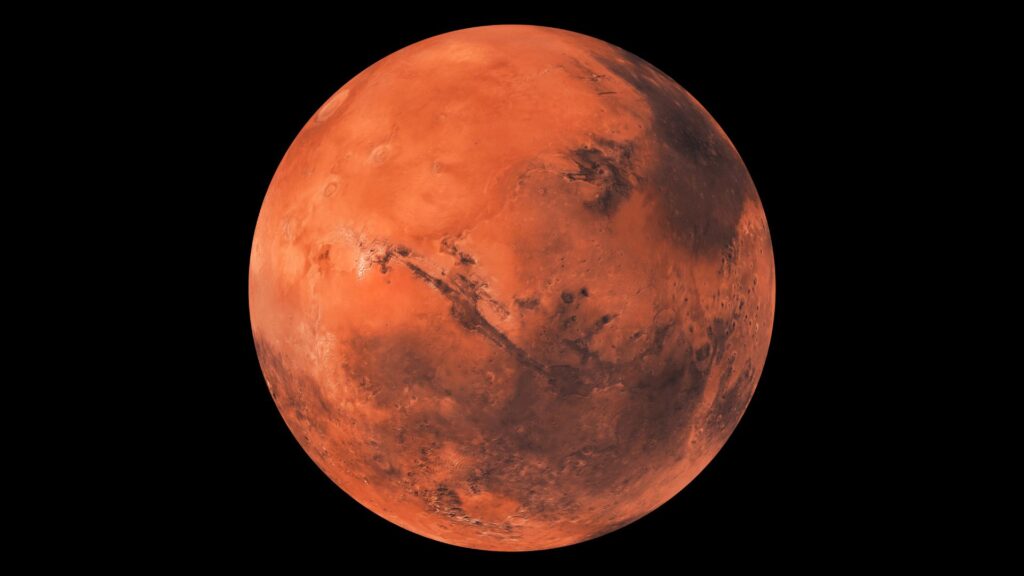
Unlike Venus, Mars is an icy planet, unlike Pluto, which owes its freezing temperatures to its distance from the Sun. The problem is that it has a very thin atmosphere, made up of 95% CO₂, but too thin to retain heat. 3.5 billion years ago, the Red Planet had a denser atmosphere, liquid water and possibly conditions favourable to life, but the solar wind, combined with the loss of the Martian magnetic field, gradually swept away the atmosphere, leaving an arid and cold planet. The surface of Mars is now hostile to the development of life, bombarded by ultraviolet radiation.
Mars is a reminder of just how precious and fragile our planet’s atmosphere is: a planet can lose its climatic balance and become inhospitable over relatively short timescales. Venus and Mars are therefore mirrors of our future: one shows what happens when an atmosphere is too thick and saturated with CO₂, the other when it disappears.
Giant planets and their satellites: natural climate laboratories
Jupiter and Saturn: worlds of gas and storms and Titan, a frozen mini-Earth
Gas giant planets like Jupiter and Saturn have no solid surface. Their atmospheres are mainly made up of hydrogen and helium, with traces of ammonia and methane. But what attracts scientists’ attention about the gaseous planets are their monstrous storms, such as Jupiter’s famous Red Spot, a gigantic anticyclone that has been active for more than 300 years.
These extreme phenomena remind us that the Earth’s atmosphere is also dynamic and sensitive to climate change. The rise in temperature caused by greenhouse gases could intensify extreme weather events on Earth, like the storms on Jupiter.
Titan, Saturn’s largest satellite, is a fascinating exception. It has a dense, hazy atmosphere, mainly made up of nitrogen, like the Earth. It also contains methane, which plays the role of terrestrial CO₂ in maintaining a relatively stable climate.
On Titan, methane forms clouds, rain and liquid lakes, but at -180°C. This shows that atmospheres can evolve differently depending on initial conditions. The Cassini-Huygens mission revealed that Titan has a methane cycle similar to the water cycle on Earth. Space probes like Cassini give us an alternative model of the climate, helping us to understand the effect of greenhouse gases on Earth.
Space missions and climate: understanding atmospheres to better protect the Earth
Why observe planetary atmospheres and key missions for the future
The study of other atmospheres in the Solar System is not just a scientific curiosity: it is a matter of urgency for our own planet. Space missions, such as those by NASA and ESA, are helping us to better understand :
- How a planet loses or retains its atmosphere.
- The long-term impact of greenhouse gases.
- The role of storms and atmospheric currents.
Thanks to these studies, we can improve our climate models, anticipate future changes and better combat global warming.
Several space missions are now helping climatologists to gain a better understanding of the Earth’s past and future:
- ExoMars: analysed the atmosphere of Mars to detect methane and understand its climate cycles.
- Venus Express: studied the extreme greenhouse effect on Venus to better model climates on Earth.
- James Webb Space Telescope: studies the atmospheres of exoplanets to detect possible habitable conditions.
The aim is clear: to better understand extraterrestrial atmospheres in order to better protect our own.
Preserving the Earth's atmosphere: acting now to avoid a worst-case scenario
How can we act on Earth to avoid a Venusian scenario and what solutions can we find for the climate?
By studying the atmospheres of other planets, we realise that our own climate is rare and precious. Unlike Mars or Venus, we still have the opportunity to act. Scientists are categorical: reducing CO₂ emissions is essential.
Mieux Donner recommends a number of high-impact associations fighting global warming:
Clean Air Task Force: This organisation effectively combats climate change through public policy and technological innovation. In particular, they have made a major contribution to the European regulation of methane, a gas with a powerful greenhouse effect.
Good Food Institute: This organisation is dedicated to innovation in alternative proteins, a much lower-emission alternative to conventional meat.
Every well-placed donation has a real impact. If we want to prevent the Earth one day resembling Venus or Mars and preserve our oxygen, we must act now.
Conclusion: space exploration shows us our future
Space exploration gives us a unique insight into the evolution of atmospheres and climates. Mars shows us what happens when an atmosphere is lost, Venus what happens when it becomes too dense in CO₂.
We have a unique opportunity to learn from these worlds to preserve our own. Donner Better helps you take effective action to protect the Earth’s atmosphere.
Ready to make a difference? Discover our recommended associations and help preserve the Earth’s atmosphere.