Donate with confidence: how do you choose a charity?
Every euro counts, but you still need to know who to entrust it to.
Every year, the French donate almost €9 billion, but behind all this generosity lies a key question: where can we give so that our support has a real impact?
Many donors want to help people in precarious situations, support social missions, defend causes close to their hearts, or fund the concrete actions of committed foundations. But how do you choose a charity or foundation that really turns every euro into a measurable impact? Follow the guide to giving with confidence.
Discover our recommended associations
Mieux Donner offers a selection ofassociations recognised for their rigour and impact:
Against Malaria Foundation: This charity was set up to combat malaria. Each donation of €5 protects one or two people for 2-3 years.
New Incentives: This charity works to increase child vaccination rates.
The Humane League: This charity is mainly dedicated to the fight against caged layer hens and fast-growing broilers, the most exploited species on earth.
Good Food Institute: This charity promotes research into alternative proteins, defending a diet free from animal suffering and more respectful of the planet.
Clean Air Task Force: This organisation works to promote regulatory policies to reduce the most potent greenhouse gases, such as methane, or invest in neglected green technologies, such as geothermal energy.
Some of these aid organisations meet the conditions for charitable status in France and are therefore eligible for tax relief. You can find out more about them on our dedicated page. Mieux Donner aims to be a disinterested foundation and takes no commission on donations.
Why choosing the right association changes everything
One donation is not necessarily as good as another, and some associations use their funds for actions that are not very effective or are not measured. Others, on the other hand, implement targeted and rigorous interventions , with concrete results: reducing infant mortality, combating climate change, or improving the lives of millions of animals.
A well-directed donation can have an impact up to 100 times greater, and by choosing your charity carefully, you can make a real difference.
How to choose a reliable charity or foundation
1. La transparence financière
To give with confidence, you need to know where the funds raised are going. A serious charity or foundation publishes its financial statements, and explains how it allocates its operating costs and social missions.
Reasonable overheads are not a problem: some charities employ highly qualified experts to carry out concrete actions for people in need. What really makes the difference is the final impact: for a given amount of money, how many people are helped?
2. A mission that embodies your values by genuinely helping others
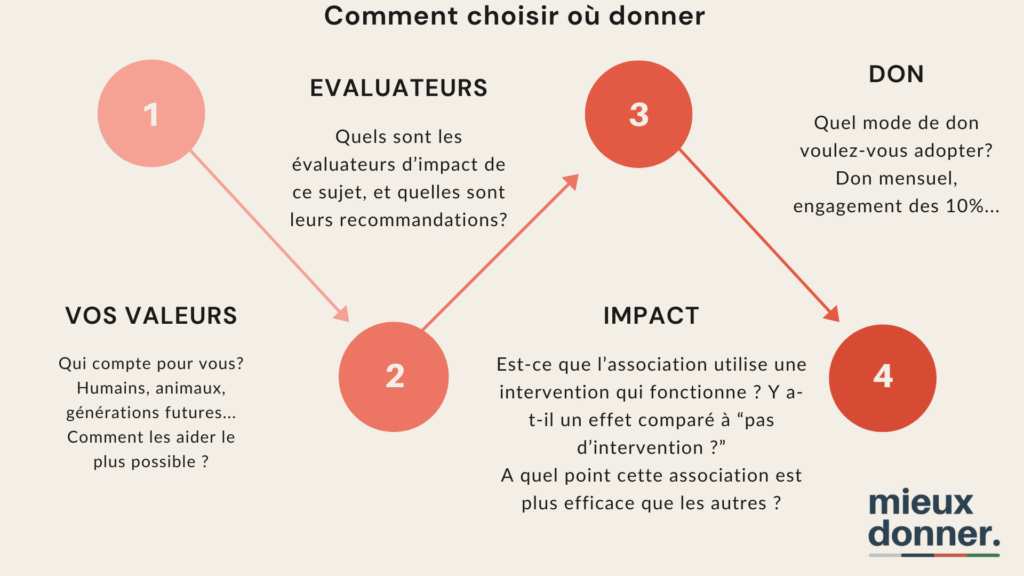
Some associations work on health, others on education, the planet or people in difficulty. Ask yourself: which area holds the most promise for helping others? You can use independent impact assessors who specialise in the area of your choice (animal suffering, climate change, poverty…) as a starting point, based on their suggestions.
For example:
If the fight against poverty and disease is important to you, GiveWell is a specialist evaluator of global health and poverty interventions. One of their flagship recommendations, Against Malaria Foundation, combats malaria by distributing mosquito nets for just €5, an intervention proven to be one of the most effective in the world.
If you’re concerned about climate change and future generations, the GivingGreen evaluator specialises in impact associations in this field. One of their recommendations, the Clean Air Task Force, works for a more ambitious climate policy, pushing for public policies such as methane regulation in the European Union and other countries, and promoting green technologies that are still too early to be of interest to the market, such as super-hot rock geothermal energy.
3. Proven effectiveness
The best-performing non-profit organisations measure their final impact, compare the effects of their interventions and have scientific proof of their effectiveness. They may receive donations from individuals or companies and donate the income from these contributions to their priority missions.
A striking example can serve as a contrast: PlayPump. Initially, the idea was to make water pumps in the form of turnstiles that children could play on. The campaign won hearts and a lot of funding. It was only later that we discovered the ineffectiveness of the approach: the turnstiles were too hard to push and were gradually abandoned by the children. The people in charge of drawing the water, often women, found themselves pushing the turnstiles themselves, which proved tiring and humiliating.
Independent evaluators such as GiveWell, Giving Green or Animal Charity Evaluators have scrutinised the accounts, activities and consequences of the actions of hundreds of charities, recommending only those with outstanding impact. They carefully monitor the final impact of the intervention, check that the intervention works by comparing it with others, and measure how much it actually improves people’s lives. You can find out more on our methodology page.
What about donations in kind?
Donating clothes, hygiene products or goods is always a preferable option to throwing them away. But beware: donations in kind often have a much lower impact than financial donations. Sorting through your cupboards can help, but it’s no substitute for a targeted and effective donation.
Charities can add value to certain goods (clothing, equipment), but cash donations to charities enable us to take more direct and measurable action.
Tax benefits linked to donations
In France, donations made by individuals to public or private organisations whose management is disinterested can give rise to a reduction in income tax, up to a limit of 20% of your taxable income. A tax reduction of 66% generally applies to donations to associations of general interest.
💡 This means that you can give €300 while only actually spending €102, once the tax reduction has been applied.
Donations and legacies, however modest, can transform lives… and deduct 66% of their amount from your tax. If they exceed the 20% limit, the excess can be carried forward to the next 5 years.
Visit our dedicated page to estimate your declared donations and find out how you can benefit from a tax reduction.
Les bonnes questions à se poser
Before making a donation :
What type of association has causes that concern me at heart?
What are the evaluators’ recommendations in this area? Do their suggested associations take into account the interests of the beneficiaries, and try to help them as much as possible?
- Has the impact of my donation been measured? Has the charity’s impact been compared with other charities in the same field?
Does the charity have to publish its finances? Have independent assessors been able to consult them?
Is it recognised as an association of general interest or a foundation giving entitlement to a reduction?
If you answer “yes” to these questions, you can donate with confidence.
Take action today
Make a donation on mieuxdonner.org
Find out more about the associations and foundations assessed
Spread the word and help change donation habits
- Take the 10% pledge and spread the culture of giving around you.
In a world of many challenges and limited resources, your donations to charities can make a real difference. You just need to know how to choose.
Giving more may be laudable, but to ensure your impact even exists, start with the first step: give better.