How are the charities compared?
The Happier Lives Institute
The Happier Lives Institute (HLI) is an organisation whose aim is to recommend the charities that have the greatest impact on improving people’s well-being. It devotes many hours of evidence-based research to this. The HLI also produces research into the challenges of measuring well-being [6].
Why well-being?
When we ask ourselves what the impact of an intervention is, we need to define “impact”. Philosophically, well-being can be seen as the most important thing in life. But what is ‘well-being’?
Philosophers have three main theories:
(1) positive experiences,
(2) satisfied desires, and
(3) a multi-item ‘objective list’ which may include ‘objective’ goods such as knowledge, fulfilment and love.
Wealth and health are conspicuously absent from this list. Most people conclude, on reflection, that these goods have no intrinsic value to us (i.e. they have no value in themselves). Rather, they have an instrumental value, a means to another end. We don’t seek money just for its own sake, but because we think it will make us happier, more satisfied, or enable us to achieve one of the objective goods that presumably constitute well-being.
Using wellbeing to compare the impact of charitable interventions allows us to focus on the essentials. It also provides a basis for comparing very different actions. For example, it is difficult to compare the impact of an anti-malaria mosquito net and a therapy in terms of money created, but it makes sense in terms of well-being. It allows us to think not only in terms of the number of lives impacted, but also in terms of quality of life.
A unit for measuring well-being: WELLBYs
How can we compare the effect of different interventions on well-being and prioritise between them?
Researchers, and most OECD governments [7], have developed simple but reliable ways of measuring well-being: on a scale of 0 (‘not at all satisfied’) to 10 (‘completely satisfied’), how satisfied are you with your life?
The advantage is that the assessment is based on the feelings of the people directly concerned, rather than on an external assessment made by someone who is far removed from their reality.
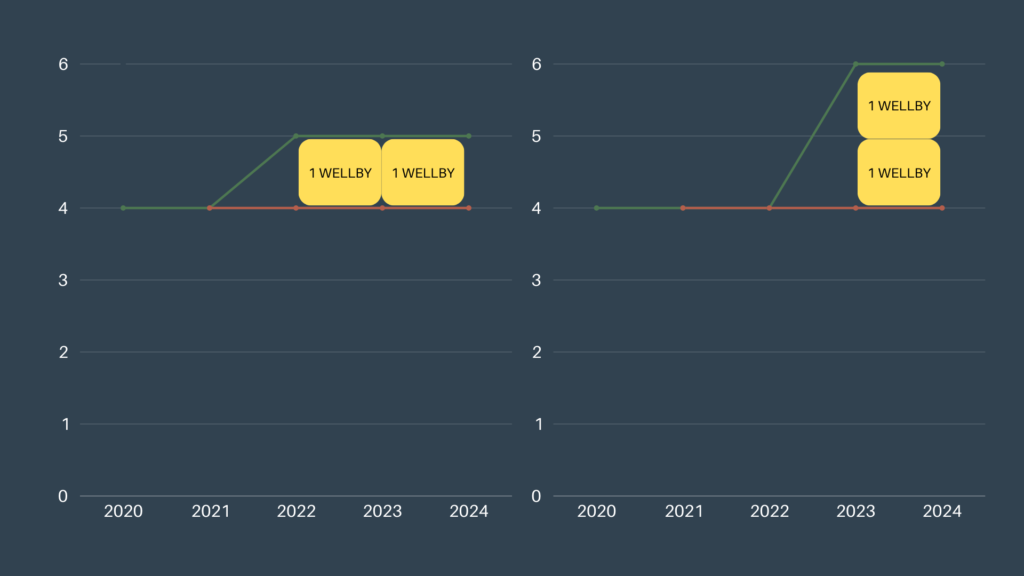
HLI uses the results of wellbeing interventions to evaluate the impact of different charities. The intervention is generally distributed to communities at random, via a Randomised Controlled Trial. Researchers then ask people who receive the intervention to rate their level of well-being. This figure is then compared with the score given by people who have not received the intervention. Each point difference between those who received the intervention and those who did not, over a period of one year, corresponds to one Well-Being Adjusted Life-Years (WELLBYs) [8].
For example, if an intervention takes a person from 4/10 to 5/10 for two years, and on average a person not receiving the intervention remains at 4/10 for two years, the intervention generates 2 WELLBYs. An intervention that raises a person’s score from 4/10 to 6/10 for one year, while the other person remains at 4/10 for one year, also generates 2 WELLBYs. Finally, an intervention that moves two people from 4/10 to 5/10 for one year also generates 2 WELLBYs [8].
We then study the effectiveness in relation to the cost of the interventions. For example, for a given intervention, we can identify 0.01 WELLBY/€. An important detail is that cost-effectiveness is not distributed equally: not all interventions are equal. The best combinations have up to 100 times more impact for the same amount of money. The HLI prioritises the most effective charities in its recommendations.
Why low-income countries?
Therapy, even for the most extreme cases, unfortunately remains the preserve of rich countries. Yet it is the poorest people in the world who can benefit most from it: better mental health is essential if they are to defend their rights and improve their living conditions. This makes a considerable difference to someone living in a poor country, where care systems are not always able to cater for them.
It is important to note that the therapies suggested in the list take into account the cultural reality of the people being treated – there is no question here of imposing a value system against their will.
Why are some recommended interventions not therapeutic?
There are windows of development during a child’s growth where certain disruptions have a much greater influence if they occur early in life. Problems in education and health problems such as malaria, malnutrition or lead poisoning have very severe effects on children’s well-being, and can affect them throughout their lives – particularly their psychological profile.
Making a real impact on well-being
The organisations quoted in the article rely on solid data and in-depth analysis to ensure that every euro donated has a strong impact. Whether it’s funding group therapy to combat depression, protecting children from malaria or reducing exposure to lead, your support can significantly improve the quality of life of thousands of people.
If you’d like to learn more about how you can improve the world with your gifts, Mieux Donner can help.