
Methodology

Why our recommendations don't target beneficiaries in wealthy countries
We could easily recommend charities that help people in France or other wealthy countries. That's not what we do, and the reason has nothing to do with indifference to what happens close to home. It comes down to a set of values, some facts about global inequality, and what the evidence says about the real impact of every euro donated.
What we believe: a life is a life
All else being equal, we help as many people as possible
The question we ask before every recommendation is simple: with the same budget, can we reduce more suffering, preserve more lives, bring more healthy years to people who need them? When the answer is yes, we go where that impact is greatest. Not because some lives matter less than others, but precisely because they all matter equally, and that equivalence demands a certain consistency in how we allocate our resources.
This framework is called impartial altruism. It doesn't rank people, it ranks opportunities to act. Refusing to apply it means implicitly accepting the opposite: placing less value on lives simply because they are more distant or less like our own, which most of us would reject on reflection.
What doesn't limit our choice of charity
Our recommendations don't depend on where a charity is based, or where its beneficiaries live. A charity headquartered in France that effectively fights malnutrition in sub-Saharan Africa can absolutely be among our recommendations. Equally, organisations working against animal suffering in factory farms, reducing greenhouse gas emissions, or tackling catastrophic risks such as pandemics or risks from advanced AI can meet our criteria, regardless of their address. What matters is impact per euro spent, assessed using the best available evidence.
Some people prefer to direct their giving according to narrower criteria: only within their country, only within their region, only to communities they know personally. The tools of effective giving are just as useful in that context, since you can prioritise and compare impact within any chosen scope. Mieux Donner chooses not to set that scope in advance, aiming instead for the greatest impact across all causes and geographies.
What drives us is reducing suffering
Many of us feel a genuine impulse to give, often sparked by something concrete: an image, a story, a nearby event. That impulse is valuable, and there is nothing wrong with wanting to help. But if we look a little deeper, what really matters in that impulse isn't giving to one charity rather than another, or targeting one country or cause in particular. What matters is that suffering decreases, that lives are preserved, that people gain access to what they need to live with dignity.
Once you frame it that way, a natural question arises: can we make that impulse go further? With the same donation, the same intention, could we have two, ten, a hundred times more impact on suffering in the world? The answer is yes, and that is precisely why we spend so much time comparing data, following independent evaluators, and updating our recommendations. Not to optimise a spreadsheet, but so that the generosity of those who trust us translates into as much real-world impact as possible.
The world is more unequal than we think
On a global scale, French people are among the wealthiest
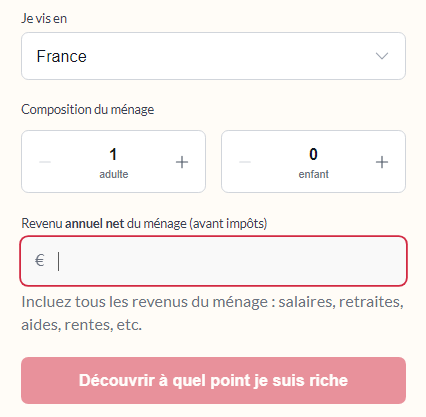
Find out where you stand in the global income distribution
It's hard to see our own relative wealth when we live in a country where inequality is visible every day, where housing costs weigh on budgets, and where many people feel they're barely keeping up. Yet when we broaden our view to the whole world population, the perspective shifts dramatically.
The median standard of living in France stands at 25,760 euros per year, or roughly 2,147 euros per month for a single person.[1] That figure places someone at the French median income among the wealthiest 6% on the planet, richer than 94% of the world's population.[2] The global median income is around 3,920 dollars per year in purchasing power parity, meaning half the world's population lives on less than 11 dollars a day.[3]
This is not an invitation to guilt. It is simply a fact worth integrating when thinking about the potential impact of donations, because it fundamentally changes what a single euro can accomplish depending on where it is directed.
Relative poverty and absolute poverty: two very different realities
We don't believe that people living in precarious situations in France have easy lives, or that their difficulties are less real because they live in a wealthy country. Problems of housing access, isolation, food insecurity or energy poverty are serious realities, and we welcome the associations and public policies working to address them.
But relative poverty as it exists in France, and absolute poverty as it affects hundreds of millions of people in low-income countries, are realities of a fundamentally different nature. In France, someone living in poverty has access to a safety net: healthcare, school, running water, sanitation infrastructure, social support. These protections are imperfect and insufficient for many, but they exist. In the countries where we recommend acting, they are often entirely absent. The problems that remain in wealthy countries are generally costly, complex, and already being addressed by many actors. The problems that persist in the poorest countries are sometimes strikingly simple to solve, yet remain massively underfunded.
To illustrate this idea, we once imagined what a Millionaires' Welfare Association would look like: an organisation whose mission would be to support people earning half a million euros a year. The idea seems absurd, and it is. But what makes it absurd is precisely that the needs of such people are already very well covered. Applying the same logic globally leads to a similar conclusion: someone living in extreme poverty on less than two euros a day has unmet needs of an entirely different nature from someone living in France, even in precarious circumstances. This is not a judgement on the value of any individual. It is an observation about the state of needs, and the opportunity to act where impact will be greatest.[4]
What the data says about the efficiency gap
William MacAskill put this intuition most clearly in his book Doing Good Better: with the same budget, you can have up to a hundred times more impact by directing donations to interventions in low-income countries rather than wealthy ones.[5] The main reason is mechanical, and it comes down to the relative purchasing power of a euro depending on the context in which it is spent. A cash transfer that represents a marginal fraction of a French household's budget can double a family's income in Kenya. A mosquito net costing five euros can protect two people for two years in a region where malaria kills hundreds of thousands of children every year. It's not that problems in wealthy countries are less real or less important: it's that the unsolved problems in the poorest countries are often startlingly accessible, and yet remain massively underfunded relative to the scale of the need.
What wellbeing research confirms
These qualitative observations find quantified confirmation in recent research from the Happier Lives Institute. Chapter 8 of the World Happiness Report 2025 produced the first published global review of charity effectiveness measured using a standardised metric, the WELLBY, which quantifies years of wellbeing generated per dollar spent. Of the 24 charities evaluated in the study, the five most cost-effective all operate in low- and middle-income countries, at an average cost of $18 per year of wellbeing generated. The UK-based charities evaluated in the same study cost an average of $2,553 for the same result, a gap of 142 times.[6] For the interventions most commonly cited as examples of local generosity, such as emergency housing for homeless people in wealthy countries, the cost rises to around $35,000 per year of wellbeing generated, nearly 2,000 times less efficient than the best options available internationally.[7] These figures don't say that helping homeless people in wealthy countries is useless. They say that the same budget, directed elsewhere, can generate an incomparably greater impact.
$18
per year of wellbeing generated by the most effective charities (low-income countries)
142x
efficiency gap between the top charities and UK-based charities evaluated
2,000x
less effective than the best international options for homelessness support in wealthy countries
About these figures: WELLBY estimates come from the World Happiness Report 2025, chapter 8 (Plant et al., Happier Lives Institute). They are produced by independent evaluators using methods of varying analytical depth.
Another unit of comparison: the cost to save a life
To grasp this gap, it helps to set it alongside a figure that French public authorities themselves use to inform spending decisions: the statistical value of a human life in France is estimated at around 3.5 million euros, a figure we explore in detail in our article on the cost of a human life.[8] This reflects what the state is prepared to spend, on average, to save one additional life through public health or road safety policies.
These two figures are not directly comparable: one reflects what the French government is willing to spend to save a life through public policy, the other what a charitable donation can achieve in a very different context. But placed side by side, they give an order of magnitude that is hard to ignore. GiveWell, the world's leading independent evaluator of health charities, estimates that a donation to Against Malaria Foundation saves a life for around 5,500 euros, and a donation to Helen Keller International for around 5,000 euros.[9] On one side: 3.5 million euros. On the other: 5,000 to 5,500 euros. The gap is a factor of 600 to 700. In other words, with the same budget that would be needed to save one additional life within the French healthcare system, it is possible to save several hundred lives internationally, funding interventions whose effectiveness is documented by dozens of randomised controlled trials. That observation, more than any other, guides our recommendations.
Concretely, what does effective help look like?
Needs we have forgotten
In France, the death of a child has become an exceptional reality, rare enough to be experienced as an extraordinary tragedy when it occurs. Fewer than 1% of mothers in Europe have lost a child before the age of five.[10] That was not the case even a few generations ago, and it is not yet the case in much of the world today. In some of the poorest countries, such as Cameroon, Nigeria, or the Central African Republic, more than one in three mothers has experienced that loss.[11] A child born in sub-Saharan Africa is approximately 15 times more likely to die before the age of five than a child born in Europe.[12]
What makes this reality particularly difficult to accept is that the vast majority of these deaths are preventable. They are not the result of complex diseases requiring years of research or cutting-edge technology. They result from malaria, transmitted by mosquitoes that insecticide-treated nets are enough to keep at bay. They result from vitamin A deficiency, which causes night blindness in children and increases their vulnerability to infections that would be benign in other contexts. They result from severe acute malnutrition, which weakens bodies to the point where they cannot resist ordinary illnesses. These problems do not lack known and proven solutions. What they lack is sufficient resources to implement those solutions at scale.
Interventions of disarming simplicity
Perhaps the most surprising thing when you look closely at the interventions we recommend is their simplicity. Against Malaria Foundation distributes insecticide-treated bed nets in the sub-Saharan African regions most affected by malaria. One net costs around 5 euros and protects two people for two years.[13] Helen Keller International provides vitamin A supplements to children in countries like Cameroon, Madagascar, and Guinea. The annual cost per child is under 2 euros.[14] Both interventions are among the most rigorously evaluated in the world: dozens of randomised controlled trials have documented their effectiveness, and GiveWell dedicates thousands of hours of independent analysis to them every year.
Other interventions, less well-known, appear in recent wellbeing data. Taimaka, an organisation treating severe acute malnutrition in children in West Africa, was evaluated in the World Happiness Report 2025 at a cost of $15 per year of wellbeing generated, based on randomised controlled trials.[15] Pure Earth, which runs advocacy campaigns against lead exposure in low-income countries, shows the lowest cost per WELLBY in the entire study at $9, though this evaluation relies on observational data and should be interpreted with caution.[16] Neither organisation currently figures among our official recommendations, but their evaluation in the World Happiness Report 2025 illustrates the level of impact that well-targeted interventions can achieve.
What these interventions share is that they address problems wealthy countries resolved long ago, through decades of public investment in health, sanitation, and nutrition. We no longer need bed nets to sleep without risking a fatal disease. Our children do not go blind for lack of vitamins. It is precisely because these problems seem distant and resolved that it is easy to underestimate the scale of what remains to be done, and the extraordinary impact that even a modest contribution can have in this context.
Against Malaria Foundation
Distribution of insecticide-treated bed nets across sub-Saharan Africa.
Learn more →
Helen Keller International
Vitamin A supplementation, under 2 euros per child per year.
Learn more →
Our recommendations are not the result of indifference to what happens close to home. They are the result of a sincere intention to reduce suffering where it is most possible, using the best available evidence. The world we live in is profoundly unequal, and that inequality creates a considerable asymmetry in what a single euro can accomplish depending on where it is directed. Choosing to take that into account means choosing not between people, but where the impact of every donation is greatest.
Discover our recommended charities
Rigorously evaluated interventions, among the most effective in the world for reducing suffering and saving lives.
See our recommendations →Sources
- 1 INSEE (2023). Median standard of living in metropolitan France. insee.fr
- 2 Mieux Donner (2025). Income comparator. mieuxdonner.org
- 3 World Bank / Gapminder, cited in Plant et al. (2025). World Happiness Report 2025, chapter 8. worldhappiness.report
- 4 Barbe, R. (2024). The Millionaires' Welfare Association: a revealing absurdity. mieuxdonner.org
- 5 MacAskill, W. (2015). Doing Good Better. Summary: mieuxdonner.org
- 6 Plant, M., McGuire, J. et al. (2025). World Happiness Report 2025, chapter 8: Giving to others, Figure 8.3. worldhappiness.report
- 7 Frijters, P. & Krekel, C. (2021), cited in Plant et al. (2025). World Happiness Report 2025, chapter 8. worldhappiness.report
- 8 France Stratégie (2013, inflation-adjusted). Elements for a revision of the value of human life. strategie.gouv.fr
- 9 GiveWell (2024). Cost per life saved estimates for AMF and HKI. givewell.org
- 10 Our World in Data, based on Smith-Greenaway et al. (2018). Share of mothers who lost a child under five. ourworldindata.org
- 11 Same source: Our World in Data / Smith-Greenaway et al. (2018), data 2010-2018, mothers aged 20-44.
- 12 Our World in Data / UN IGME (2024). Sub-Saharan Africa rate (5.9%) vs Europe (0.4%). ourworldindata.org
- 13 GiveWell / Against Malaria Foundation (2024). Cost and impact of insecticide-treated nets. givewell.org
- 14 GiveWell / Helen Keller International (2024). Cost of vitamin A supplementation. givewell.org
- 15 Plant, M., McGuire, J. et al. (2025). World Happiness Report 2025, chapter 8, Table 8.1: Taimaka, $15.15/WELLBY. worldhappiness.report
- 16 Plant, M., McGuire, J. et al. (2025). World Happiness Report 2025, chapter 8, Table 8.1: Pure Earth, $9.23/WELLBY (shallow analysis, observational data). worldhappiness.report